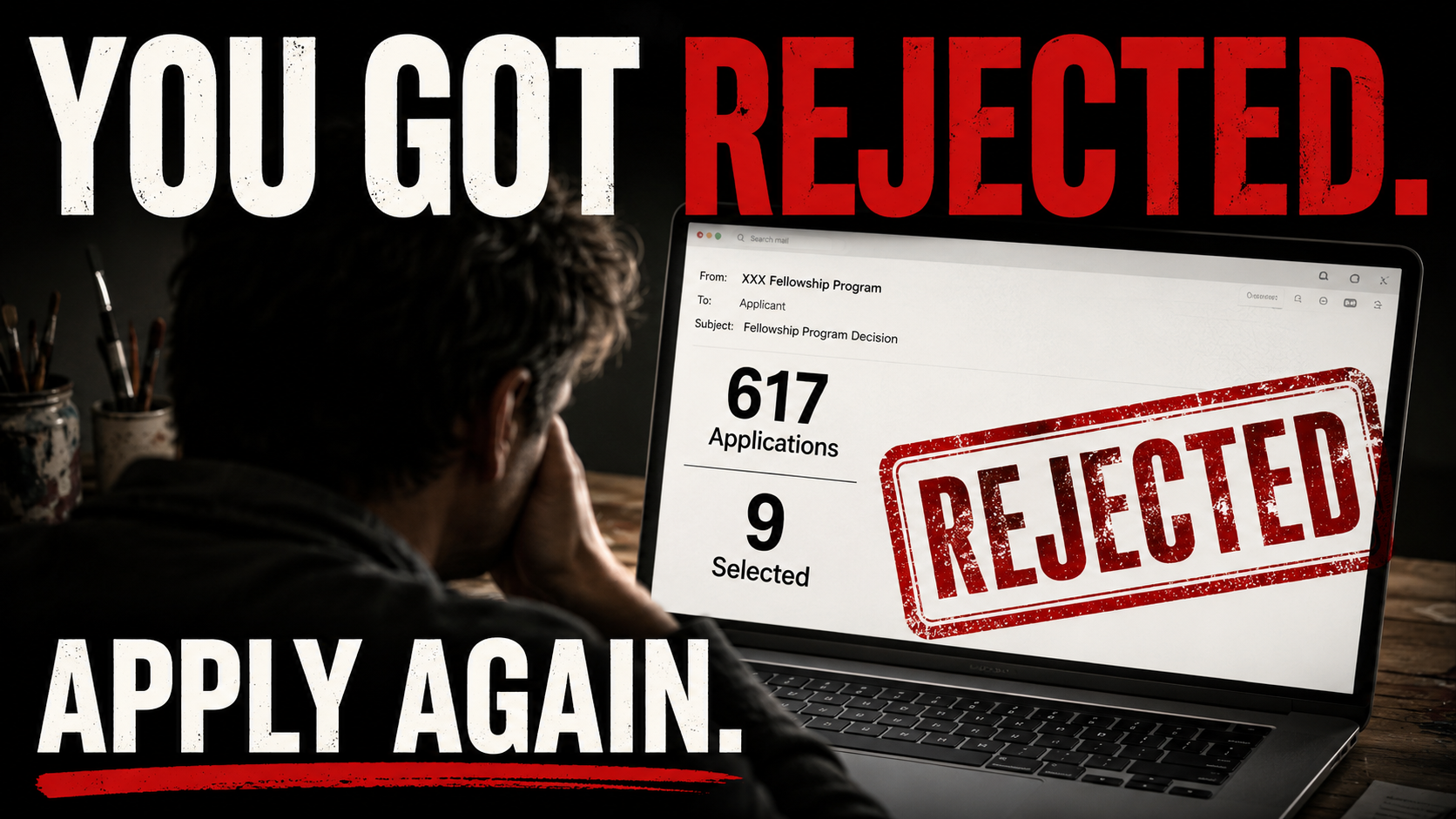
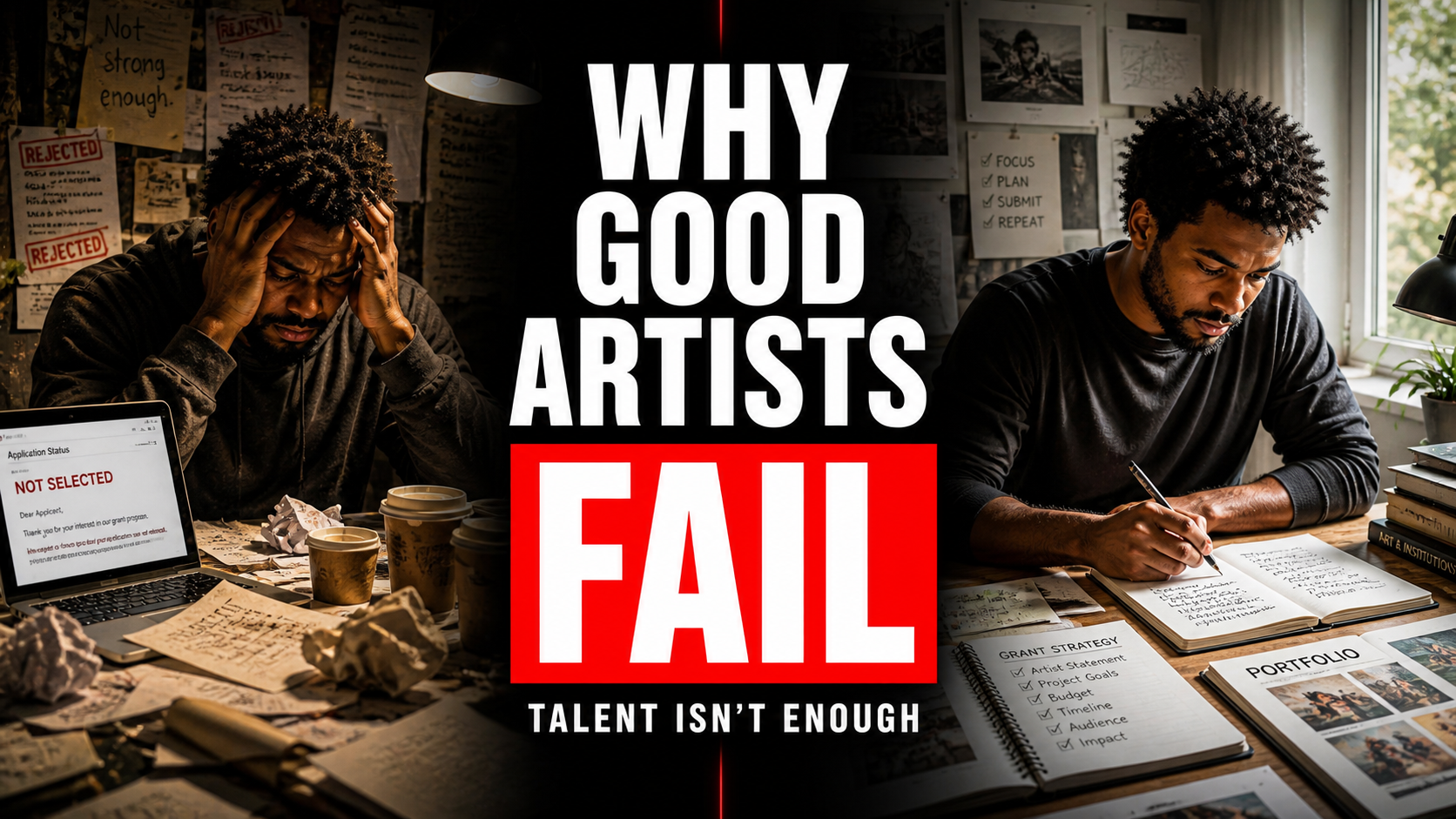
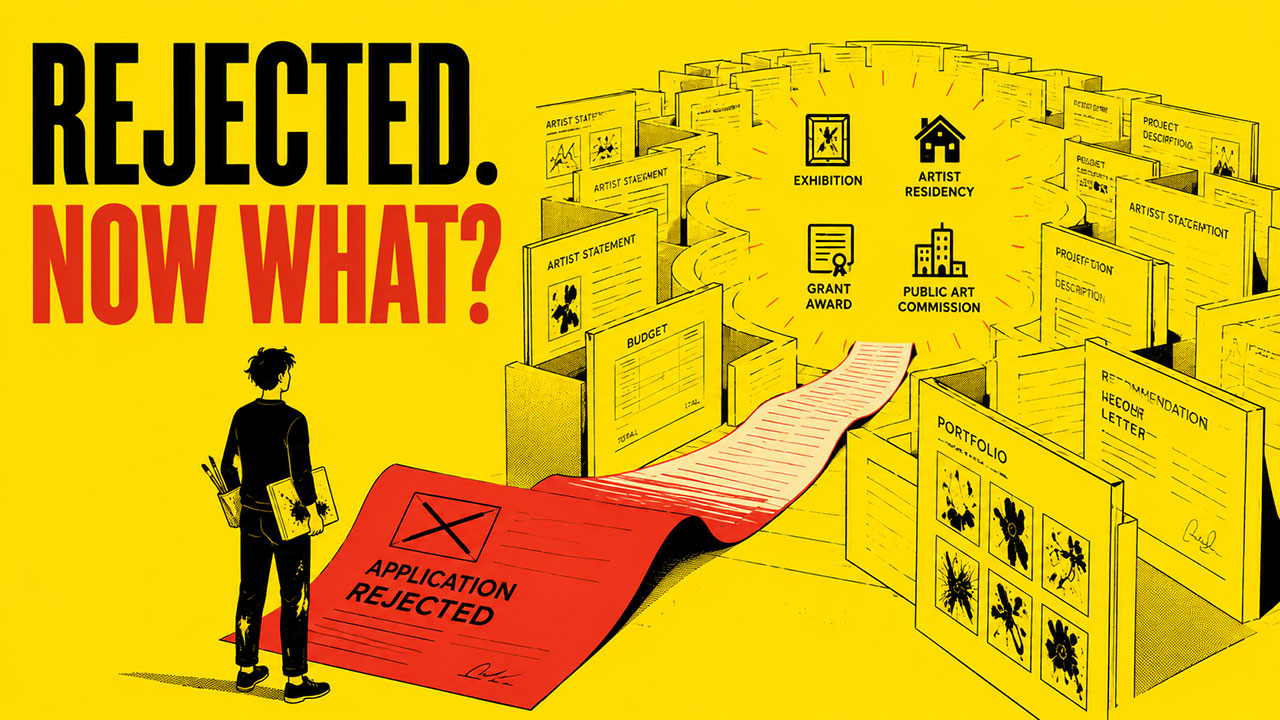
If you are tired of applying, waiting, and hearing nothing back, I want to say this as clearly as I can: a rejection email is not a clean reading of your talent. It hurts, yes. It can make you question the work, your direction, and what is worth your energy. But most grant rejections are not simple statements about artistic quality. They are the result of a competitive system, human review, limited money, and how well your project got translated into an application.
Why Good Art Still Gets Rejected by Grant Programs?
The first thing to understand is the math. At the Canada Council’s Explore and Create components in 2024–25, 7,370 applications were assessed and 1,735 were successful, a 23.5% success rate. Creative Australia says its grant rounds are usually between 15% and 20%, and its September 2025 Arts Projects round came in at 12%. Creative Capital’s 2026 open call selected 109 artists from a pool of 4,546 applications. In other words, many good applications are going to lose even when the work is serious, timely, and well made.
That matters because artists often turn a rejection into a personal story: my work is weak, I am not ready, maybe this whole thing is a waste of time. But funders themselves describe something much less dramatic and much more brutal. Canada Council says applications are checked for eligibility, assessed by peers against published criteria, ranked against one another, and then funded within the limits of the available budget. It also states plainly that not all requests can be supported because of high application volume and limited funds. Even when an application is good, it still has to beat other good applications in the same round.
And the round itself matters. Canada Council’s 2023–24 Explore and Create rate was 16.2%, markedly lower than the following year’s 23.5%. So one rejection cycle can reflect the conditions of that round as much as your long-term trajectory. This is why you cannot read a single decision like it came down from a mountaintop. Sometimes the room is simply more crowded than usual.
Once you understand that, rejection becomes painful but usable. It stops being a verdict on your worth and starts becoming information about fit, clarity, evidence, and competition.

Why the Wrong Grant Rejects Great Work?
A lot of artists lose before the panel even gets to the interesting part. Most programs begin with eligibility. Canada Council says submitted applications are first checked for basic requirements before they move into assessment. Creative Capital’s open call has strict rules around age, residency or visa status, years of professional practice, degree enrollment, and what kinds of projects are not eligible. Some Creative Australia opportunities require very specific conditions, like a confirmed invitation or a presenting institution with a cash artist fee. A strong artist can get rejected simply because the proposal does not belong in that room.
Then there is fit. Funders are not only asking whether the proposal is good. They are asking whether it is right for that specific program. Creative Australia’s criteria repeatedly ask about suitability, viability, timeliness, and impact. For some residencies and project grants, peers assess whether your practice actually suits the opportunity, whether the plan is achievable, and whether the activity makes sense at this stage of your career. If your project is still mostly research, but the fund wants a public presentation plan, confirmed partners, or a commission already in motion, your proposal can fail on fit rather than quality.
Fit is not a moral category. It does not mean the project is bad. It means the project is misaligned with that deadline, that funder, or that program design. Artists get hurt when they confuse those two things.
So before you write, interrogate the grant. Is it for your discipline, geography, project phase, scale, budget size, timeline, and way of working? If the answer is fuzzy, do not romanticize it. A clean no before the deadline is better than a beautiful no after it.
Why Clear Writing Matters in Art Grant Applications?
Here is the painful truth: the panel is not meeting your full artistic self. They are meeting the version of you that exists in a form, a project description, a budget, and a set of support materials. NYFA puts it directly: your proposal is a stand-in for you. If the writing and visuals do not advocate for the work, nobody else is in the room to do that job.
This gets even sharper when you look at how support material is actually reviewed. Canada Council’s guidance says peer assessors spend up to 10 minutes reviewing support material in addition to the application itself. Creative Australia tells applicants that peers may review only set limits of images, written pages, and 10 minutes of audio or video, and it advises artists to provide recent, relevant examples that best demonstrate quality. That is not much time. If your best image is buried, the video link is confusing, or the samples feel only loosely connected to the proposal, you may never get a fair encounter with the strongest part of the work.
That is why plain language matters so much. Artquest public program advises applicants to answer questions directly, use plain English, and let someone unfamiliar with the project read the application. Creative Australia’s panel feedback says much the same: explain what the project is, how it will happen, why it matters, and why now. That is not dumbing the work down. That is making it readable under pressure.
And pressure is real. Canada Council’s peer-assessment research found that reading load itself is becoming a challenge for assessors. The question is not whether the application sounds impressive in a vacuum. The question is whether a tired but intelligent reviewer can understand your project, trust your judgment, and remember your work after a long stack of other files.

What Grant Panels Actually Score?
Most artists understandably fixate on artistic merit. But major funders usually assess more than artistic quality alone. Creative Australia’s criteria consistently combine quality with viability and impact. Peers may look at vision, innovation, relevance, quality of previous work, collaborators, capacity to deliver, realistic planning, fair payment, co-funding, and the likely benefit to careers, communities, or audiences. Arts Council England also says eligible applications go through feasibility and risk checks before final decisions are made. So when a funder says no, the issue may be the project’s logic or delivery rather than its central idea.
This is where many strong artists quietly lose. Not in the idea, but in the confidence gap around the idea. NYFA argues that the budget tells another version of the story. It helps a reader understand scope, priorities, and whether the result being promised matches the resources requested. Artquest public program makes a similar point: the budget needs to be clear, balanced, and specific enough to show where money comes from and where it goes. If the budget is vague, the timeline feels impossible, the partners are unconfirmed, or the costs do not look believable, reviewers start doubting the delivery, not necessarily the art.
Recent Creative Australia panel feedback keeps repeating the same advice: break down lump sums, explain how costs were calculated, include support letters, give a realistic timeline, show practical steps, and pay artists fairly. The repetition tells you something. Panels do not only want to love the idea. They want to believe it can happen.
So yes, great art matters. But funders are also buying confidence in execution. Good art gets attention. Credible planning gets grants. Usually you need both.
Why Competition and Subjectivity Matter in Grant Decisions?
Grant systems try hard to be fair, but they are still human systems. Canada Council and Creative Australia both rely heavily on peer assessment, which means applications are read by artists, arts workers, and other field experts rather than by some faceless algorithm. That is a strength. It also means judgments are made by people who bring experience, taste, context, and finite energy to the process.
Canada Council research published in 2024 found that the growing volume of applications is putting pressure on the peer assessment process. Some assessors said that reviewing support material could push the time needed for a file well beyond a nominal 20-minute allotment, and one assessor described handling 125 applications. The same research flagged reading load as a real challenge and recommended reviewing that burden. This does not mean panels do not care. It means your application has to be built for speed and comparison, not for a leisurely studio visit.
There is also no escaping the fact that artistic merit is not math. In one Canada Council context brief, the Council states that definitions of artistic merit are fluid and subjective and vary across cultures, traditions, genres, and styles. That does not make peer review fake. It means excellent work can land differently depending on who is in the room, what other files are being compared with yours, and what the opportunity is trying to do.
So when you get rejected, remember this: you were not rejected by “the truth.” You were rejected inside a comparative process shaped by criteria, scarcity, human judgment, and context. That distinction matters for your sanity as much as for your strategy.
How Structural Barriers Shape Grant Rejection?
I also want to say something that does not get said enough. Grant writing does not measure talent evenly. Some artists are writing in a second or third language. Some are translating community-based, embodied, oral, or process-led practices into forms designed around written explanation. Some are also navigating accessibility barriers in the application process itself. None of that makes the practice less serious. It just makes the application harder.
Canada Council’s own materials acknowledge this directly. In its context brief on culturally diverse arts, it notes that linguistic barriers can affect artists’ ability to write grant proposals and advocate for themselves. The Council also offers application assistance for eligible applicants that can cover writing, editing, organizing support materials, translation, and sign-language-related support. Its 2024 peer assessment research even recommends improving application forms and piloting alternative application formats. That is the funding system itself admitting that accessibility and fairness are linked.
If writing is what keeps hurting you, the answer is not automatically, “I should stop applying.” The answer may be, “I need better scaffolding.” That could mean using application assistance where it exists, getting a trusted reader, building a reusable bank of materials, or choosing programs that publish clearer panel feedback. Creative Australia, for example, publishes general peer feedback and invites applicants to contact staff to discuss future applications and other funding options.
You are allowed to need support. More than that: increasingly, funders themselves are telling you to use it.
What to Do After a Grant Rejection?
When the rejection lands, do not sprint straight into another application just to prove something to yourself. First, diagnose the rejection. Was it ineligible? Wrong fit? Weak clarity? Thin support material? A budget problem? Or simply a brutal round? Canada Council now gives many applicants a breakdown of scores by criterion, and Creative Australia publishes high-level peer feedback from recent rounds. Creative Capital, by contrast, says the volume of submissions means it cannot provide individual feedback. So part of becoming strategic is learning how to build your own feedback loop when the system cannot do it for you.
If your scores or feedback show a pattern, treat that as gold. Weak viability scores usually suggest the plan, budget, timeline, or collaborators did not feel convincing. Weak impact scores often mean you did not explain why the project matters now, for whom, or what changes because it exists. Weak clarity is usually a writing problem, not a practice problem. Once you know the pattern, you can fix the right thing instead of just working harder in every direction at once.
A practical recovery sequence is simple. Rewrite your core materials in plain language: a tight artist statement, a short project summary, a one-paragraph “why now,” a clean bio, and a concise explanation of who benefits from the work. Then review your support material like a panelist would: lead with the strongest evidence, label everything clearly, and remove anything that asks for too much patience. After that, make the budget tell the same story as the proposal. If the words say one thing and the numbers say another, the application fractures.
Please hear me on this part: you do not need more hustle theater.
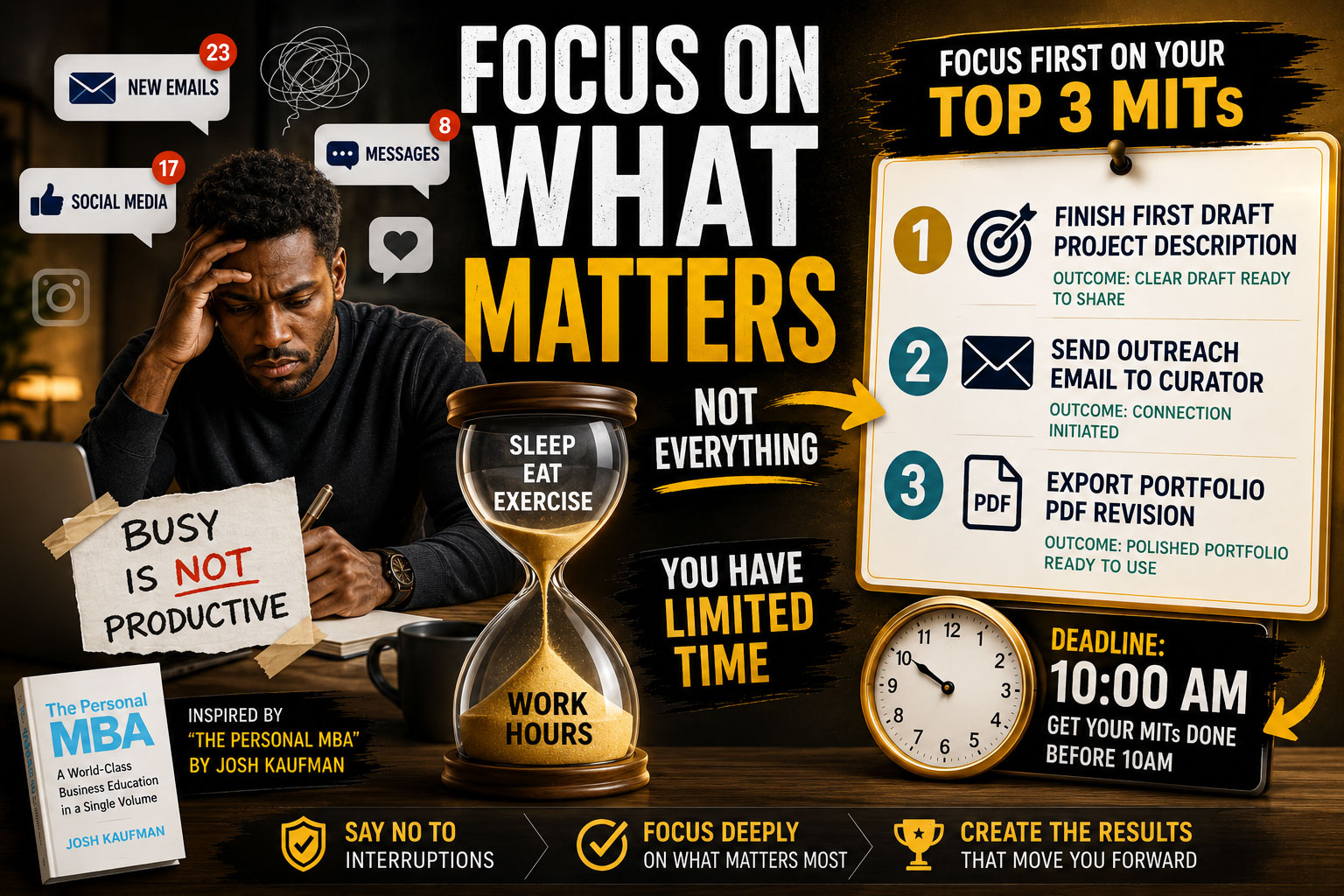
You need sharper selection, clearer translation, stronger evidence, and more recovery time between rounds. Strategic persistence beats exhausted desperation.
How to Turn Rejection Into a Better Funding Strategy?
If you are struggling right now, I would keep one sentence close: good art is necessary, but it is not sufficient. The grant has to be the right fit. The application has to be clear. The support material has to land fast. The budget has to make sense. And then, even after all that, the project still has to survive competition, scarcity, and human comparison. That is a hard system. But it is not the same thing as you are not good enough.
This is why fewer, better-fit applications usually beat spraying your energy everywhere. NYFA’s guidance on the grant process argues that artists should keep applying, but in a more strategic way. That is what you are after now: not more motion, but better aim.
Build yourself a grant kit. Keep a living document with your short and long bio, artist statement, project summary, work-sample captions, budget template, and notes from past feedback.
Artquest public program recommends preparing core materials in advance and then tailoring them to each fund. That way each rejection leaves useful residue behind. Instead of starting from zero every time, you start from a stronger base.
Do not waste the rejection by turning it into self-erasure. Use it. Tighten your targeting. Strengthen your writing. Improve the work samples. Fix the budget. Apply to fewer, better-fit opportunities. Ask for support when you need it. The goal is not to become a perfect applicant. The goal is to make it easier for the right people, in the right room, to understand why your work matters and why this project can happen now. That is how good artists stop wasting time on weak applications. And that is how rejection, slowly, starts losing some of its power over you.