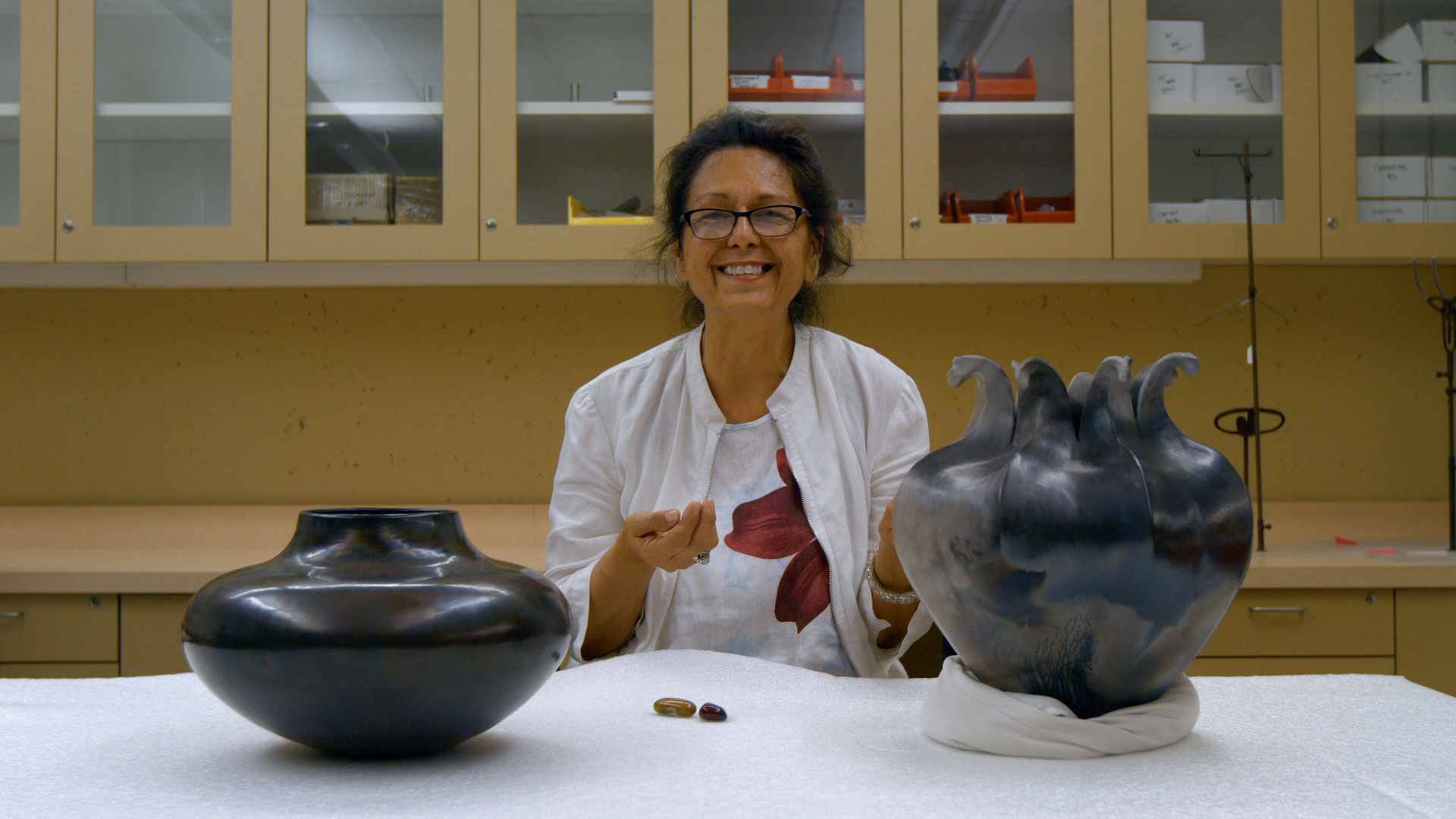
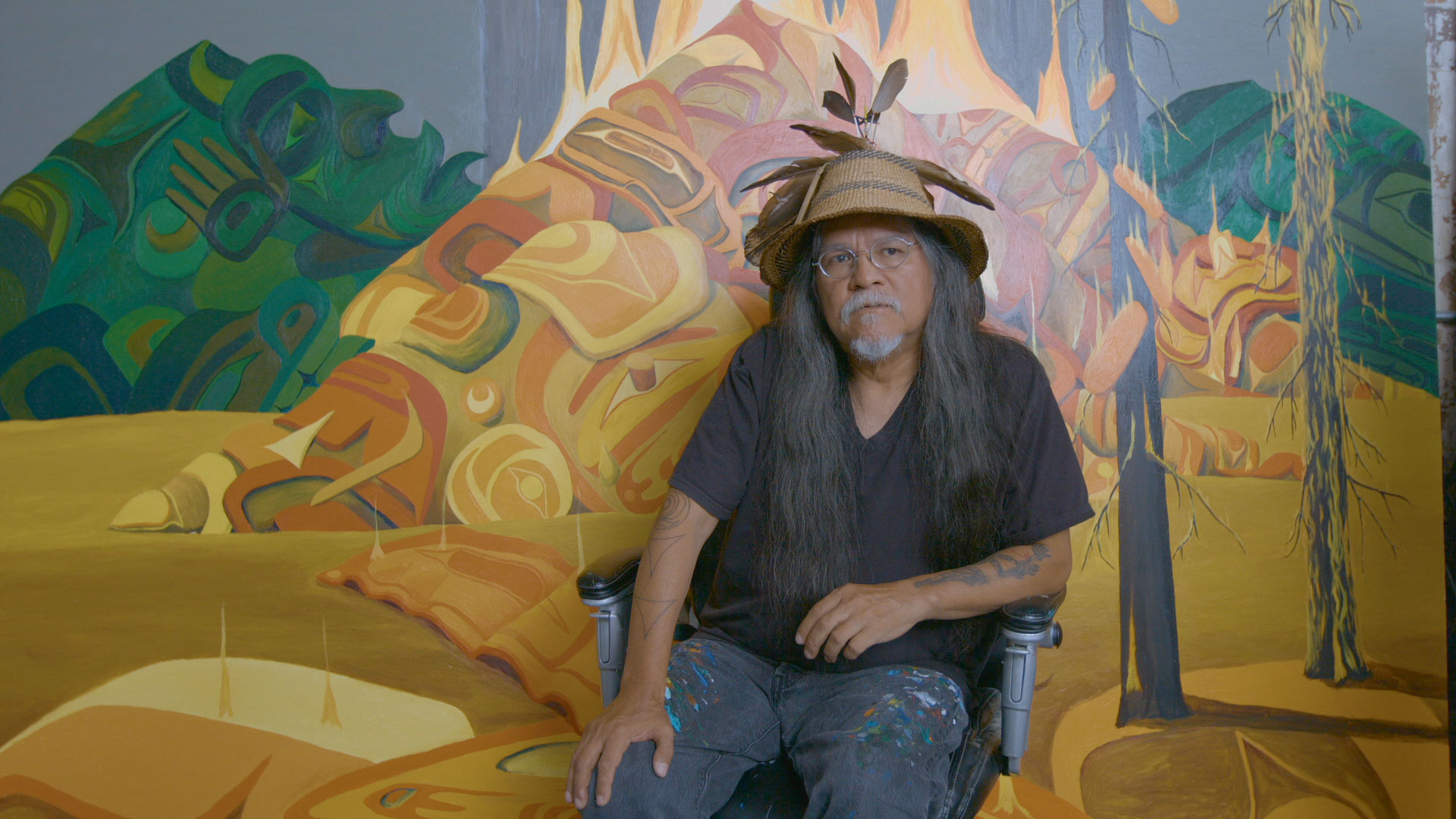
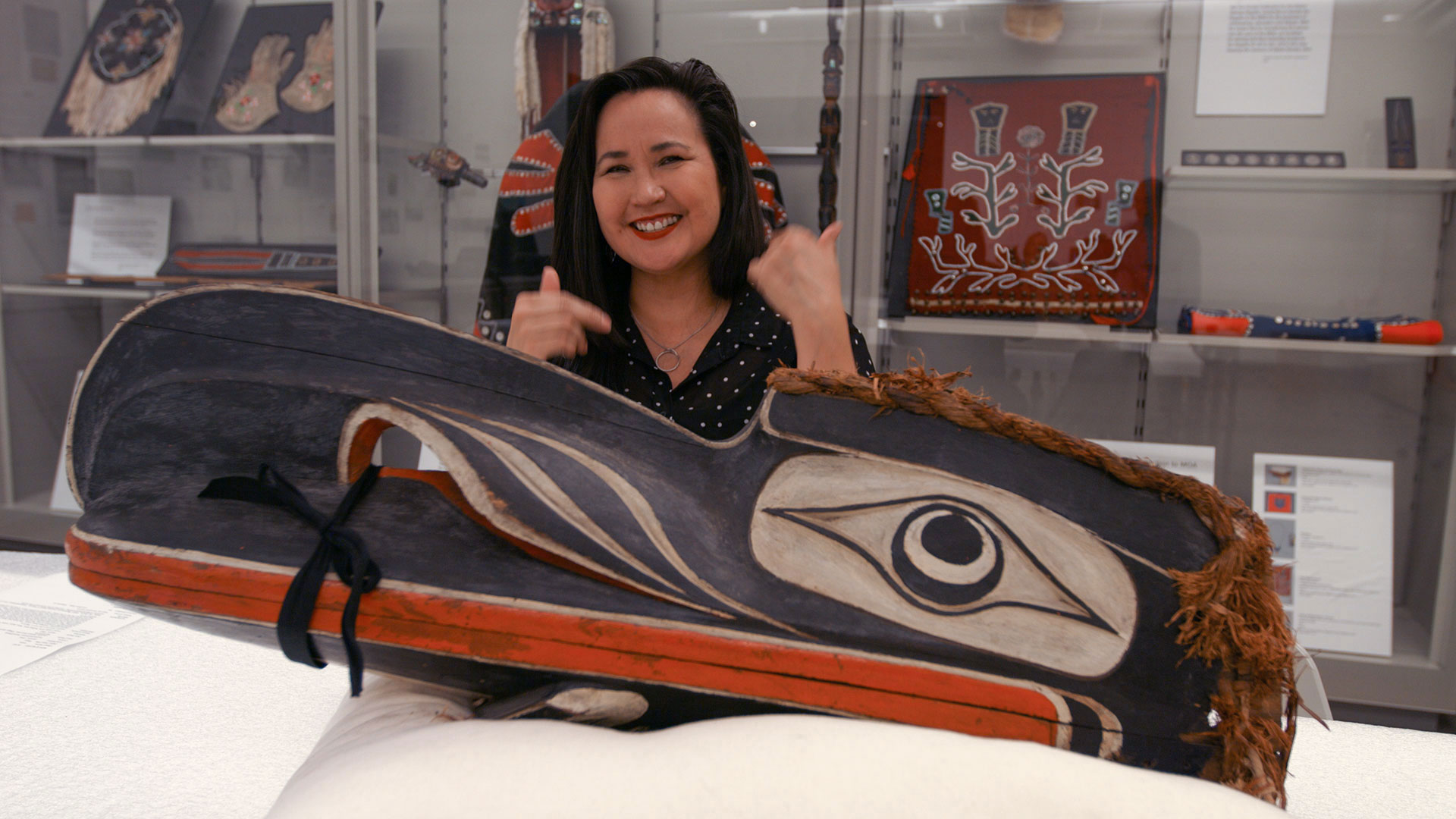
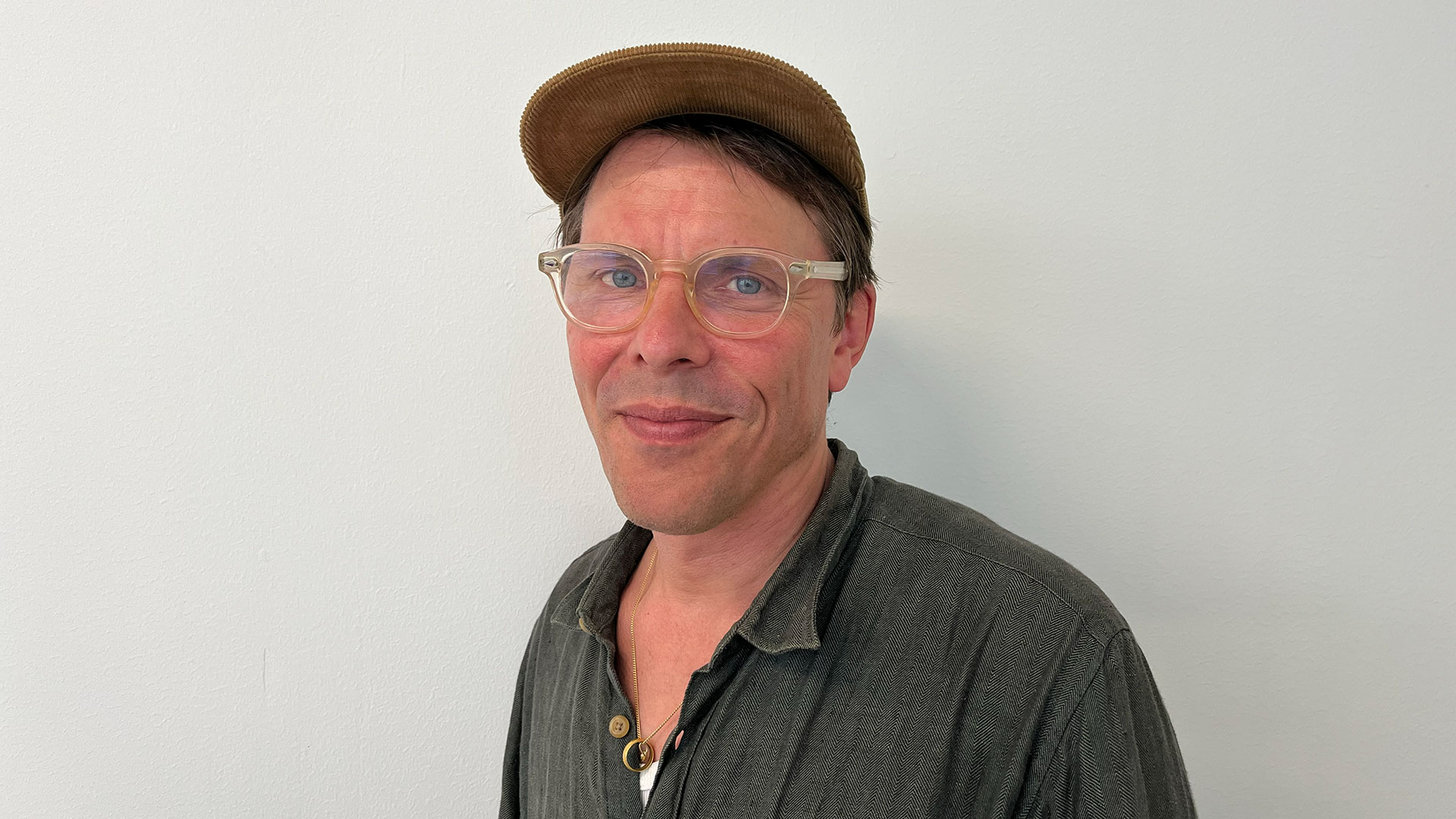
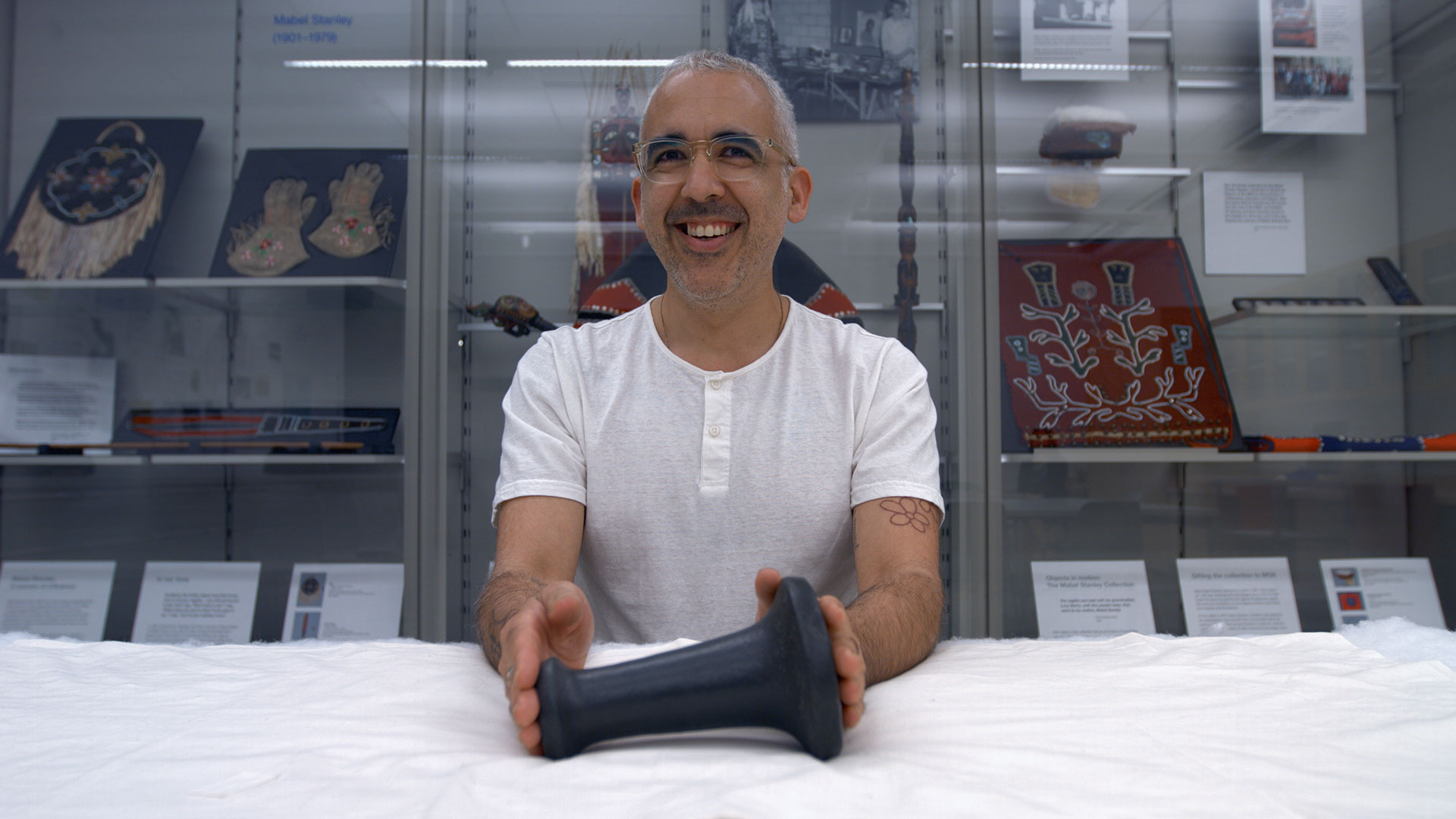
Peter Morin is a Tahltan artist and curator. Throughout his artistic practice, Morin investigates the impact zones that occur when Indigenous practices collide with Western-settler colonialism. Morin’s artworks are shaped, and reshaped, by Tahltan epistemological production and often takes the form of performance interventions.
This work has been commissioned by the Vancouver Biennale

Full transript
Marc Johnson: Prior to our meeting today, you accepted to talk with me on the basis of a Haisla magʷayᵒ (Maul) made in Kitlope (British Columbia) that you have chosen in the collection of the Museum of Anthropology at UBC. Could you tell me more about this artifact and how you feel about it?
Magʷayᵒ (Maul), Haisla (Culture), C. 700-1850, 17.8 cm x 11.4 cm, Made from one piece of dark green-grey stone, Object Number A1646, Museum of Anthropology, University of British Columbia, Canada. “While this maul is said to have been collected in Kitlope and is therefore attributed to the Haisla, in form it is generally considered a kind of “type specimen” familiar in many areas of the Pacific Northwest […] the maul is also more than an object of contemplation. In its material and form, and in relation to the knowledge, time, and practices it embodies, this tool represents functionality and may have been understood in other metaphorical ways that can be speculated but no longer known [Duffek, Karen, 2019]”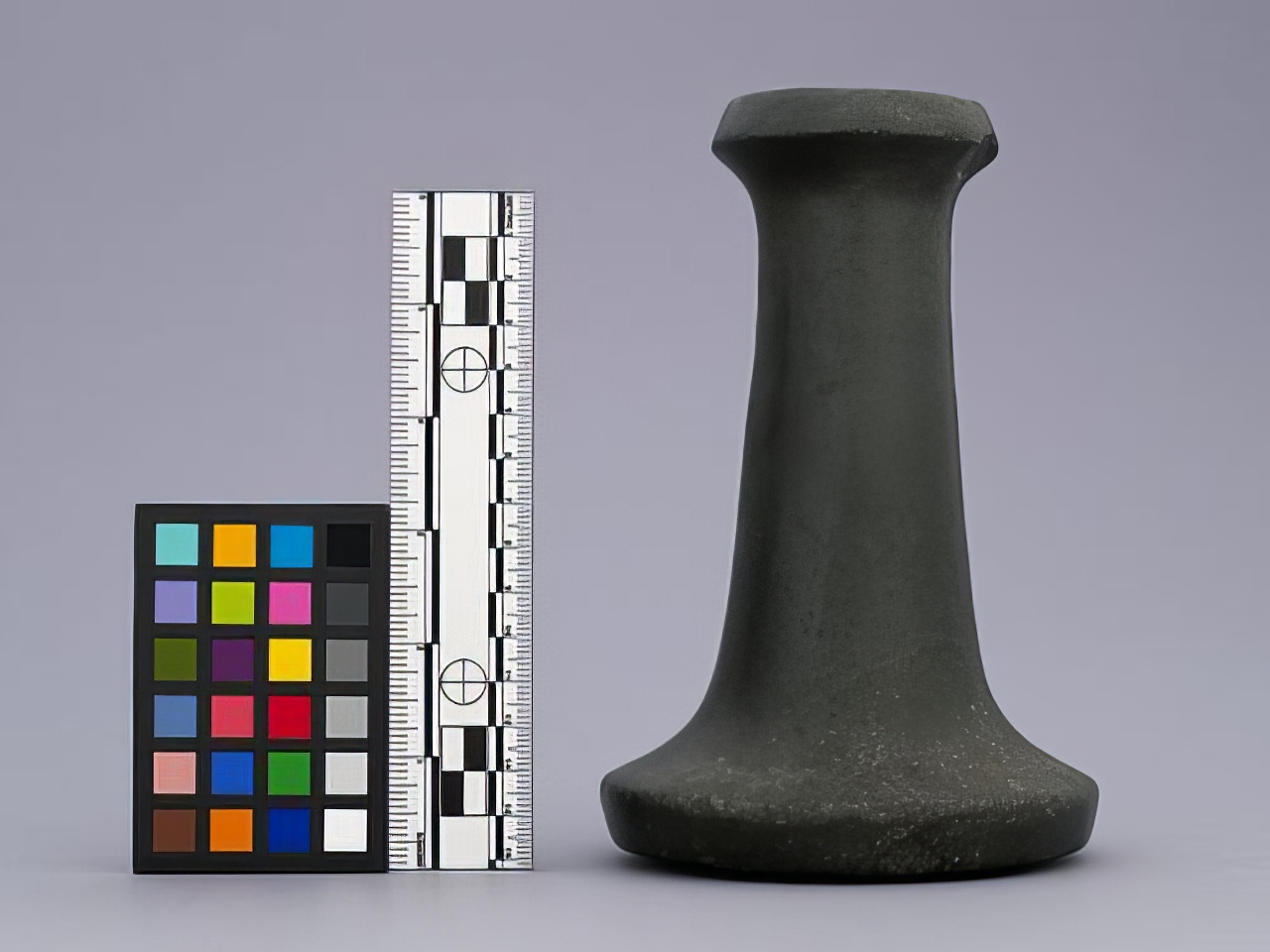
Peter Morin: This is an incredible object. I have many thoughts about objects in the museum and their histories. I think of the unnamed bodies in the museum, the history of expertise connected to the makers, and how the makers are plugged into cosmologies or knowledge traditions. We have established language around how knowledge works in institutions. There’s a history of French thinkers, for example, which keep coming up in my work right now. I’m working with grad students at OCAD University (The Ontario College of Art and Design) in Toronto and seeing how much French thinkers and the French canon are promoted via rational and humanist histories, German expressionist thinkers and all those things. We have an example of how we’re supposed to relate to that kind of knowledge; there’s a lineage of knowledge we’re connected to (as we know from people like Foucault). We’re supposed to carry on that knowledge through our work and we’re supposed to know the history of those thinkers in order to participate in that canon. “Canon” is such a strange word.
With this object, it’s very different. The makers are the lineage and there are many mistakes in the making. We don’t get a chance to see the mistakes in the museum. That relationship is really interesting to me: how the history of mistakes sits beside rationalist French thought and how the two can walk together. Mistakes are the evidence of the body as well. When we go to different museums and see the words “Artist Unknown,” it removes that possibility. Mistakes make a body human and “Artist Unknown” removes the possibility of the human body making these things. I’ve been thinking about that a long time, and about how — when Indigenous bodies come into these environments — desperate we are to see something of ourselves reflected back.
The colonial manifest destiny is an amnesia-making machine. We look hard and deep to see something of ourselves reflected in the objects, but most of us don’t know how to look at them. Most of the time, we look for the mistakes. I’ve made many mistakes in making art. Every time I come to these museums and see the beautiful work our Tahltan ancestor artists make, I feel like a failure. I feel like I’m not good enough at all and I’m pretty good. Yet I look at those works and think I’m not nearly skilled enough to make such things. I feel like I should quit. It’s funny: I’ve never said that out loud before (or maybe I have). I know I’m not the only one who looks at them, so there’s a very interesting and complicated love and admiration. That’s one part of the complication; the second part is grief. The third part of the complication is negotiating and navigating trauma, or a PTSD response, as a result of Canada’s colonial interventions into the lives of Indigenous artists and Indigenous families.
The fourth part is fear of failure. I think the fear of failure comes from residential schools and the intergenerational survivor experience. It’s the same fear of failure as in speaking our language because we don’t want to make a mistake. It’s a terrible leftover of getting hit for speaking our language; we don’t want the physical impact of getting hit. All of that happens while looking at objects in the museum made by ancestor artists. All while realizing that while those ancestor artists made this, they were speaking to me. They were making it for my body so that I can continue making it or continue using it in the ways it was intended to be used. It’s a very complex thing.
Lately, I’ve been interested in the spiderweb as a way to navigate those intersections (I’m using that word in the feminist tradition). I use the word “intersection” but, as useful as it is, there’s problems with all the words so I’m trying it out, maybe making a mistake. I’m using the idea of intersection in the tradition where matriarchs use and understand that word, which also informs ideas of continuum.
This object here is saying something to me and, as a performance artist, I’m thinking about my body and what it’s able to make. The idea of failure is an interesting component piece to performance art. I think Indigenous performance artists and their strategies are unique in the spectrum of performance art. I can feel the hands that held this, all of them. The other complication is holding actual Indigenous art history. Some of my most expansive works as a performance artist have been in relationship to museums. I feel very blessed to have spent a lot of time at the Museum of Anthropology (MOA). Years ago, it had a Tahltan Nation exhibition. It was funny because I had no idea. At the time, I told someone at the Bank River Art Gallery I wanted to curate an exhibition of Tahltan Nation artwork then I found out MOA, the Royal BC Museum in Victoria and the Museum of History were all collaborating on an exhibition of Tahltan Nation artwork. When I went to the Bank River Art Gallery, I was nobody, so it hardly mattered. It was a whole other time. I like telling this story because I never thought I’d be a performance artist. Part of that is the body making meaning in relation to the environment, to other bodies in the room and to time. I’m also very interested in the mitigation and understanding of risk within performance art. Depending on the performance art we do or make, the mitigation of risk can lead to a rupture reframing some part of knowing, reframing power structures which endeavour to control our way of knowing. Part of the mitigation of risk also means that in Canada’s colonial situation — having lived within it in this body — they don’t want us to know how powerful our body is, because it’s also a resource extracted to serve Canada and its manifest destiny. The rupture causes pain, but also enables us to know how powerful our body is. This device I am holding lets us know very clearly how powerful our body is without rupture; it’s a performance of knowing. Its action also clearly lets us know that what we’re making is a contribution.
We had the exhibition Mehodihi: Our Great Ancestors Lived That Way here at UBC. Ditta Cross, who is an education programmer, asked me to present. I actually misunderstood her: I thought she wanted me to talk about my work. I was just an emerging artist working at the Redwire Native Youth Media Society here in Vancouver. Ditta only wanted me to come and talk about the exhibition. I spent so much time in super nervous preparation, and wrote a terrible speech experimenting a lot with poetry or a poetic sort of language. I’m a sensitive person, so being around objects that have so much power is very hard for me. Now that I’m a little older, I can mitigate that, but when I was younger and was asked to do the speech, I was not good at it. I spent way too much time in the museum and I guess I was filled up with too much spirit energy. I ended up having a migraine. For some reason. I had Tylenol Extra Strength with me and I took three tablets (which is a lot).
I was overwhelmed with energy but what I thought I was going to talk about wasn’t what was requested of me. So, in the last minute, I had to flip my head around. Ditta Cross and Karen Benbassat reassured me that no one was going to show up and I’d be fine. I had several slides of my previous work in the background behind me. I was so overwhelmed that I couldn’t talk. There were 10 or 12 people in the audience, then Charlotte Townsend-Gault showed up with her art history class, which filled up the right half of the theatre. Then, Karen Duffek showed up with her art history class, which filled the other half. I was not prepared for any of that. I was so stuck with the idea of sharing my reflections of the exhibition that happened here at the Museum of Anthropology.
I can talk about those complicated experiences inside my body now. Fifteen years ago, I could not. It was exactly the second time I’d spoken in public. When I work with art students now, I talk about my worst experience public speaking, about all the mistakes I made. I remember it started with an agonizing 15 minutes of silence, because I couldn’t even say hello. Robert Davidson had an exhibition on time as well, which was incredibly moving to me. It added the complication of me openly crying while I looked at the artwork. I’d never imagined a drawn “line” could be like that. His line in the painting was like it was singing. It was like a loving act; it was so incredible.
I was asked to talk about the Tahltan Nation collection, but I don’t remember anything I said. A white woman (I can’t remember who she was) in the audience who asked, “I’ve lived here for a long time. My family has lived here for generations. I love being in the woods. Can I have a deep relationship to the land like Indigenous people?”
I said “No” because I was so overwhelmed. People were surprised at it and it’s a funny response but I wasn’t trying to be rude to her. She asked me something that meant something. Everybody in the theatre laughed at my glib response. I feel badly about that. I did go on to try and pull apart my answer about the nature of relationships to land. Earlier that week, Skeena Reece had said something to me about how people have been here for generations. We can’t just tell them it’s time for them to leave. People come here and fall in love or they need a place to stay, to be safe; we can’t just say that. I relayed those words to the question-asker, but it never felt like enough. It has never felt like enough. I don’t even know why I’m saying this right now; I don’t even know who she was. Now that I’m forty-one, I think I would have told her yes. “Yes, you can.” It’s a very different answer.
Exploitation is a whole other thing, though. Exploiting the land is different. We need to rethink the language of how we articulate our relationship to place. There’s a danger of one story of relationship to land covering over another person’s relationship to land. I do a lot of collaborative work now. In the work I share, specifically with Ayumi Goto and Ashok Mathur, we actively attempt to de-centre “whiteness.” I think the language of “whiteness” enables one story to cover up other stories.
Civil rights activist Audre Lorde helps us still. In her speech in 1979, she said, “The master’s tools will never dismantle the master’s house.” It’s a very clear guideline. Tools, such as the one I’m holding, are sometimes very clear. Sometimes tools help us know the power of our bodies and that this power is a contribution. Sometimes, tools help us understand our relationship to a cosmos. Sometimes, tools help us understand that bodies are complicated. I believe there are so many systems older than the colonial system, which often sits at the centre of how we talk to each other and understand our stories to the land. That’s why even the attempt to de-centre “whiteness” helps us to see each other better, to see our bodies better.
There are many tools we inherit. It’s all Karen Benbassat’s fault that I became a performance artist. It might have been different if I hadn’t run into her at Rangoli, when she said, “I’ve been thinking about what you said at that first talk.” Somebody once asked me if I’d ever show my work in a museum. My answer was no because I didn’t understand how to shift the politics. The answer in my head was, “Don’t you have to be dead to show at a museum?” Even in my rather crazy state, I was glad I didn’t say it out loud because it’s not true. Years later, I ran into people who were in the room during my talk. At one baby shower, a guy told me I looked familiar. When we finally settled on where he’d seen me, he said, “You were going through many emotions that day.” I told him I wished I were. I’d just taken too many Tylenols and I was a bit high, not on purpose, but sort of on purpose. It’s very funny and weird that I’ll never forget that woman’s question. I never wanted people to laugh at such a vulnerable moment. Just recently, I did some work with objects from the Royal BC Museum: 100-year-old drums. I held them with my hands. Brian Seymour, the collections manager, was so nice. He was telling me the usual thing, that there might be poison on them (Peter Morin is referring to the preservative often put on such objects in many museums, especially in the past). I’ll also never forget Joyce Johnson telling me I was allowed to see the objects here, because I didn’t know if I could. Joyce put me in contact with Allison Cronin and she brought them all out for me to look at. She had someone with her; she’d left the room for a second and that person told me to put the gloves on first. Then Allison came back and said, “No, these things belong to him. He can touch them with his hands.” Because I was so young, I held them and just cried. I hadn’t expected that. It was a real gift to be able to hold those objects. Just like the time on the land when Annie Hinyu brought out a Tahltan beaded belt and put it in my hands; everything changed after that. That’s how we’re supposed to experience the work as makers (even a bad maker like me).
In two days, we made eight videos of me holding and dancing with the drums. In two days, I held more than 800 years of Indigenous art history. The music in those videos is played with its graphic scores by musicians. It’s my latest work: it was in Kingston, at the Agnes Etherington in an exhibition called Soundings, curated by Dylan Robinson and Candice Hopkins. There was violinist Parmela Attariwala and cellist Dorothy Lawson, who is from B.C. and living in New York.
I’m going to be in the next show, a big Indigenous show, at the National Gallery. I couldn’t believe it when they called. We have to do a site visit in June. I started doing a performance piece where I become the collective breaths of everybody who traveled all the pathways in Tahltan Nation territory. I bring that breath into concert, into connection with the artwork. They said they wanted me to do that and I said, “Okay, great. Can’t wait!” Then they told me how many artworks were in there. They told me I might pass out. The conservation team was told I’d breathe on all the paintings and objects and they said no. I’m working with Rachelle Dickenson and Greg Hill. I told Rachelle, “Well, I didn’t say I was going to spit on the paintings.” She said they’d have a trauma team follow me in case I pass out or hyperventilate. I thought, just how big is this gallery?! They also want me to meet with the elder who advises them. It will be interesting. The show will be in November.
About my tattoos: I’m Tahltan from Northern B.C., from the Crow Clan. My mom is Janel Creyke and my father is Pierre Morin. Pierre Morin is from Thetford Mines in the middle of Quebec. They met and fell in love eventually; now they have a beautiful love. Maybe it’s always been beautiful. Anyway, we moved here when I moved from the North to Surrey, B.C. upon turning 16. I didn’t really understand what the colonial amnesia thing was. Everybody was talking about identity at the time. I found a book called The Tahltan Indians by George Emmons when I was 18. The book had drawings of Tahltan artworks. When I turned 21, I decided I wanted to get one of those George Emmons drawings of a Tahltan Nation artwork tattooed on my body. It’s this one: two bands between my shoulders. Anthropologists often refer to them as a burden strap for carrying a moose, which is a heavy thing. It goes across the forehead and over the shoulders around the front, to support the pack in the back. Bones were sewn into the strap so it wouldn’t bunch up. The bones Emmons found and wrote about in his book were often sewn in, so nobody saw they had markings on them until they were removed from the strap. I always found that fascinating. I was just a young kid; I come from a place where people work very hard. The elders I grew up with worked really hard. I wanted these tattoos to remind myself that I have to work hard like my elders did.
The second is a stick-and-poke tattoo over my heart done by Gabe Hill, a Cree-Metis artist here in Vancouver. I had a friend named David Melville, a Caribbean-Canadian guy. He was my elder for a long time, my brother and my friend. He passed away. After that, a lot was going on in my life but this little hummingbird always followed me around. David had something called peripheral neuropathy, a deadening of his nerves. He was a really tall, beautiful guy who couldn’t move. I thought, if he couldn’t move in this reality, he was going to become a hummingbird in the next reality. This hummingbird here is to remind me of the love he shared with me and the love I have for him.
The tattoo on my left upper arm says, “I am a musical instrument for Mother Earth.” In 2009, I curated an exhibition which took place in two parts. One part was called Speaking in Landscape Tongues, and the other Speaking to the Old Ones. Cheryl L’Hirondelle — a Cree-Metis performance artist, singer/songwriter and thinker — was one of the first Indigenous folks to consider the internet as an Indigenous space. She did a performance for my curatorial project in which she repeated a phrase over and over in Cree. I loved it so much and eventually asked her about it. I’m not going to try and repeat what she said in Cree because I can’t remember. She used English to communicate what she’d been repeating: “I am a musical instrument for Mother Earth.” This tattoo is Cheryl L’Hirondelle’s artwork.
That takes me to my right forearm tattoo. There’s a Nlaka’pamux artist, Dion Kaszas, who has been contributing to the Indigenous tattoo revitalization in Canada. The potlatch ban was part of a piece of legislation called the Indian Act: it outlawed tattoos. So, this is what Kaszas calls an earthline — it’s a skin stitch. He stitched it into me with a thread and needle. As he explained it, Nlaka’pamux clothing often had a line painted around it, which was supposed to remind the wearer of their connection to the Earth. Then, he added this stick-and-poke sun tattoo above. It’s very interesting because the hummingbird is a prison tattoo-style, sewing needle-style stick-and-poke, while the sun remembers Indigenous stick-and-poke tattooing.
Let’s move on to this mark given to me by Dion Kaszas, below the earthline. In Nlaka’pamux culture, these four stitch lines represent courage and bravery. Kaszas said to me, “I want to give you this mark because I’ve witnessed the work you’ve done as a performance artist, and I want to honour you for what you give to us. I want to offer this remembrance of courage, because you need to be brave in your work.”
That leads me to the tattoo next to it. There’s a Mi’kmaq artist named Jordan Bennett. He apprenticed at the Earthline Tattoo School with Dion Kaszas. My current work deals a lot with memory, and what memory does. I also want my work to remember the Indigenous artists who passed away. I think because I’m part of that art history; I’m responsible for remembering them. One of the first artists whose work I encountered was Shanawdithit. She’s often labeled as the last of the Beothuk people, but for me, she was a drawer and an artist. I told Jordan I wanted a mark to acknowledge Shanawdithit as one of the first Indigenous artists to inspire me. The tattoo is a stick-and-poke Beothuk canoe with a skin-stitch line and the North Star. The reflection of the Beothuk canoe is Shanawdithit’s drawing of the moon. The next tattoo is on the back of my right upper arm. There are two very important women in my life: their names are Corrina and Desiree Sparrow. Corrina is Musqueam-Pentlatch and Desiree is Gitxsan. They said they wanted to have the same mark as their little Crow brother. So, we all have a flying crow mark. That wasn’t enough for me because I love them so much; I also got a sparrow. That’s a sparrow for my Sparrows on my left arm.
There was a kid I used to work with named Naomi Kennedy. She told me she made extra cash by giving tattoos at her house. I wanted to hang out with her and give her some money, because I had extra money. Naomi did that sparrow for me, as well as a second crow. A long time ago, I had a dream about a crow with a human heart. It’s probably my regalia, though I hadn’t made it yet. Yolanda Skelton, who is Gitxsan, did. She’s cousins with Desiree Sparrow, and she made me a Northwest Coast vest. It has a crow on the back, with a Northwest Coast human heart. The tattoo came first and the vest came second.
Let’s go on to my left upper-arm tattoo. Tania Willard, Gabe Hill and I are part of a collective called Bush Gallery. It’s a fluid collective of many amazing, powerful people (Jeneen Frei Njootli is one of them). We put up a bush gallery — Bush Gallery made a bush gallery — meaning we put up a teepee. We had Dion Kaszas come and do a tattoo action inside the teepee. My tattoo is a stick-and-poke circle with a skin-stitch hashtag symbol inside. At the time, when Tania and Gabe and I first did a bush gallery, none of us knew what a hashtag was. It seemed to make sense to use landmarking tape to write “#bushgallery” on the land. We did that and now we have this tattoo.
That leads me to my front left forearm. Twenty years later (it’s always “20 years later” because I can’t remember dates), I returned to the George Emmons book. In our language, the tool tattooed on my arm is called a tùgotti (tacluta in Tahltan4), which is used to remove the flesh from moose hide in order to turn it into smoked, tanned hide. The flesh is pulled off and the fascia has to be removed. There’s a mark along its centre, a beautiful drawing on the bone. I wanted to put it there because it’s my ancestor’s paintbrush. The tools of artmaking: from the burden strap in the back, where I can’t see it, to the tùgotti on my forearm, where I see it every day.
The next one is two flowers beneath the tùgotti. It is part of my effort to show my allegiances to artists and to remember the artists who have significantly changed my life. My grandma’s English name is Dinah. She had three names in our language: my favourite one has a meaning that is communicated in English as “When the river is at its highest and throws sand on the banks.” This design is my grandma’s artwork. Currently, it’s on a pair of moccasins my mom wears every day. The tattoo was done by a young Métis woman named Audie Murray, who also apprenticed at the Earthline Tattoo School.
We move to my back left forearm, which is also honouring and sharing my allegiances to Indigenous artists. There’s an incredible Wolastoqiyik-Maliseet artist named Shirley Bear who was my mentor, elder and friend. She used to sign her artwork with this mark. It’s usually referred to as “Abenaki Woman,” but for me, it’s Shirley Bear. I recently did a performance with Jeremy Dutcher (also Wolastoqiyik) and Bracken Hanuse Corlett, who is Wuikinuxv and Klahoose. The three of us got matching tattoos, because we’d all been inspired by Shirley Bear. The performance was called Ancestor Song Research Laboratory. The last ancestor song was to turn off all of the equipment, go to the microphone, and talk about why Shirley Bear inspired, saved, or helped us to become artists.
My mom’s name is Adzudza (her English name is Janelle). She got that name from an elder lady named Emma Brown. Emma Brown was 107 years old when she died. My mom has Alzheimer’s disease and I’ve been thinking a lot about memory and what memory does. I refuse to see my mom in any deficient way. She isn’t falling behind; she’s going ahead. She’s helping me understand that love helps us remember. Love does. Our family has a genetic marker that leads to familial Alzheimer’s. There are only three families in Canada that have this genetic marker and our family is one of them.
I think about what the body is able to do: what it’s able to perform and also how it performs memory. I think about how hard my mom fought to be a matriarch. I’m also abstractly thinking about de-centering “whiteness” in our experience, so that we can see each other better. There’s a colonial memory that gets prioritized; if we can’t remember the dates, we’re not active participants in the colonial structures of power. We don’t get to activate them. These objects, such as the magʷayᵒ (Maul) I hold in my hand, they don’t solely activate colonial structures of power. They have a memory too. My mom is a time traveler and by trying to understand her experience more in my performance practice, I’ve become a time traveler as well. These objects themselves are time travelers and they speak to a continuum like the spiderweb I spoke of earlier. It’s all mapped out within this cosmos. Picking up this object, which is made by an ancestor artist for me, I am also an ancestor artist for someone else down the line. This moment, these words, might mean something for a future ancestor artist. Or they might mean nothing. When I hold this, I can feel all the bodies that have held it. That is huge.
Penny Louie (Kaska-Tahltan Artist), My Story of Making and Sewing Hides (Open Space Arts Society, Victoria, 2012), 20.
This work has been commissioned by the Vancouver Biennale
Acknowledgements
This work was made possible with the generous institutional support of the Museum of Anthropology (UBC), the Museum of Vancouver, the Vancouver Art Gallery, the Vancouver Biennale, the Vancouver Maritime Museum, Vivo Media Art Center, the Cultural and Scientific Service of the Embassy of France to Canada, and the Buschlen Mowatt Nichol Foundation.
This work could not have been possible without the support of Barrie Mowatt, Murray Nichol, Karen Duffek, and Jim Breukelman.
Copyrights notice
This interview is licensed under a Creative commons license CC BY-NC-ND. The license enables users to copy and distribute the material in any medium or format in unmodified form only, for noncommercial purposes only, and only with attribution to the author(s). Adaptations of the work are permitted. The Interview may be republished noncommercially so long as attribution is given to the author(s).
Note on copyright ownership and licensing
We are committed to respecting the intellectual property rights of others. While all reasonable efforts have been made to state copyright holders of material used in this work, any oversight is unintended and will be corrected in future editions, provided the publishers have been informed.