This work has been commissioned by the Vancouver Biennale

Full transript
- Meeting the Mask
- Art, Injury, and the Return to Creativity
- Formline as a Way of Thinking
- Public Art, Healing, and Residential School Memory
- Bringing the Masks Back to Life
1. Meeting the Mask, The Big House and the Presence of Potlatch
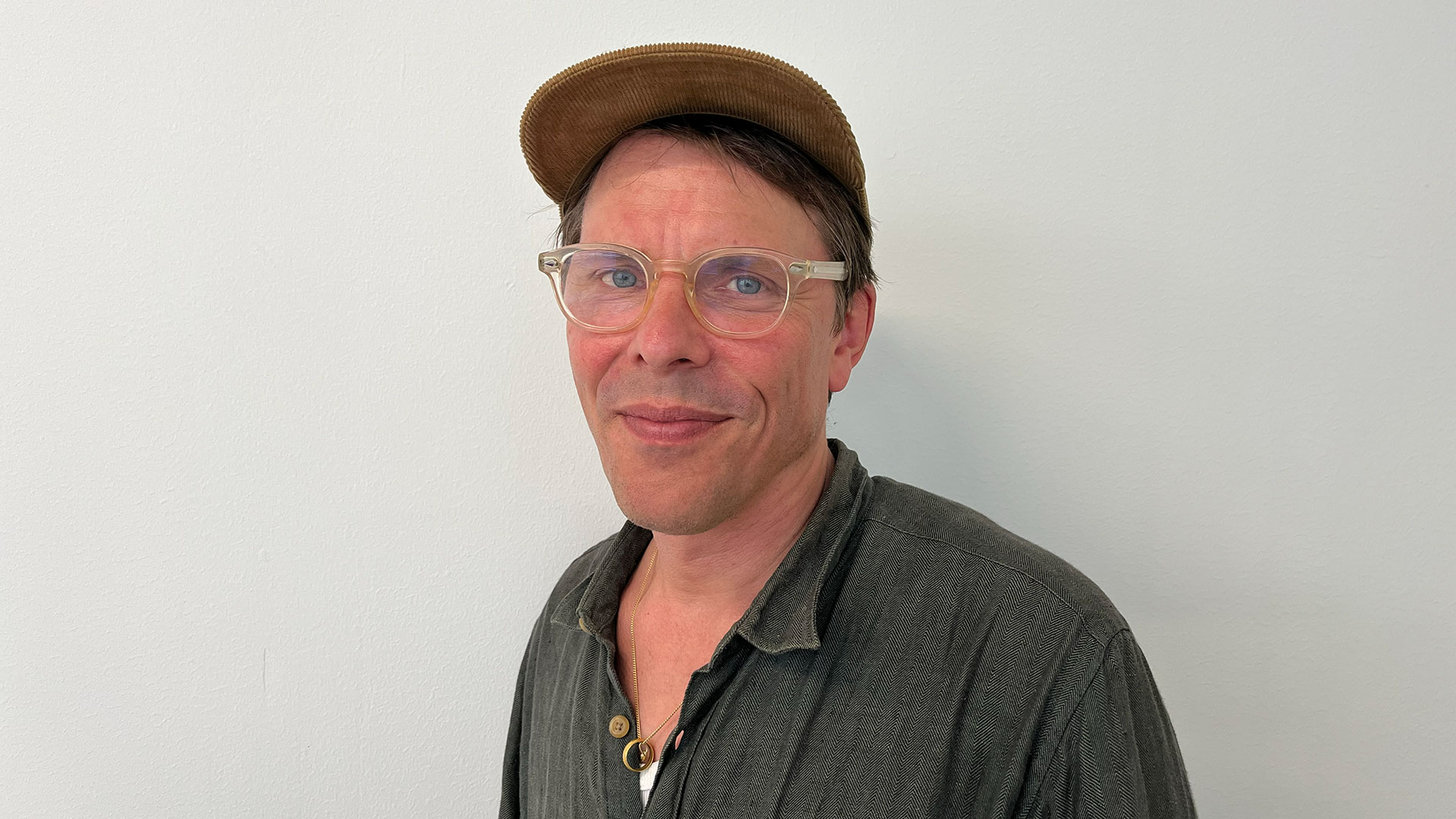
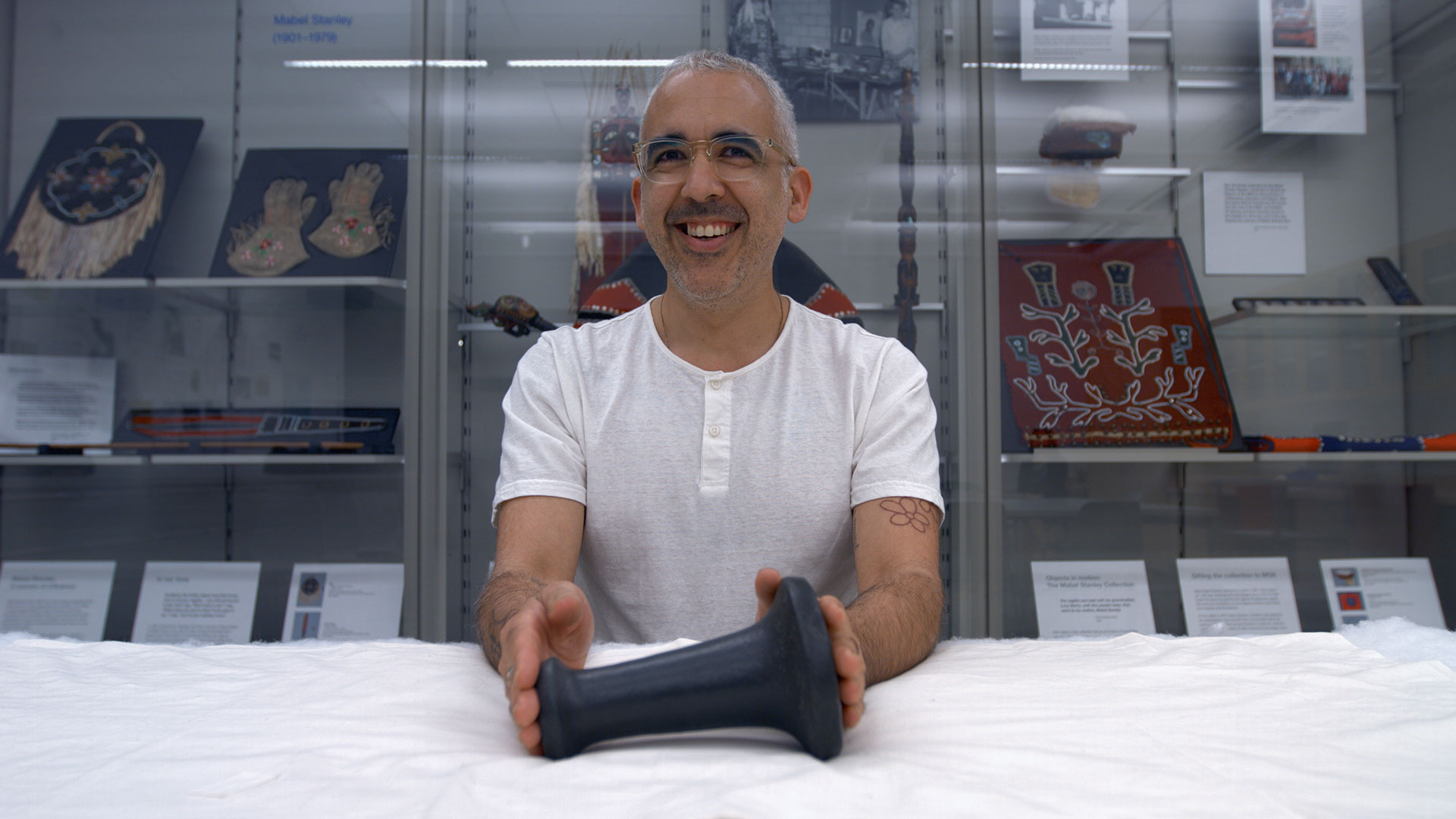
Marc Johnson: Could you tell me more about yourself and your relationship to the mask in front of you?
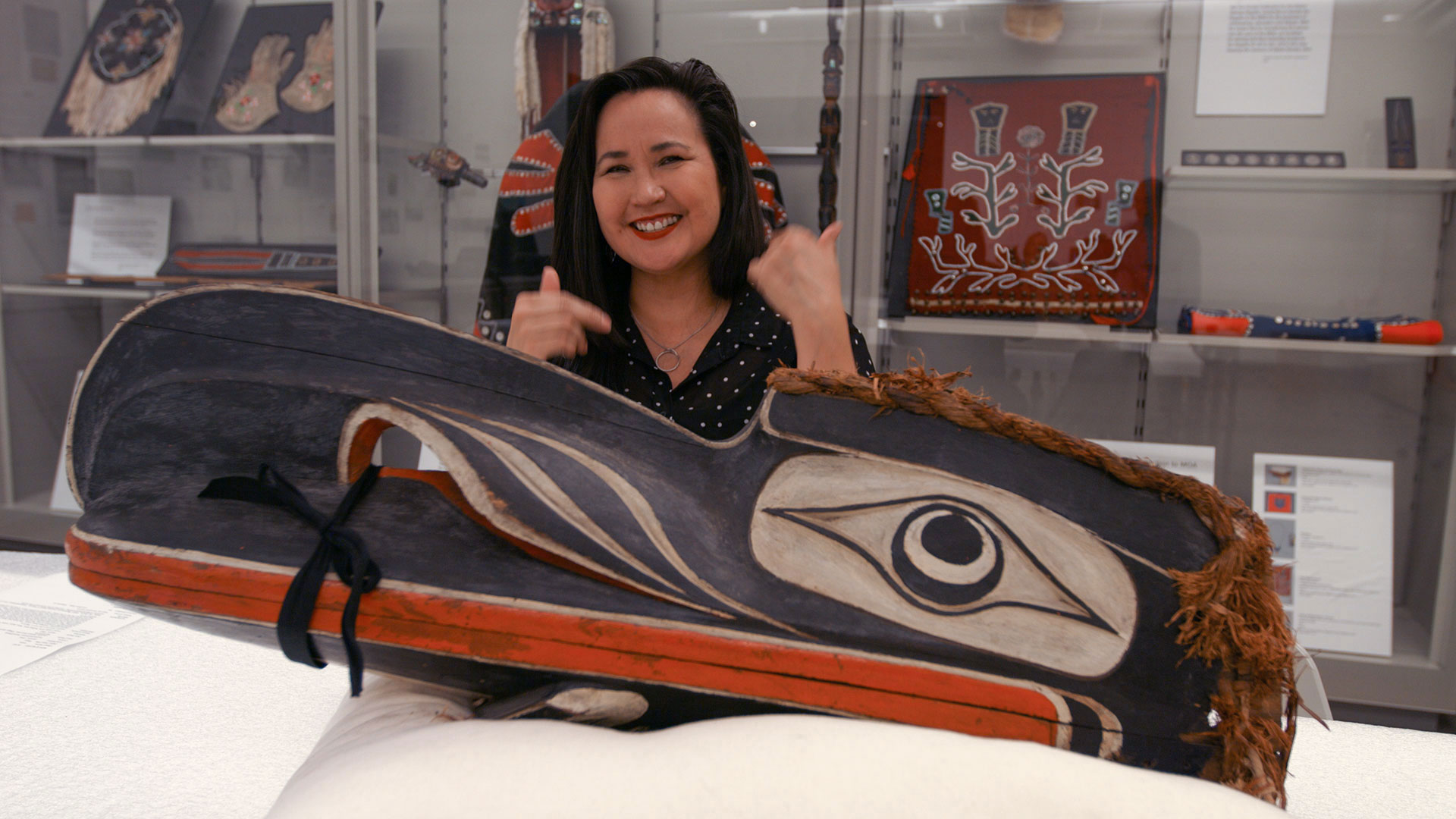
Connie Watts: I’m Connie Watts. I’m Kwakwaka’wakw, Nuu-chah-nulth and Gitxsan, and this mask is from my great-grandfather, Harry Mountain
(Hereditary Chief Harry Mountain of the clan Mamalelequala, “The Real People”, had two noble names: Nega’ (Mountain) and Na’kapandzilas (Ten Times Over). Mountain was born on Knight Inlet, B.C. in April 1888. He was a fisherman. Harry’s mother was Mukukwilow and his father was Chief Nage’ who were both born on Village Island, BC).
I didn’t grow up potlatching.
I remember, at six years old, going to my grandmother’s family (whom I didn’t know) from the Nuu-chah-nulth territory. You could feel the presence of the potlatch bans because you drove in under tree cover, through a tiny little road. I thought we were lost for sure when we got off the little ferry. We were driving in the middle of nowhere, down a tiny little road. We turned a corner and there was the Big House (Big Houses are large gathering places where sacred communal events are held). I remember my relief to see so many cars and people. Most were inside, but some were still milling outside. I didn’t know anyone, so I was a little hesitant even through I’m the more outgoing one in our family. My older sister was definitely more hesitant than me.
We went wandering in and soon had family all around us. I remember feeling a massive presence of oneness.
It’s the way we grew up. Our immediate family was always very close. They were so similar to my grandmother’s personality, and my grandmother and I got along really well.
For the big potlatch, we went up to Alert Bay. It’s where I saw the Hamat’sa performed for the first time (In the Hamat’sa dance ceremony (or Cannibal Dance), one of the most important dances in Kwakwaka’wakw tradition, members of the sacred Hamat’sa society perform moves that narrate tales of the cannibalistic giant from the north end of the world, Baxbakwalanuksiwe’. In the story, several brothers lost on a hunting trip come across a mysterious house with red smoke rising from the smoke-hole. The owner is away, but one of the house posts is a living woman with her legs implanted into the floor. She warns the brothers about the owner, Baxbakwalanuksiwe’, who has four man-eating birds as companions: Gwagwakwalanuksiwe’, the man-eating raven; Galugwadzayi, Crooked-Beak of Heaven; Hamasiwe’, a smaller bird with a duck-like bill; and Huxhugwadzayi, a spirit-crane who cracks people’s skulls to suck out their brains. The brothers manage to lure Baxbakwalanuksiwe’ into a pit and throw hot stones on top of him until he dies. With the giant’s death, the men acquire mystical power and sacred treasures from him, including wooden whistles, a bear mask, bird masks, costumes, and a Hamat’sa pole, all used in later ritual performances. There were four bird masks and four dancers, and they had a “spotter”: the person helping and leading them because the masks are so heavy. They’re out there for so long; they have to train to do the dance because it’s so physically taxing — but it’s amazing.
Even if I wasn’t raised in a carving family, when I look at pieces like this mask, I feel all the parts and how everything fits together. I feel the way the lines move and come down — and I feel the look of the animal itself (Here Connie mentioned her upbringing had been alongside the “distant relationship with our traditional ways of potlatching.” She first approached it in school). When I first got my interior design degree, I started to play with Northwest Coast form. I knew in that moment I wanted to be surrounded by this feeling.
2. Art, Injury, and the Return to Creativity
I actually started art because of a head injury. I fractured my skull in two places and lost my ability to read, to write, and to imagine anything, to create. It was five years after the accident before I switched to fine art, and started to feel it. I wasn’t one to go and sit with the carvers, because I would think through the way a piece felt. My first piece was a bear chair — layered pieces of wood, which I realized in interior design with Northwest Coast shapes. I layered it because of the beautiful depth one could get in the carvings.
We didn’t have the same access to the older wood, our old trees, the old growth, anymore. As a people, we would look at materials as something to explore, to see, to discover. I looked at all these plywood pieces, thinking, “To create depth, I can layer them back.” That’s where I first started to layer pieces to get the idea of depth and movement.
If you ever see a layered cut-out piece, you have to be right in front of it — and even if you are, you have to move up and down and around it, to see exactly how it’s supposed to be and how it was drawn. For me, that’s exploring and seeing a representation of the depth of our culture. It’s always moving, always changing, and we’re always looking at the newness of everything.
I know the necessity of preserving our history because so much got decimated during the 67 years of the potlatch ban.
I love the fact that museums have kept the work. I’m glad for colonizers realizing it’s worth money, and museums realizing they could buy it. I would rather have it here — as many people say, stolen — than burnt.
When masks were coming massively into museums, they would pile hundreds of masks and regalia outside the Big Houses and burn them. I can feel myself getting emotional, because for us they’re living beings. It’s the mark of an ignorant way of seeing a culture and not respecting it. I would rather have it preserved somewhere I could come and visit it again, than have it gone forever. We never really believe in things once they are gone. I mourn a little bit, but I mourn more the depth of the stories we had, the pieces that were there. Yet, I do have a sense, as soon as I walk into the presence of anything from our past, that it is real life. For me, that’s what our artwork represented. With my art, I look to see whether or not I can create those feelings.
I always start with people. The big piece at Vancouver International Airport is the essence of my inspiration: the feeling of these masks, knowing when I run my hand down one, it holds all of our ancestors in it (The work Hetux represents a Thunderbird, which is the keeper of the sky as well as the incarnation of Connie’s grandmother Louise Watts. “Hetux” means daughter in Nuu-chah-nulth). When I first started the piece of my grandmother, the big Thunderbird, I couldn’t figure out the details. It wasn’t coming, and it wasn’t until my best friend said, “Well, who is it?” that I thought, “My grandma.”
Then it made sense. All of a sudden, the moon was her emotion, the hummingbirds — her creativity. On her body were two wolves: her strength and ability to have a huge family. I remember waking up in the morning with 16 people at the breakfast table for her regular breakfast. We’d come in and add to it, and she had everything prepared and ready to go — taking care of family with that loyalty.
The salmon on the belly symbolizes her providing for everyone. The sun on the tail is because she was always very directed, very focused, and very blunt. If she didn’t like you, you knew it. She just wouldn’t talk to you. If she loved you, she loved you totally; it was the way she did things. She ran a house on a tiny budget with my mom when we were growing up. She always had gardens and they grew their own food and canned it, all to make sure everyone was fed. The sun is that life force, that growth.
When I went to go visit her (before I had finished the design), she was talking about history. She said the wren is a symbol of our history keepers. She knew everyone up and down the coast: who was married to whom, who was the cousin, who was this or that. I thought, “She’s the history keeper.” That’s her voice, that was the wren that was put in the throat of the Thunderbird. With every piece, every part and detail has meaning.
When we were in the Big House with our feasts and dances, everything had meaning. Whether or not in the immediate now, potlatches were alive. New things were being written and new dances were being created. The stability came from the whole community. There was so much life. With all of my work, I try to keep that life in everything, to express little facets all over, so you can never be given one answer. You have to discover it as you go through, and your meaning may be totally different from mine.
3. Formline as a Way of Thinking
I started teaching a First Nations art class for Vancouver Island University two years ago. I told them, “I don’t know our historical way of doing formline. I do it how I feel; I create how I feel. But I’ll do something.” As the class was getting closer, I realized that I could describe our nation, how I feel our Indigenous knowledge works. I started to talk about our genius. For me, we were geniuses. Both Mom and Grandma would be saying that we don’t brag about things. But as a First Nations person in this world, we have to frame it that way because people won’t understand it otherwise. We were exploring. We didn’t dominate other cultures as we went into them.
We explored all the way down to New Zealand, China, Japan, everywhere, gathering knowledge and sharing our own, in a symbiotic relationship with everyone around us. Our canoes were all different styles; some were sea-going canoes. We lived green and never left footprints. There are some things now being found — how they were preserved, I don’t know — but most things went back into the ground again. They had their life cycle. They lived and went back again. We were green and were recycling before it was a trend. We lived as one and we weren’t of the land. In an essay by Gerald McMaster, he spoke about being “of the land.” (Gerald McMaster and Clifford E. Trafzer, eds., Native Universe: Voices of Indian America, Washington, D.C.: National Museum of the American Indian, Smithsonian Institution, in association with National Geographic, 2004).
He said, “It isn’t a hunter-gatherer; it is universal.” I thought, “That’s exactly it.” We were so connected not just to our own surroundings, but to everything around us; we felt everything. We were connected (Here Connie provides an anecdote of her mother thinking of her every morning, even when Connie was busy and unwilling to talk. Yet she never failed to catch up with her; they were connected in a special way). My grandmother says we’re getting very lazy because everything gets put into boxes, meaning computers. We don’t use our minds anymore. We don’t put that demand on ourselves for the capacity to remember so many things. You could say we’re more global now; we have different things to remember, but her mind was like a trap. It had so much information in it. She was able to do so many different things. I taught that to those kids the ability to see that connection, that knowing, that symbiotic living with the whole universe. I said, “This is us. This is our formline.” The masters say it comes because we were so harmonious. We lived as one and it’s a symbol in our shapes, forms, and styles. There are no First Nations words for an ovoid, U-shape, S-shape; they were made up to describe our work. Which is how we refer to it now because that’s how it’s been dissected, as science does.
I said, “This is the way we were.” I had them create shapes, forms, and lines. They were all grumbly because they didn’t know where this was going so I’ve refined it more this year. I made them take a picture of an animal, and use their shapes to make it up. It had to have the same composition as the animal’s outline, but how they filled it or what they put behind it was their choice. Then they moved towards a feeling, an emotion — whatever their concept or value was. They’d use their shapes and forms to create symbols they chose, which told a story.
Then they chose a person, and a place that represented something to them. The place was their final project which they handed in later. I had the first four pieces on the projector with their names. I asked them, “What is your community like? What does your artwork show about your community? Is it harmonious?” Many times, they used lots of colour and were almost musical in their expression, but they had to think. The description of the way we feel our formline is similar to Celtic knotting; it’s an idea which represents how they think. Our formline represents how we think. In my work, I take that ideology of showing how we think and continue with how our inventiveness and ability to feel-think, feel-see, feel-know. It is all tied into the way our energy emanates. I’m always working towards that — telling a story (which is why I always use a story, a person, or a feeling), because then you can layer things into it to express it.
Marc: Could you tell me more about your great-grandfather, Harry Mountain? How did he use his mask? How do you perceive this mask today?
Connie: My grandmother had passed, and we went to a memorial feast for her. It was my first time back in the Big House since I was six, but it was the same feeling, the same sense of family. It wasn’t the same building because the Big House in Alert Bay had burned down and was rebuilt. We went up two weeks earlier because, for the first time, I had started to ask questions about our family crests. Our main family symbol is the swan. They also gave me the orca, killer whale, bear, copper shape, and the Thunderbird — a big one. I started to create regalia with it. I had a design for our own family, though what got sewn, and the buttons put on it, tell a whole different story. I’ve finished my niece’s button blanket, and mine is almost done — it needs some finishing and buttons to be added.
My cousin Wally danced the Hamatsa; he was invited into their society (which is how it was done). He did his initiation dance, the first dance where they accept you into the society. Then you must work to be able to do the actual Hamatsa dance. The entire dance is quite a process with four different corners and the long-beaked masks. I don’t know how they are able to do it, but they sit, get back up and move. That was the first time I saw it danced in that Big House, in that territory again. I have a very close affinity to it.
Marc: What about your work today at Emily Carr University of Art and Design? What was the hiring process and what would you like to achieve there?
Connie: Just like the course I taught at Vancouver Island University, I teach art through a real living and understanding, not through saying “this is us, just copy it.” Because Emily Carr is a smaller university of art, design, and media, I think we can start looking at Indigenous knowledge implementation in really meaningful ways — not just as an add-on, but something with true direction. Brenda Crabtree, the director of the Aboriginal Gathering Place, is one of my best friends. We had a pajama party, where she told me about this job and how she was going to post it. She knew I had already worked in the department, and she wanted to retire and needed a successor to come in. I thought it would be a really good fit. I’ve never really worked for someone; I’ve always worked for myself and done my own things.
Working at Emily Carr is a little different. There is financial stability, but it’s still a lot of fun with what we create. At the Aboriginal Gathering Place, we are always doing new things. I had to learn many more traditional and historical aspects and materials than I knew, because Brenda wove baskets; they made and stretched drums, did moose-hair tufting, beading, created baskets from birch bark — all these different things, and I was amazed. I had already woven; I’d gone to Brenda once, needing headbands for the vests I was making for the boys, and she taught me how to make them. I started thinking I could make all sorts of things. As I was weaving, she said, “Just because you made a headband doesn’t make you a weaver.” I started laughing. I could see that now. I couldn’t figure out how to make it stay; there are always systems put in place when you’re building up your basket or anything else. I have a lot to learn there, and there are more traditional materials. It’ll be fun. Of course, there’s also the academic side to it. Hopefully, I’ll be getting my Master’s soon, and learning more. I’m juggling lots of things, keeping super busy.
Marc: Could you talk about the sculpture you have made as a graduate student in 1997 called Vereinigung, which is now presented at the Harborview Medical Center?
(Vereinigung means “unification” in German. Connie explains how it reflects the unity and respect the First Nations have for the life around them. It also represents her lack of mastery of her native tongue, which was absent in the school system, while she learned German and French.)
Connie: I had childhood trauma when I was very young. I realized design was a way to access my creativity but still keep a shield up — because I wasn’t designing for myself, but always for other people. When I had the car accident, I didn’t remember anything that happened before; it took everything away. When I started to create, I had no real boundaries. I had no real sense of reality. The grad piece — a big bear, wolf, and raven — is made from the templates cut five weeks before the grad show. I was thinking, “No problem, we can do it!” It was a huge piece.
The airport piece came afterwards. They asked if I could do it at home. I didn’t even have a studio set up — I said yes. I got to Port Alberni, telling Mom I needed a studio. I had been building things out of her basement, and she asked if I could do it there. I told her it was going to be a little too big. She went and found a building. The band had an empty building which I rented. I was setting up things as I was going.
The way I was producing back then was based on just instinct. Now that I have my thinking mind and all of my history back again, I still struggle with the exposure of being seen. When I built my house in Port Alberni, I knew it was a statement. I designed it to express what I felt on that land. Every time I express myself, I find I need to step back a little and hide out until I’m ready to go back out again. That need to hide has been hard to overcome; it was easier just to design things. I also didn’t worry about what anyone thought, because I was barely thinking.
When I first got out of school, a lot of it was just going, going, going. I was feematerials and making things. Now, my mind is much busier, and I also think that my expression has more depth. Even if what I want to produce takes a lot longer, what I know and feel about our culture is better expressed. I take the time to see and express it yet there’s a balance. I’m still doing interior design projects, which are quick since I have to get stuff done. In those interiors, I do sculptural pieces, too. It’s quick, but I still have the little shield of design. It’s still a struggle for me to feel comfortable with producing artwork, showing my work. That’s the progression. Access to art was easier right after school when I had no brain, compared to now, when my brain is fully functional again, and I have that hesitation. I have questions; I have an instinctual need to hide. I think it will come easier as I learn more and find my footing again. Maybe that’s why I took the job, too — for the access to so much knowledge.
I was an A-student all through high school. University was a little different because I was just fooling around; it was easy for me as I could just do the work. I guess I’ve always expressed myself through knowledge.
This way, working back in Emily Carr, working back in a university setting, I have more access. People stop in and we have conversations about the way events happen, the way classrooms are happening — whether or not it’s grounded knowledge, as in Indigenous knowledge, of knowing. We have really abstract conversations on a continuous basis. I think that’s the kind of information I need to be surrounded by to get my footing again, to start producing again. I’m still producing, but it’s not as directed as I’d like. I like to have a statement about what I’m producing and why, and what it’s saying. Just like these masks hold an entire history, when I create a work, it should have a feeling of that whole history. All our ancestors behind us, and all future generations to come — that is us. The work should reflect that in everything we do; these pieces, these masks, reflect all of that.
Connie: Quick question: Has this mask been sprayed with a preservative?
Karen Duffek: This museum has never done that. Some things in this museum might have some sort of thing. Back in the 1800s, or in Europe and places like that (especially in the old museums in the United States), they would use arsenic. With this collection, the pieces came directly from Kwakwaka’wakw community members, and everything is from the 1950s. They’ve only been sitting here, and this museum never did anything like that.
Connie: Thank goodness. I’m hesitant to touch it because it’s in my brain that it has been sprayed. I was thinking it might be poisonous.
Karen: We do get old things from other sources of which we have to be cautious.
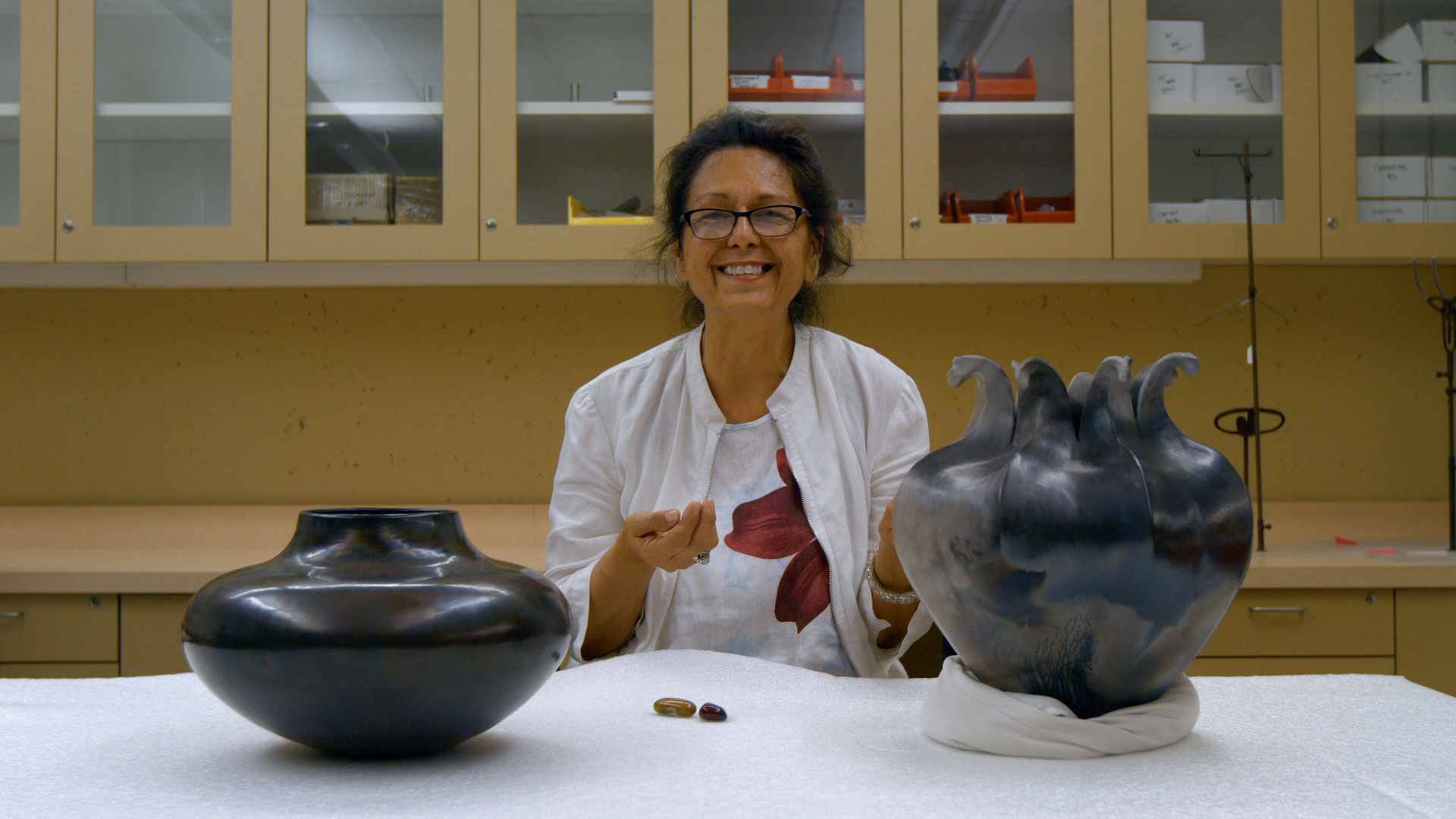
Connie: Especially in the States, where the need to preserve came so suddenly. Now, I might start playing with the mask, because I want to feel it. See my hesitation in picking up the mask? That’s something odd for us, because in the good old days, we’d think, “Sure, I remember making this,” while picking it up to see and know it. See the face? There is what looks like a frog underneath it — or is it another bird? Hayimḥimaḥ means “I don’t know” in Nuu-chah-nulth. The first thing I learn in many languages is how to say, “I don’t know.”
Do you see how we’re shy towards these pieces? It’s because we, especially me, I’m much more removed because my family grew up outside the reserves. We grew up in Campbell River. I was the only brown face until Grade 4 when Joe moved in, who was Asian (). I had the only really dark hair until he came in! Bertrand came in later on, in Grade 5 I think. Everyone was non-Native, usually of European descent. Coming back into this space (even when we were in the potlatch just recently), I could feel the hesitation: not knowing and yet knowing. I think that’s the memory that runs in our blood that we have to trust. Then the logical mind is awed at the preciousness. In our ways, this mask was alive, so that reaction would be like walking up to someone and staring at them, aloof in awe. You wouldn’t do that. You would embrace and feel and see them, right? But we have that hesitation towards pieces like this. It could very well be the power, the feeling that goes with them. Every time I feel them, I feel like crying, because it’s memories of our people being whole. It’s a big thing (I didn’t know I was going to cry so much).
Marc: Were you growing up with art in your family?
Connie: No. In my immediate family of three girls, I was the creative one. People ask me if I have made art since I was a small child. I think of the way my grandmother was creative: she was always crocheting, knitting and sewing. That’s the way that I was creative — except that I loved baking. I made a cake for my friend Rena’s wedding. She was going to get cupcakes from the Italian bakery; they told her to come for them two weeks before her wedding. When she went, the family had closed down the business. So, I offered to make her wedding cake.
When I bake, I like to know what flavors are going together. I knew I was going to make caramelized banana cake, but not just that; I also made devil’s food cake with it. I put one layer of devil’s food between two layers of caramelized banana. Between two of these I put chocolate ganache and between the other two — caramelized bananas. I had mascarpone frosting over the top. I knew every flavor as it went down, you could taste every little part. That’s what I liked about baking; always mixing all the flavors and putting them together. I did things like that when I was younger — and I baked very young. At age four, I could already double a recipe. We were really good at math later on, because that kind of calculation got us used to numbers.
I was also sewing really young. I had a tiny little machine when I was six, and I started making Barbie clothes. We were really poor, so I always had to be inventive in how I did things. I outlined the shape, sewed down the edges, but when I tried to stick it on my Barbie, it wouldn’t make way for the volume. I ran into the closet and started looking at everything, and I realized there were darts going down to leave that space. I couldn’t figure out exactly how they did it, but I made the simple form and made sure there was room for the head to fit in.
I would just go and look, and that’s how my grandmother did everything. She often didn’t use patterns when she was knitting things. She would just look and see — and maybe count, because she had been a knitter from way back. I did the same thing.
When I was really young, I occasionally got a colouring book; but I wanted to save it, I didn’t want it to get wrecked. Mom was always working in some school system, so she had blank papers. I’d take the papers and draw out the design in the colouring book, and colour that one, so my colouring book would still be pristine. I had lots of crafts like that to motivate me. The TV guide was out at the time and they had little craft sections. One was folding old TV guides a certain way, then going to the craft store to get a clown head. I cut the feet out of cardboard and used felt for the little buttons. I made a whole little clown.
I think I had to fold five or six Reader’s Digest’s and they were quite thick. I folded all of them and then realized I had folded two wrong. I unfolded and refolded them all. My mom said it was painful to watch. She was telling me it looked good, maybe just put the others in the front. I said, “No, that’s not the way it’s supposed to be,” and I fixed my little clown. I think my mom still has it somewhere.
I was always making things, always using different materials. We often shopped in the thrift stores, and as I got older, I would find different clothes and remake them, by mixing them together. I’d restitch them in a way that I liked, or take them apart and use the materials. It was always a process of looking at the way things go together and making.
My mom once got my sister a Meccano set. She got me a science set which I gave to my sister because I never used it, and she gave me the Meccano set. I spent hours with it. My mom would come home and I’d show her that I had the drawbridge working! That’s what these masks do; we can see them; how can we make them better? The transformation masks — how are we going to make them work better? (A transformation mask, also known as an opening mask, is a type of mask used by the Indigenous people of the Northwest Coast and Alaska in ritual dances. These masks usually depict an outer animal visage, which the performer can open by pulling a string to reveal an inner human face carved in wood. The act symbolizes the wearer moving from the natural world to a supernatural realm).
There is a constant need to improve on anything we’re doing. Those Meccano sets were exactly that, like making drawbridges or a crane. I made a crane that could lift things, and I think I made a car or a tractor. It was one set; I put it all together, then took it apart. That’s very much how we used to think; we always reused. We didn’t get new things. We didn’t store it; it was just reused again. I never thought, “Oh that took so long, I have to keep it.” It wasn’t in my DNA to think that way. It was always, “Now I can make something new!” and take all the parts and use it again.
That was my creativity when I was young. I was always an academic in school. Math, chemistry, and physics were my favourites. I caught up on English in Grade 11, when we had a teacher who went back to the beginning, and I started to see the formula of English and how it fit together. As a result, I could write better. My history teacher was very sad when I went to Grade 11 since he’d thought I was going to become a historian. Not me, and I think it had to do with the fact that there was nothing on us. In Canadian history, we weren’t even in existence except for little blurbs here and there. For me, we were so much more. I think I was always very angry in history class but I didn’t know it until later on. When I look back, I just avoided it. I did it, then forgot it. An exam would come up, I’d write it, get a good grade, then forget all of it.
Then, design came up at the University of Manitoba. My mom made university a prerequisite for my two sisters and me. I avoided it at first since I didn’t like making decisions. My mom came in, put the university calendar on my bed and asked, “So, what are you going to take?” I said I’d look. She started flipping through it, reading program descriptions. I realized the only way I’d figure out what I wanted to do was by eliminating what I didn’t want to do. Medicine was out; law was out; things kept falling by the wayside. Architecture was the one that stuck. It was based in math — concrete, yet creative at the same time. But I didn’t want to go to school for another seven years.
I don’t even know how, because you couldn’t Google back then, but my mom started phoning architects across Canada. One in Calgary said his daughter had just gone into the interior design program at the University of Manitoba. So, I came home and my mom told me about the program, and gave me the number to ask about it. I said, “I don’t need to ask her. I’m good, I’m going to go do that.” She hated when I said things like that, because I always see things in my head and, if it’s a fit and it’s right, it’s good to go. She made me phone the architect’s daughter to ask if she enjoyed it. She said it was a lot of work and really hard. I remember her going on and on that it was difficult and really intense, but I asked if she liked it. She replied, “Yeah, it was good.” That was good enough for me. I hung up the phone and told Mom I was going to do it.
I didn’t know Mom had already signed me up for The University of British Columbia, Simon Frazer University, University of Victoria and I got into all of these universities. When the University of Manitoba letter came, my mom handed it to me, and for the first time in my life I hesitated, because I didn’t know what the answer would be. I’ve never been so nervous in my life as when I was opening that letter. It told me I was accepted into the program. I said, “See? I’m accepted,” as if I had known, but I had no clue.
That’s when I went into interior design. The car accident brought me back to Emily Carr and I ended up in art. I always say there’s no such thing as accidents; I see it as my ancestors telling me to do my work and to use my gifts. Clearly, I wasn’t, so they took them away, and I had to work really hard to get them back. Now, I’m in a flux of using everything I have, all the time, so I don’t get whacked again — whether or not it’s through a car accident. Making sure that I keep doing what I’m supposed to be doing, and sharing the knowledge I’m supposed to.
Marc: Fantastic. Would you like to talk about the design of your house and how it works?
Connie: I’ll talk about my first outdoor piece in Parksville instead. The biggest public work I’d done — actually, a corporate work — was Hetux. It wasn’t until Parksville came up, and their business association had funds to do a sculptural piece. They were looking for a maquette, and I made a very sad maquette. (That’s the whole hesitation thing; I’m always fighting with actually doing something, because as soon as I show someone, it has to be real). It had the essence of the piece, with a seal, bear, and raven all posing circus-style on a ball. I knew it was water, land, and air. At the time, I had cut out these designs with them in their poses, without the central Tree of Life. It wasn’t in a radiating form. Trying to make them stand up, I got a green floral block, and stuck them in there. (That’s me not wanting to do something. Very strange things come out of massive avoidance).
I dropped it off late. They phoned a little later and told me they were going to put it out to call. They did and were wishy-washy around me doing it or not doing it. I guess my second proposal wasn’t what they wanted; they favored the first one — the sad-looking maquette. The person called and told me they wanted to put it off. Maybe I wouldn’t be the first artist to do a public piece in Parksville, but a later one. I said, “That’s great. The budget I gave you will probably double, but that sounds good.” He replied that he’d talk to the association members one more time. Then, he called back to tell me I got it.
That’s when I built the maquette. I was thinking it was alive now. It was a piece. I realized that they were tiered up from water, land, and air, around the central figure — the Tree of Life. Then, the story started to build.
I always know the essence of what a piece looks like; it’s not until I’m in it that I see the design. That’s the issue with public work in general; I won’t know it until I’m in it to produce it. Many public art commissions, whether public or private, are asking for your design upfront. Asking me to create something that’s not really going to live, because it may or may not be chosen, doesn’t make sense for me. I’ve never gone down that path with public works. This piece was accessible because it was a business group coming together, a group of human beings sitting and deciding that this was going to happen. When it works that way, it’s very easy for me to see the life in the piece and all its little parts. After I had the Tree of Life, there was a little butterfly, a bee, and a dragonfly that ended up in the top. The words below were “explore,” “embrace,” and on the raven, “entice.” Their words came out, the moon came out on the round shape. It all starts to come to life when I can see it living. When they said yes, I could see it all coming to life. That’s how I tend to work with most pieces. Because I had just worked at the Olympics and had fifty-odd pieces of different artists’ work installed in the 16 venues, I knew all the rules around public works. They have to be built so that stupid people could climb them and stay intact, because if they fell off and it was all intact, it was their fault. If it broke in any way, it became the City’s fault. It’s built very stably and can withstand people climbing on it — but I went back, and it seemed the circles in the cheek of the moon fit Heineken bottle caps perfectly. Someone must have stuck one in, and they went all the way around. I was laughing and I thought I’d better take it out in case Mom saw my piece with Heineken caps in it. She hates alcohol. I’m a Raven so I realize the playfulness that they were out partying one night, and some genius decided that it fit totally easy. I tried to pop them out but they were just a little too deep, so I had to take them out carefully as not to wreck the piece itself. Funny things like that happen with public works.
4. Public Art, Healing, and Residential School Memory
I did a piece for the Alberni Indian Residential School (Strength from Within is a sculpture made by Connie Watts in 2014 commemorating the victims of the Alberni Indian Residential School from 1890 to 1973, with three years interruption between 1917 and 1920 after it burnt down. Art Thompson (1948-2003) was born in Whyac, an isolated village on the western end of Nitinaht Lake on Vancouver Island. His ancestral roots lie in both the Coast Salish (Cowichan) and Nuu-chah-nulth (Ditidaht) nations). That is a piece that makes me cry too, maybe not this time, but when I’m there reading it or being it.
It has the Thunderbirds, their tails all facing in. On the residential school side, because it’s a moment in time, the Thunderbirds’ wings are down and it’s devoid of any design. There are children in the front looking remorseful, because even if they’re not abused to the same degree that other kids were abused, they are still so broken. Inside, there’s a little closet with fetal figures, a boy and girl. They represent the kids that were locked in closets or just killed and thrown away. The parents and everything else are attached to the columns of the piece itself. There’s a centerpiece that divides the boys and girls, and there’s signage talking about the residential school. As you make your way around, it’s healing. It talks about the court cases too.
The Thunderbirds’ wings are up, and it’s a more contemporary version of our Northwest Coast style — closer to my style, the way I design. There’s a skateboarder on one of the wings that says “spirit nation” and on the other side is a drumming circle with a drumbeat. It’s a balance between the contemporary youths doing youthful things and our cultural resurgence coming back. There are mother-daughter figures hugging in the middle, a little angry boy on one side, and a father coming back into the picture on the other. They are attached to the columns because they are still holding onto that rightful anger for the history. Then, the healthy side is continual. We’ve always had “healthy” — different degrees of it, because of the atrocities that happened.
I’ve always loved Art Thompson’s work,11 so I looked at his stylization and recreated it in the cutout forms for that Thunderbird. In the middle are the wolf dancers and the female dancers that usually line up on either side, while the wolves dance in the middle. That’s the healthy side. On the healthy and healing side, the kids from Haahuupayak came down when we poured the concrete, and I told them to put their hands in it. Sure enough, one of them said, “Can we do other things than just our handprints?” I asked what, and she said she’d like to draw a sun. I said yes and all the girls’ eyes lit up. A little boy looked over, asking, “Anything?” I said yes, and he took his shoe and plopped it right in there. I pulled his foot back out, and it was a really deep impression. On the healthy and healing side, I have those children’s markings to show that life. The Thunderbirds all go into the center, because when it rains, the gutters come down the center and all of the rain conglomerates in the middle. I say that’s the millions of tears that were dropped for that moment in time.
When I was making that piece, it was the same aspect of knowing it. We had more community engagement with it. That’s why we started to use the quotes. That’s why I didn’t represent it as the only thing that existed, because the survivors and the people that ended up dying there had to be better represented.
It was a balance between healing and health.
Getting back to the story of the bottle caps in the cheeks, I was away when it happened. My sister, her family, my mom, and I went off to Europe on a family vacation after we got it installed. Two weeks in, I got an email from one of our band members saying, “Your piece has been vandalized.” I didn’t even want to think about it. It took me a day to ask what happened. He said, “The little blue boy got ripped out.” I started laughing, thinking that an angry boy pulled the angry boy off the sculpture. I said I wished it could have been filmed, because it would’ve been an installation piece. It’s the essence of what we’re dealing with, the idea of healing. I went back and asked, “Do you still have it, or do I need to remake it?” They had it. His head was just bent; I bent it back and reinstalled it. He’d been in there the whole time, a little more crooked, a little worse for wear, but still part of the whole piece. That’s how you can tell our pieces are alive, because things like that happen. It’s part of the storytelling.
Those are some outdoor pieces that I have created so far. I have another outdoor piece for BC Hydro, based around my grandfather, with the same idea of storytelling (The BC Hydro and Power Authority is a Canadian electric utility in the province of British Columbia, generally known simply as BC Hydro). I heard a story about the Thunderbird, nesting up in the mountains. Thinking of “hydro” and water, I thought it would be a cool story with the Thunderbird playing one day, stirring it up and making that river run really fast. I thought of my grandfathers and their hard work: Harry Mountain, Percy Steritt and Tom Watts. I remember being out on my grandfather’s fishing boat once off the coast of Prince Rupert. They’d take their boats all the way up and be gone for days. I remember waking up and looking at him one night. I started talking to him, but he just stood there, his eyes a little droopy, leaning against the wall behind him. His hands were on the wheel, but he was so still. My sister said he was sleeping. I said, “He’s not sleeping. Right, Grandpa, you’re not sleeping?” He still didn’t say anything. We watched him; sure enough, it was a 20-minute power nap, standing. I don’t know how, but he did it but he did what he had to do to keep going. They had a certain amount of time to get up to where the fish were, to fish, and bring them back to the cannery so he had to work hard.
That piece was all about that feeling. For me, the feeling of energy and hydropower, that force of the water, were the essences of my grandfathers. They came together. About getting into an accident because I wasn’t living my life with my purpose, I think that’s the sadness we feel with these pieces, even if they’re spectacular. People that were close to the masters back in the day when they were living and feeling our culture, using the lines to express that emotion and feeling. You can see the strength come through every line and form in these pieces. It’s a sense of wholeness, of knowing and being. Living our ways and being a human being, as we call it. The term “human being” had to be earned all the time. It wasn’t just momentary; it was an ongoing practice. These pieces have a sense of that in them.
Marc: Do you speak any Aboriginal languages?
Connie: No, I don’t speak our language. I’ve taken one language class where I can say “?ukłaas Connie,” which means “my name is Connie.” I can’t remember it now; it’s been too long. We learned this introduction in a beginner class. I learned how to read it, and one of the elders said, “It would help if you listened to elders a bit more.” Clearly, my pronunciation was still off. That’s the gentle way of our people teaching us. They wouldn’t say, “You have to work on this.” They’d give you a solution: “Maybe you want to listen to the elders a little more.” With my enunciation, I tend to chop it up into its syllables rather than saying the entire word. My grandmother was more direct. She’d ask me why I talked like that. I’d say, “Because that’s the way it sounds in my head. That’s how I see it.” I don’t have fluency in our language.
The first piece I showed here at the Museum of Anthropology — the one beside these beautiful Hamatsa masks — I called “Vereinigung,” which is German for “the act of unifying.” My mother was perturbed, asking why I didn’t name it with one of our words. We were in Campbell River then; it would’ve been a Kwakwaka’wakw name. I replied that in school I took French in Grades 8 to 12, and German in Grades 10 to 12. I had access to those languages, but not to our own language. It wasn’t until my mom and someone working with her started Native Studies, a component of which was the language. When they started working on the language, it was after my time. That first sculpture was called “Vereinigung” for the fact that we didn’t have access to our languages. We had access to other languages, but not our own. I can’t describe anything in either of the three languages, and I’m very distant from Gitxsan. The last time I was up there visiting the family, I was 12. When my grandpa passed, we flew in to Kispiox in the Seven Sisters mountain range. When we walk into wherever our family’s from, we feel the connection again. It may be one of our historical pieces, it could be the landscape. Whatever it is, it’s imprinted in everything that we are.
When I went back, I didn’t necessarily have the same connection with my family up there, except for some of my cousins. Yet seeing this land where we used to spend time, and know, and travel around, all brought the same feeling. The Seven Sisters have a huge story around them that I don’t know, but I know they’re significant. I could feel their significance as soon as I came into the space. We keep going up and picking up all these little pieces, with things like that. That’s the beauty of having access to a collection of our old works; we wouldn’t have had it otherwise. There was too much trauma and devastation in many of our communities. There were some very dedicated, beautiful artists, like Art Thompson, Beau Dick and a long list of carvers. I didn’t realize the reason behind our movement. It was the tourism trade coming in that gave people their right to carve again, because they weren’t doing it for potlatches. They were creating for collectors and tourism and everything else. There was a big resurgence.
In Gerald McMaster’s essay, he says art lost a sense of its use. Earlier I spoke about a piece being crafted for a particular person.
(Gerald McMaster, Reservation X: The Power of Place in Aboriginal Contemporary Art (Gatineau, Quebec: CMC; Fredericton: Goose Lane, 1998)
In the Kwakwaka’wakw and Comox areas especially, they never quit potlatching, they just did it in kitchens. At Christmastime, they’d start potlatching, because no one would question all the family piling into the house. They’d give out the names, sing the songs, and no one would come and stop them. It wasn’t in the Big House, but they always found different ways to continue. Things got burnt and people got tossed in jail when they got caught. In Alert Bay and Village Island, which are very remote, I don’t know why they took boats to travel for days to get up there, just to catch people potlatching and burn their things. How dedicated and destructive must you be to travel so far away from home to destroy a culture that is still living on? We may have gotten marked up a little, but we’re still strong, still finding that strength in everything. Wherever I go, pieces like this mask, which I know are tied back to our family — whether or not it’s a place (going back up to my grandfather’s and the Seven Sisters), or feeling one of my great-grandfather’s pieces, or even finding some of the Nuu-chah-nulth grass weavings (we used to have a lot of weavers in our family and territory) — they all have that same breath and life. It has entered into me, and it’s an amazing feeling. It’s a big honour to be able to have this mask here. Even if there’s a little sadness, there’s a big honour that goes with it, too.
Karen: There are more and more of these pieces, used by families within potlatches. We’re sending up quite a big number of things for Ruby Dawson’s family this long weekend. It’s quite interesting now, bringing things and trying to connect them to life again. It’s a museum artifact, but still has an ongoing life. It gets used, then comes back and it sits here, then goes out again; some pieces have done that quite a bit. New pieces, too — Willy White’s robe is being used a lot in Alert Bay. It’s been going on for quite a long time here with some pieces. William Wasden Jr. used his headdress in his first and second potlatch. Beau Dick even carved it out to fit William’s head better without anybody knowing — we all laugh about that.
(Willy White’s Chilkat and Raven’s Tail weaving were exhibited in 2002 in the exhibition “My Ancestors Are Still Dancing.” The records in “Karen Duffek fonds” sub-series mention that: “During his exhibition at the Museum of Anthropology, Willy White began weaving a gwishalaayt, or Chilkat robe. The weaving was later finished at his home in Prince Rupert, British Columbia. In 2004, a “taking off of the loom” ceremony and feast was held to celebrate the completion of the gwishalaayt. Though Elizabeth Johnson was the curator for this exhibition, Duffek worked closely with her, and the files relate to Duffek’s involvement within the process. File contents relate to exhibition research and planning, draft exhibit texts, correspondences, transcripts of interview with the weavers, and recordings of the final ceremony.” More information can be found through: Karen Duffek fonds, “Willy White: My Ancestors Are Still Dancing”, Museum of Anthropology, UBC, 2002-2004, p. 27-28)
Connie: See? The Kwakwaka’wakw’s do what needs to get done. Ask for forgiveness later on!
Karen: It brings a new relationship and dynamic to a museum as well; it’s quite exciting. People like Gloria Cranmer Webster are saying they shouldn’t be borrowing these things back, as if begging for something; they should be carving new ones. Whereas, for others, something in the old one had that intangible thing, that connection.
5. Bringing the Masks Back to Life
Connie: It’s the sense of life in the piece and honouring it; it would be like leaving our elders in an old-age home. The analogy that they shouldn’t be danced or borrowed, it’s like just leaving them. We’d never leave them. They’re part of our community, a part of our life. Everything is alive. Allowing that life to be breathed back into the piece again brought its own life back into the community: it’s the dynamic energy between the two that makes it remarkable. That’s so exciting. Is someone documenting the pieces going in and out?
Karen: There’s a filmmaker, Marina Dodis, who did a short film that we’re going to have in our education circle here. It’s about a potlatch “breaking bear,” a big bear stand (they used to break coppers on it) that was brought up a year and a half ago for the Scow family potlatch. It stood there at the front. In her film, Dodis interviewed the young chief Byron Alfred, and it was very new to him. He spoke about reconnecting to these things, and what it meant to him. You could smell the smoke in that bear, sitting back in its case with the smell.
Connie: It’s a life back and forth. That smell is the essence of the Big House from the big fire in the middle. The sun breaks in the morning time and comes straight through all the smoke coming up. It’s such an incredible, powerful feeling. The pieces that are danced in there bring that same sense of energy into it. To have them coming back, I always think of them as our ancestors; they’re a part of us. It’s a remarkable opportunity of not only letting the piece live again but bringing those stories back with it. It’s only out for a bit, but it comes back and is allowed to live its life. Its life is just going to be extended a little longer than what it initially was. One day, maybe it will go back again, and that will be it for its time. It’s a remarkable thing. It makes me feel excited. My little sister will be very happy to hear that the pieces are going and that there’s no arsenic on ours; that’s fantastic. She’ll love that. She has that same feeling. “They’re supposed to live their life,” she said when I was talking to her about going into the museum, seeing these pieces and loving them. She said, “They’re alive! They’re supposed to be living.” She’ll love the fact that they’re being sent back home and brought back into their family. That’s how we felt going back into the potlatch, being brought back in, for my grandmother’s memorial two years ago.
I did a piece for Potlatch 67-67 called A Thunderbird Woman. The Hamatsa dance is so huge for me, and the Thunderbird is very strong in our family. I thought it would be incredible for it to honor so many of the women who have been knowledge keepers for what has been lost.
They kept lots of information and knowledge, while taking care of the kids. They were at home, in the old-school sense, but they really took on their roles holistically. A Thunderbird Woman is that sense of Mom raising us in a First Nations way of learning and understanding. We were not necessarily going to potlatches, but we lived First Nations. I thought of all the women who had that strength inside of them, and A Thunderbird Woman got going. I began to see her in the Big House, coming in and feeling shrouded; it was a direct response from feeling the Hamatsa dances.
When I was growing up, people started saying only men were allowed to dance it. Of course, the women came back in, saying it’s people. People dance in Hamatsa masks. The idea of men dominating the Big House again made me think of how there was nothing that recognized the strength of the female embodiment of knowing, being, and survival.
Then the Thunderbird Woman enters into the Big House, shrouded in white cloth and layers, with tons of rags layered on top of her. Four supernatural beings are around her, guiding her in — I haven’t designed them yet, I don’t have them in my head. They signify different things, such as our ancestors, the energy of the universe, life itself, fluidity — the water and the wind, the movement of energy. We’ve been removed, distant from it. These beings gradually start bringing her back into the Big House, chanting around her. These four supernatural beings begin taking her shrouds off and putting them in their little pouches; their masks are designed around what they represent. As they get down to that final shroud — it’s a big cloth — they each take a corner and lift it off her. You can see her wings, but her head is still down. They all have two staffs designed for the energy that they carry, and they start to dance around her. It’s the movement of cleansing, whether or not it’s with branches or smoke or anything else, that they perform around her. As she feels their energy going through her, her head begins to come up, she starts moving. Then we see her Thunderbird, and her wings. (Because of our technology in costume design, I always imagine this being bigger than anything that’s been around.) Her wings rest in front, and her head is up, looking around. The ancestors, the supernatural beings, are still around her with their staffs, moving her as she’s going around the Big House. She’s searching, looking at people, a little leery but curious and welcoming. As she starts to feel her strength, she goes up to each of the supernatural beings, who part into their four corners. She thanks each of them by dancing, giving them energy back again. When she leaves and moves on to the next one, they go into the center, and give all the white shrouds from their little pouches back to the fire, which takes them and re-cleanses them. Then they all start going around as the beat picks up, and the energy picks up. They are all dancing in and around her, then they stop and bang their staffs down. In that moment, her wings open up, her head flips up — she’s a female figure in the Tree of Life. That’s the end of the performance: her opening up and being whole again. In the Tree of Life are the children, the families, a sense of all of the life that she carried.
I made the Thunderbird mask for the show, which could not be danced because it was far too heavy. It was my first carved piece. I made the wings that went around her. It was born from that story and the feeling of being in the Big House again, and seeing and feeling these dances, feeling that life. One day, I’ll create the whole piece.
The Comox Valley Art Gallery made a book with the Kumugwe Cultural Society. It’s a downloadable online catalog which goes through their collaboration with the gallery (Kumugwe is a figure in the mythology of the Pacific Northwest peoples. Known as “Copper-Maker,” he is the god of the undersea world revered by the Kwakwaka’wakw and Nuxalk First nations). We had a very First Nations gallery opening, and they welcomed us all in, danced, and opened the show. The next day we went down to their Big House where they performed (they perform all the time during the summer, speaking about the dances and what happens in them). That’s what my piece was made for, and that’s when I learned about their potlatching and their kitchens. One of them had an old recorder — one of those big, wheeled recorders, with tapes going through it. They have many of their songs recorded, too, which is fantastic.
It was incredible, a whole different return into the potlatches. The ban went on for 67 years and it’s been 67 years since. I still feel hesitant to be close and around them. This comes from my grandmother being terrified of us doing anything First Nations, because it meant life or death to her. It was so dangerous to be First Nations in her time. That went through my mom and it’s still resonating through me. She never let us speak the language. Even late in the 1990s on the dock in Port Alberni, when I said Hayimḥimaḥ — a word I learned in Nuu-chah-nulth — she was immediately angry at me. I told her, “Gran, it’s the ‘90s. It’s okay to speak.” But it was never okay for her or us to speak in our language. The hesitation to be expressive in our way, in our own culture, is still mending, still healing.
The catalog is really beautifully done. I wrote an essay for it, talking about that story that came out. It has everyone’s work in it — Karver Everson, Andy Everson, John Powell, George Littlechild, some of Beau Dick’s, Mungo Martin’s work, Liz Carter, Steve Smith, Randy Cook, Shawn Hunt (who did an electronic transformation mask there). It was a fun, very cool show to be a part of, because of its relationship with our past, our ceremonies and how some of us are more distant than others. The Eversons have really taken on sharing the dances, sharing what they do in a potlatch. It’s not a mystery anymore: this is what it represents and this is why we’re doing it. The same way I looked at our Northwest Coast forms and made those kids experience living the creative life of developing a whole form. They do the same thing with storytelling and potlatching to let people see. Not all will see it; it will go right over some people’s heads, but not the people who are really listening, understanding where and why those dances are, where they came from, what their part is. There’s the Full and Half Moons dance, where little jokers and mimics come out and play (In Kwakwaka’wakw tradition, the full and half-moons are seen to battle for the right to show themselves at night. In one particular dance, the full moon and the half-moon come out onto the dance floor making noise and pointing to the moon shape above their respective masks. The singers, realizing that they are fighting over who should show themselves, suggest that they have a dance contest. After a hilarious bout of dancing, the winner is declared by the assembled guests and will be allowed to journey across the sky that evening.) They create a lightness, because the potlatches went on for four or five days, sometimes a week. That way there was always humor in them, too.
(The exhibition Connie Watts mentions was at the Comox Art Gallery and was called Hiłt’sist’a’am (“The Copper Will Be Fixed” in the Kwakwaka’wakw language), and was part of the thematic program Potlatch 67-67: The Potlatch Ban – Then and Now.)
Willy White’s Chilkat and Raven’s Tail weaving were exhibited in 2002 in the exhibition “My Ancestors Are Still Dancing.” The records in “Karen Duffek fonds” sub-series mention that: “During his exhibition at the Museum of Anthropology, Willy White began weaving a gwishalaayt, or Chilkat robe. The weaving was later finished at his home in Prince Rupert, British Columbia. In 2004, a “taking off of the loom” ceremony and feast was held to celebrate the completion of the gwishalaayt. Though Elizabeth Johnson was the curator for this exhibition, Duffek worked closely with her, and the files relate to Duffek’s involvement within the process. File contents relate to exhibition research and planning, draft exhibit texts, correspondences, transcripts of interview with the weavers, and recordings of the final ceremony.”
This work has been commissioned by the Vancouver Biennale
Acknowledgements
This work was made possible with the generous institutional support of the Museum of Anthropology (UBC), the Museum of Vancouver, the Vancouver Art Gallery, the Vancouver Biennale, the Vancouver Maritime Museum, Vivo Media Art Center, the Cultural and Scientific Service of the Embassy of France to Canada, and the Buschlen Mowatt Nichol Foundation.
This work could not have been possible without the support of Barrie Mowatt, Murray Nichol, Karen Duffek, and Jim Breukelman.
Copyrights notice
This interview is licensed under a Creative commons license CC BY-NC-ND. The license enables users to copy and distribute the material in any medium or format in unmodified form only, for noncommercial purposes only, and only with attribution to the author(s). Adaptations of the work are permitted. The Interview may be republished noncommercially so long as attribution is given to the author(s).
Note on copyright ownership and licensing
We are committed to respecting the intellectual property rights of others. While all reasonable efforts have been made to state copyright holders of material used in this work, any oversight is unintended and will be corrected in future editions, provided the publishers have been informed.