There’s an old piece of folk wisdom that’s quietly one of the most useful ideas you can carry around:
Don’t ask the barber if you need a haircut.
His answer is almost guaranteed before you sit down. He isn’t necessarily a liar or a bad person. He just earns his living cutting hair, and that fact quietly shapes what he sees when he looks at your head.
The interesting thing about this idea is that it isn’t really about dishonesty. It’s about something much stranger and more universal, which is the way the rewards in someone’s life shape what they sincerely believe to be true. Once you notice this pattern, you see it in almost every conversation where someone is giving you advice, including the conversations you have with yourself.
An incentive is anything that rewards or punishes a behavior. Money is the obvious one, but it’s far from the only one. Status, attention, approval, job security, the feeling of being needed, the comfort of belonging to a group, the relief of not having to admit you were wrong. All of these shape what people do.
The finding that decades of psychology and economics keep landing on is that incentives don’t just change what people do. They change what people see. They quietly edit reality before anyone notices the cut.
The psychologist Ziva Kunda called this “motivated reasoning.” When we want a conclusion to be true, we don’t usually invent fake evidence. We do something subtler. We search a little harder for reasons that support it, examine the counter-evidence a little more skeptically, and arrive at our preferred answer feeling like we got there through pure logic. A large analysis pulling together 266 studies found a strong, consistent tendency for people to take credit for good outcomes and blame circumstances for bad ones. We are, in a sincere and well-meaning way, slightly rigged in our own favor. The barber genuinely thinks you’re looking a little shaggy. He isn’t scheming. He’s just looking at you through the eyes of someone who cuts hair.
Motivated reasoning: The tendency to reason your way toward conclusions you already want to be true. You don't fabricate evidence, you just search a little harder for what supports your preferred answer and examine the rest a little more skeptically. Coined by psychologist Ziva Kunda in 1990.Why the art world is full of barbers?
This matters everywhere, but it matters especially in any field where money is unstable, opportunities are scarce, and reputation does a lot of the work. Art is one of those fields. Recent surveys of visual artists in the UK found median earnings around £12,500, with more than four out of five artists describing their income as unstable or very unstable. When the ground is shaky, advice becomes louder, more confident, and more consequential. The people offering it are often kind, often experienced, and often quietly invested in the answer.
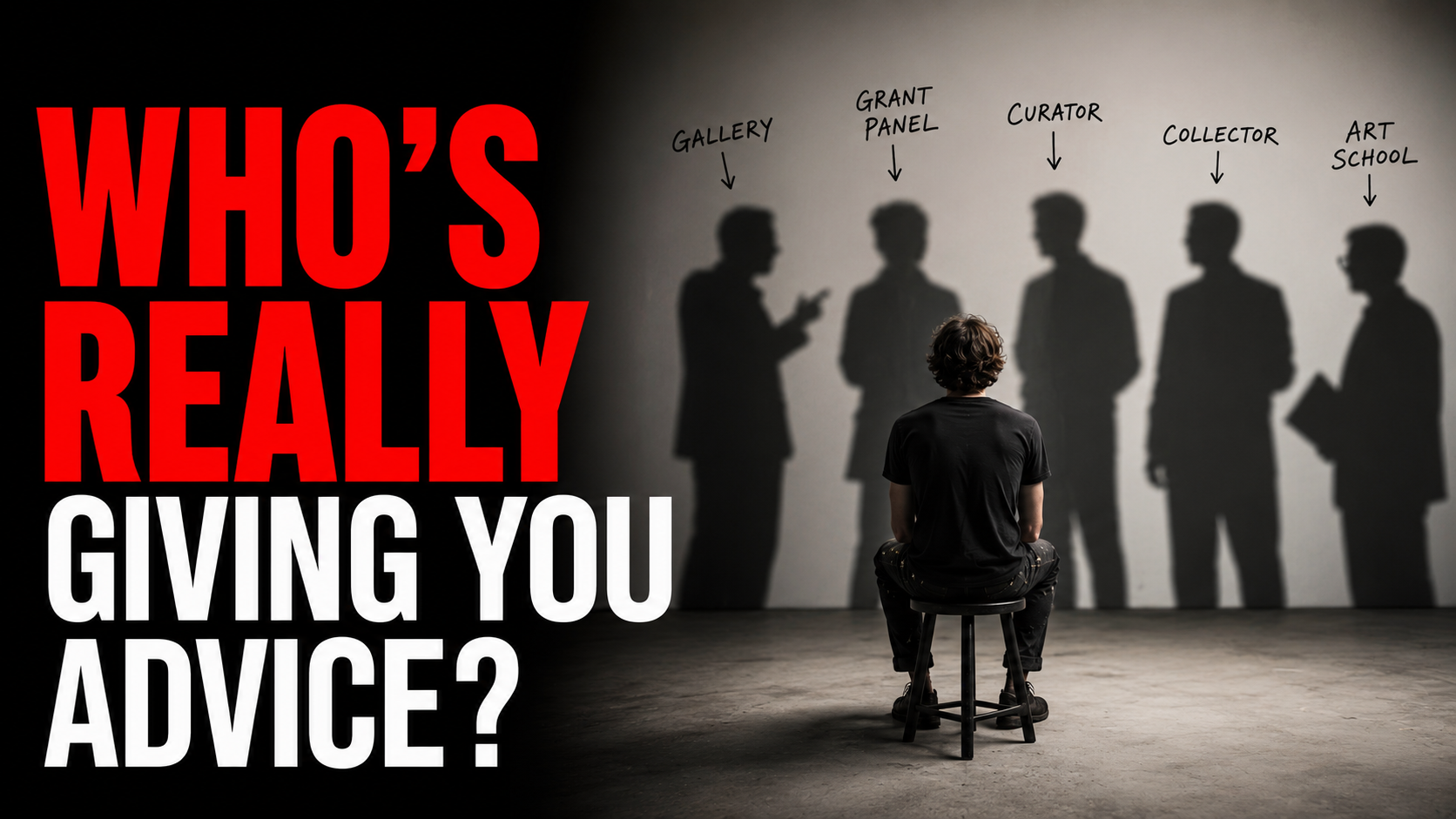
Take the gallery that wants to show your work. A gallery earns by selling. So a gallery has a structurally honest reason to prefer work that is legible to buyers, recognizable as yours from across the room, and priceable within current demand. None of that makes a gallerist a villain. But it does mean that the advice an artist hears from galleries tends to point toward consistency, repeatability, and a recognizable signature. That might be exactly right for one artist and quietly suffocating for another. Two galleries can give an artist opposite advice not because one is wise and the other is corrupt, but because a large gallery’s business depends on cultivating artists, while a small gallery’s business depends on cultivating collectors. They are looking at you through different windows.
Or take the person who advises artists about grants while also selling grant-writing packages on the side. There is no need to assume bad faith. But the advice that artists need professional help with applications is advice that increases demand for the service the adviser is selling. Research by George Loewenstein, Daylian Cain, and their colleagues found something almost funny: when advisers disclose their conflicts of interest, they often feel licensed to give more biased advice, while the people receiving the advice feel social pressure to follow it anyway, because refusing now feels like accusing the adviser of dishonesty. So even transparency, on its own, doesn’t fix the problem. It can make it worse.
Conflict of interest: A situation where a secondary interest, often financial, risks influencing someone's judgment about a primary duty. The person doesn't have to be dishonest. The structure of the situation does the distorting work, often without anyone noticing.Or take grant panels and funders. Public arts funding bodies genuinely try to manage conflicts. They use peer review, they screen for entanglements, they insist on artistic merit as the primary criterion. But peer review still operates inside budgets, formal criteria, and the quiet pressure of having to justify decisions to a board. That means clarity, fit, and administrability creep into the judgment alongside artistic risk. A panel doesn’t have to be cynical for the most legible, easiest-to-defend application to slowly become the most fundable application.
Is the room really on your side?
Art schools face one of the most uncomfortable versions of the barber problem. Schools are not fraudulent. But they are funded by enrollment, which means their financial survival depends on persuading more people to enroll into a labor market that is genuinely difficult. National data shows that students with fine arts degrees earn less, on average, than graduates in many other fields, and one careful study found that student debt reduces the likelihood of working as an artist after graduation by more than thirty percent. None of this means art education is a scam. It means the institution’s incentive to recruit, the student’s hunger for an artistic identity, and the labor market’s reality are not automatically aligned, and the people inside the institution often genuinely believe they are.
Curators and museums sit inside a similar tangle. A curator does not work in a vacuum. They work inside donor relationships, attendance targets, prestige hierarchies, and programming calendars. A study of art philanthropy found that more than sixty percent of art-funding dollars stay local and that funding levels track institutional prestige. This doesn’t reduce curators to donor servants. It does mean the show that gets made is rarely the show that lives purely in someone’s imagination.
Then there is social media, which may be the cleanest modern example of the entire problem. Platforms reward certain things: frequency, brevity, emotional intensity, recognizability, conformity to whatever the algorithm currently favors. There’s a concept called Goodhart’s law that says once a measure becomes a target, it stops being a good measure. Likes started out as a rough signal that people found something valuable. Once everyone started chasing likes, they became a signal that people felt a quick reaction. Those are not the same thing. Many artists exhaust themselves optimizing a number that no longer represents what they originally wanted, and the platform is happy for them to keep trying, because their effort is the product.
Goodhart's law: Once a measure becomes a target, it stops being a good measure. Likes, follower counts, sales figures, and engagement rates all start as rough signals of something real and slowly turn into the thing people chase instead.The barber inside your head
Even other artists are not neutral advisers. Peer advice is often shaped by survivorship and by the very human need to make sense of one’s own life. One artist’s “say yes to everything” is another artist’s burnout. One artist’s “protect your purity” is another artist’s avoidance of feedback. Motivated reasoning makes it easy to reinterpret your own path as the principled path. This is why artist-to-artist advice can be simultaneously generous and misleading, often in the same sentence.
The hardest barber to interrogate is the one inside your own head.
Artists, like everyone else, can choose opportunities that protect identity rather than build skill, money, or audience. The residency that mostly proves you’re a real artist. The show that mostly confirms you belong to the right circle. The decision to refuse a commercial opportunity because the refusal feels morally clean, when really it just feels safer than risking judgment. Your own mind has incentives too. It wants to feel competent, principled, and consistent with the story you’ve been telling about yourself. When that mind gives you advice about your own work, it is not always a neutral source.
Skepticism without cynicism
It would be easy to take all of this and decide everyone is on the take. That would be a mistake, and not just an emotional one. The evidence doesn’t support it. Research on conflicts of interest by Sunita Sah has shown that strong professional norms can genuinely reduce bias. A study of arts nonprofits found that greater reliance on private funding did not, on average, divert spending away from artistic programming. People resist their own incentives all the time, especially when their values, their training, and their long-term relationships are pulling in a different direction. Incentives are pressures, not destinies.
The useful stance is somewhere between trust and suspicion. Call it disciplined curiosity. When you receive advice, you don’t need to ask whether the person is good or bad. You ask what they’re rewarded for. You ask what they’re measured on. You ask what they quietly lose if you say no. You ask what story they need to keep telling themselves in order to feel like a good person, because that story is often the real source of the advice. You ask the same questions of yourself, with extra care, because you are the adviser you trust most and examine least.
The barber isn’t your enemy. He’s just the wrong person to ask. The skill is in knowing which questions to bring to which people, and which to bring back to your own desk in the quiet, where the answer is harder to dress up and easier, eventually, to hear.