This work has been commissioned by the Vancouver Biennale

Full transript
1. An Ancestral Name and a Lightning Story
2. T’xwelátse and the Journey Home
3. Transformation Written into the Landscape
4. Clay as Prayer to the Earth
6. Mentorship, Blue Corn, and a Life in Clay
7. Language, Community, and the Work Still to Be Done
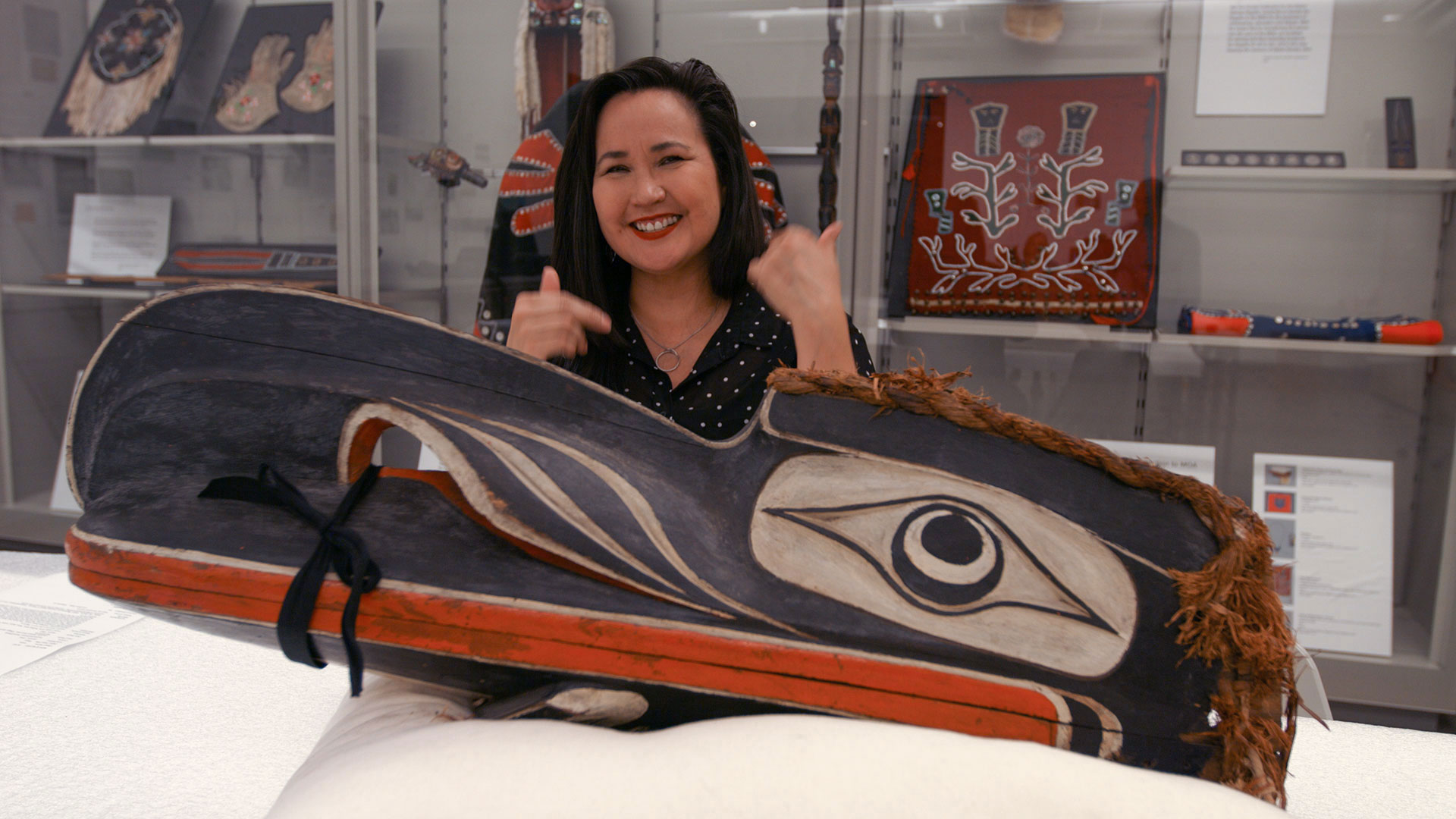
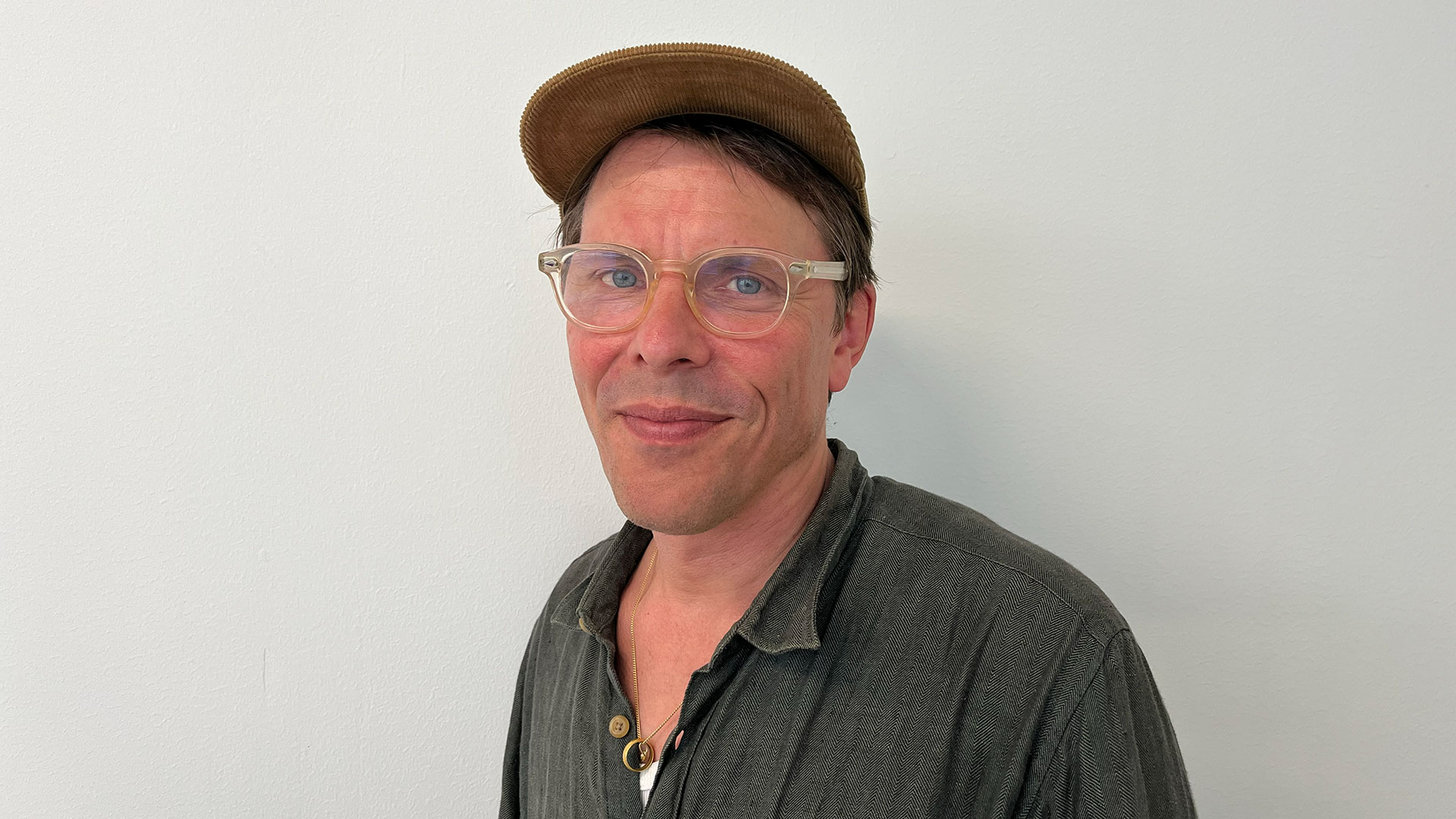
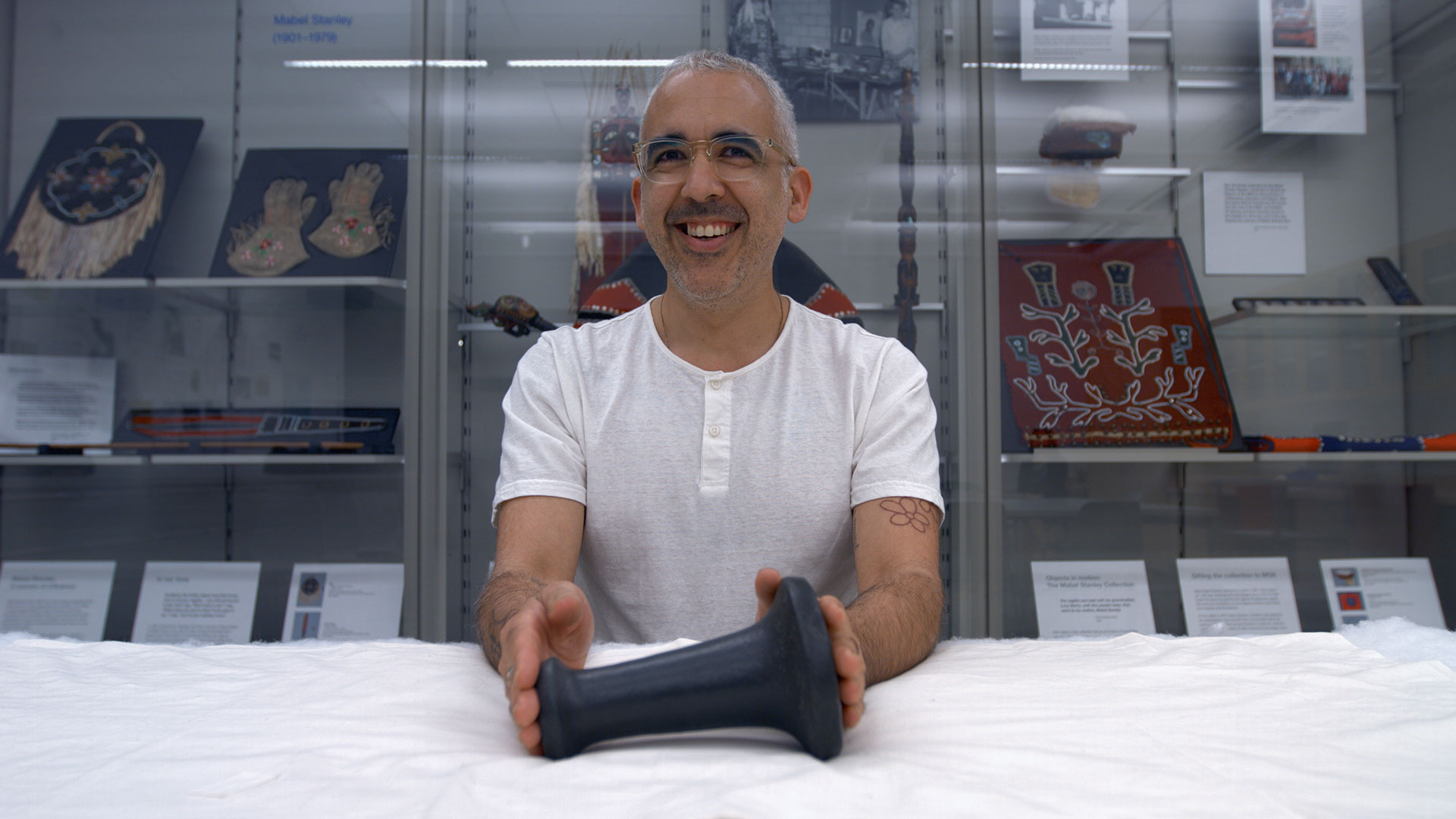
Marc Johnson: The Museum of Anthropology acquired your works and you brought a few today from the reserve. Could you please tell me more about yourself and your working process?
Laura Wee Láy Láq:
Ey Swayel, Lumlamelut Wee Lay Laq tel skwix, telí tsel kw’e Ch’íyaqtel, Norman qas te Roberta skwalexs te shxwewálí, qe Duncan qas te Beatrice skwalexs te selsí:là:lh.
1. An Ancestral Name and a Lightning Story
I carry an ancestral name Lumlamelut. That comes from a lightning story. My ancestor that carried that name was born in the middle of a major thunder and lightning storm on the banks of the Fraser River, which we call Stó:lō. She was a twin to Wee Lay Laq the Fifth, who was born one month earlier on the banks of the Vedder River area. They were down there preparing fish and out she popped. I don’t know the exact translation of the name Lumlamelut, but she’s buried just a half a block from where I live. She worked tirelessly for the community and she never married. She helped her brother, who was one of the great leaders of the time.
Wee Lay Laq is my father’s name. In English, it’s Wealick, but I’ve always used the Wee Lay Laq name, which is in upriver Halq’emeylem. My father is Stó:lō, or considered Stó:lō from Tzeachten, which means fish weir, because we had a big fish weir river ran through at one time. We originated from Chilliwack Lake and we were the caretaker of that lake. There were two villages, one on the south and one on the north side. It’s said that all of the shxwlá:m — or the doctors and healers — would come from all of what we now consider Salishan territory, from Montana and up in the interior of British Columbia and onto Vancouver Island. They’d all go there to practice and encourage their spiritual connection and powers and gain strength from this area. In the lake, they have what’s called water babies, which are supernatural beings that reside there, so it’s a very special, powerful lake.
Over the course of about 250 years, we migrated down the valley to what’s now called the Chilliwack Valley into Stó:lō territory. Stó:lō, again, means river, so it’s people of the river. We moved because of geographical changes that were taking place. There was a lot of landslides and a lot of shifting and moving of the earth, so that caused us to move further and further down into the Stó:lō. But my original ancestral language is Lhéchalosem, which is what they now call the Nooksack language, now considered in the United States part, then we adapted into the upper Halkomelem language, is what I speak now.
2. T’xwelátse and the Journey Home
The story I was telling you is about T’xwelátse, who is one of our transformer stones, and I’m one of the 12 grandmothers who take care of him. Actually, he speaks to me. People will send me to sit with him and they’ll ask, sometimes, questions that they would like answered by him. He was given as a marriage gift and he traveled from the Chilliwack Valley down into the Sumas-Kilgard area; that’s what it’s called now. Originally, there was a giant lake that supported the wellbeing of the Indigenous people. They’re the Semá:th people or Sumas people. He lived there until the turn of the century. There was a lot of vigilante activity happening from the states. People were coming up and were hanging Indigenous people.
One notable person lynching was of Louie Sam, which is very highly documented. Everybody scrambled to get away from all of that and moved up into the mountains, further north, to hide from this horrible activity. They left T’xwelátse behind because he’s a very big, huge, heavy stone, and they couldn’t really move him quickly. Some people from across the line in western Washington State, as it’s now called, saw him and didn’t know what he was. So, they took him into a shop and they charged people 25 cents to see all these curiosities, and he was one of them.
He sat there for a number of years until some ladies came from the Burke Museum of Natural History and Culture. They said, “Wow, this guy is really curious. Where’d you get him?” They told them the story of how he got there, and they said, “Well, would you ever consider are giving him to the Burke Museum?” And so, off he went on his journey. He went down to Seattle and he sat in there, in the basement, much like we are here. He sat there for years and years until one of our anthropologists went down there to do some research and saw him in the corner.
He said, “That’s T’xwelátse.” So, they started one of the first repatriation processes to bring him back home and they took him from the Burke Museum to the Nooksack. They officially gave him back to us and he came across the border into the Sumas territory, then he eventually made his way up to Stó:lō Nation. While we were doing the work around that, I was sitting with my dad at one of these meetings. All of a sudden, I heard this voice in my head and it said, “I need a cape.” I looked around and I said, “Dad, did you just tell me you need a cape?” And he said, “No. I didn’t say anything,” and I said, “Okay. This is very strange.”
So, I asked myself, “What kind? Out of cedar? Out of wool?” Afterwards, I went up to the person who was the leader of the conversation and said, “Okay, this happened to me. Should I make a cape?” And he said, “Well, I guess so. If that’s what he’s calling for, you better get busy.” I had no idea how to make a cape, but I had a really big Salish loom because I was learning how to weave swōqw’elh blankets. I thought, “Well, if I just get the cedar, I can just hang it down and just weave a loose kind of basket weave, then we can wrap that around him to travel in.” Then, everything started to fall into place.
My friend Brenda Crabtree said, “Oh, come over to my house. I’ve got a Jerry Stripper and we can easily get this done. My friend Muriel Roberts, who was also one of the caretakers, said, “I just got a feeling you needed help. Do you need any help with something?” I said, “I do!” She came over and helped me weave it, then she went and got this huge, beautiful string of rabbit fur that we put around it. Then we took it down there and covered him. He travels and he just wears it all the time.
When people found out that he would say things to me, when he did this little traveling tour, like a rock star, and they asked me to come with him to make him feel more comfortable. So, I did that a few times. We took him up to Harrison and we’d take him to various places around the community. He’d roll out of this big van. People would go visit him.
I was teaching language in the Stó:lō Community Development Corporation office, which was on the Tzeachten First Nation. They wheeled him in there and he was there the whole year I was doing language lessons. I developed the Halkomelem language program for my community, Tzeachten. The funniest thing happened when we left for holidays for three weeks; we turned the lights off and everything was empty. I walked into this big board room. He was in the corner when the Point family had made a nice canoe for him to sit in. Anyway, I hear, “Where were you?” And I’m like, “Hello? Is there somebody in the room?” because it was kind of dark and there was nothing there. “Where were you?” I went over and I went, “Oh, T’xwelátse.” “I was so lonely,” he said because he had gotten so much attention, I guess, and then, all of a sudden, nobody was there. They all disappeared. Anyway, I said, “We’ll never leave you again.” So, we put him in a place where he’s always surrounded by people.
Then, oddly enough, I also developed the language program from the University of the Fraser Valley and I insisted that they move the language out of the college. It became a university off the campus and into Building 10, which is our resource centre. It was a new building. I said, “We need to have our language here” and they moved him there. Then, I saw him every week. Everywhere I go, we always seemed to be together. I don’t teach there anymore. I taught some other people to take over for me because I’m doing other work.
Anyway, he’s very powerful. The whole reason he changed into stone was because he was mistreating his wife. He and Xexá:ls, who is our transformer spirit, had this huge battle. “You have to stop what you’re doing,” Xexá:ls told him. “What you’re doing is not very nice.” He wouldn’t listen. So Xexá:ls just got tired of fooling around and she just whacked him and turned him into stone. She said, “There. Now you’re not doing that anymore.” So that’s how he became stone.
He’s a pretty powerful guy. He sits there at the Stó:lō Development Corporation, and that’s basically our first repatriation act that that took place about 12 years ago in 2006. So, he was missing and at large for nearly a hundred years. Then he came home.
3. Transformation Written into the Landscape
Transformation is a huge part of our culture. Xá:ls and Xexá:ls, Siwash Rock here, is a transformation story. The twin mountains, or what they now call the lions, were twin sisters and they were transformed into those mountains. We have, up in Stó:lō territory, the Lhilheqey who is married to Mount Baker or Kwelshán, and they have daughters who guard and look after the wellbeing of the river. Our stories are written in the landscape and through transformation, a lot of them are all super interesting stories.
MJ: How is this related somehow to what you do here and there?
LW: Well, when I was a little girl, I traveled up there a lot. My grandfather became a Fraser Valley milk producer. He went to an industrial school. A lot of people went to residential school, but he was indoctrinated into industrial school. So, he and his brothers became Fraser Valley milk producers. The government gave them all between 60 and 80 acres of land to conduct this work. When I was a child, I was up there a lot, helping on the farm. Actually, the mountain olla that we’re going to look at, I think it was embedded in me by traveling up there. There was no freeway then. We’d go on this side road, the Fraser Highway. It would take hours to get up there and then we’d spend the day.
My grandfather lived solely off the land. He didn’t have running water until the 1960s. He had no television. He had a radio, but all the food was from the land, all the milk and cheese and eggs and everything. He’d have pigs and stuff like that he would butcher. He had Clydesdale horses to do all of his tilling. My appreciation and my love for the land and my need to thank the earth and for all that it gives us came primarily from those early experiences. I’ve absolutely never considered myself an Indian or a First Nations artist, ever. I even kind of revolt against calling myself an artist because I’m so much more than that. It’s not that simple, is what I’m saying.
If I go into a gallery, I don’t go, “Is that a German guy that made that?” I don’t identify creative process with ethnicity. It’s not that I’m not proud of who I am and my lineage, because I have a very strong and very respected lineage both through my mom and my dad’s side. But, to me, ethnicity is secondary. I’m a citizen of the world and of the universe, and I’m here to honour the earth through this creative process. I’ve found this great way that I find very satisfying to do that.
4. Clay as Prayer to the Earth
I think it’s funny that if you Google me, for example, the that’s all it is. I’m Salish. I’m Kwakwaka’wakw and that becomes the story. But I’ve never, ever promoted myself that way. I’ve just said, “I make pottery.” It’s just as simple as “I work with the earth.” That’s it. To me, it’s a way of being just establishing the fact that we are all just people. When we do that, when we give these labels, we’re dividing ourselves, when really we should be searching for our shared commonalities and celebrating that. I’m all for who we are and recognizing and honouring our history, but that shouldn’t be the sole focal point. This speaks for itself. It’s its own identity.
It’s not about me, necessarily. Something comes through me and here it is, and I don’t even know quite often how it happens. So, these vessels are more like prayers to the earth, thanking the earth and capturing things that are unfolding in these very slow-motion processes that are taking place around us all the time. I always love to say we are traveling at close to a thousand miles an hour and everybody thinks we’re standing still. I love to say that over and over because it gives you a perspective of like, “Oh, right. We are tiny. We are small.” There’s huge, powerful goings-on out there, and we have actually very little control over it.
I really like the fact that when I begin to work, I don’t know where I’m going. I might say, “I’m going to start with an olla, a big round vessel,” but I never know how it’s going to come out. This might pop out and I’ll go, “Whoa, wow. Where did you come from?” The other great thing is that markings come on them. There might be birds; there might be people; there might be whales and ravens.
One time I was working for an exhibit at the Institute of American Indian Arts Museum in Santa Fe, New Mexico. I’d never been there and I was really excited. I made this really huge, big vessel — about this big — and I put this light pinkish slip on it. I took it out to Barnton Island, where I was firing it. When it came out, there was this woman who was sitting on her side, tending a fire, and all behind it was these big flat maces. I thought, “Wow, look at that.” It was the last piece and it was put on exhibit. Bob Kornstein at the Bellas Artes Gallery saw it and I became part of their stable of artists as a result of the show.
But when they saw it, they said, “Wow, there’s a woman.” It was called the Lady in Waiting. I put it in on the table in my studio and they’d go, “There’s a person sitting on there.” So, it’s not like I’m like making up a story. This stuff just appears.
Another time, we were firing and a huge owl started barking like a dog. My mom was with me. We’re very, very close. She travels a lot with me. I said, “Mom, what the heck is that?” She said, “Oh, it’s a big owl. It’s sitting somewhere around here in the tall grass. Just wait. It’ll lift up.” Sure enough, it was just barking really loud and I was like, “I’ve never heard anything like that.” Sure enough, it was big, huge barn owl and it lifted up and flew right over us. There was only one piece in there and it had this beautiful owl right across it. That was pretty much the main marking that was on there.
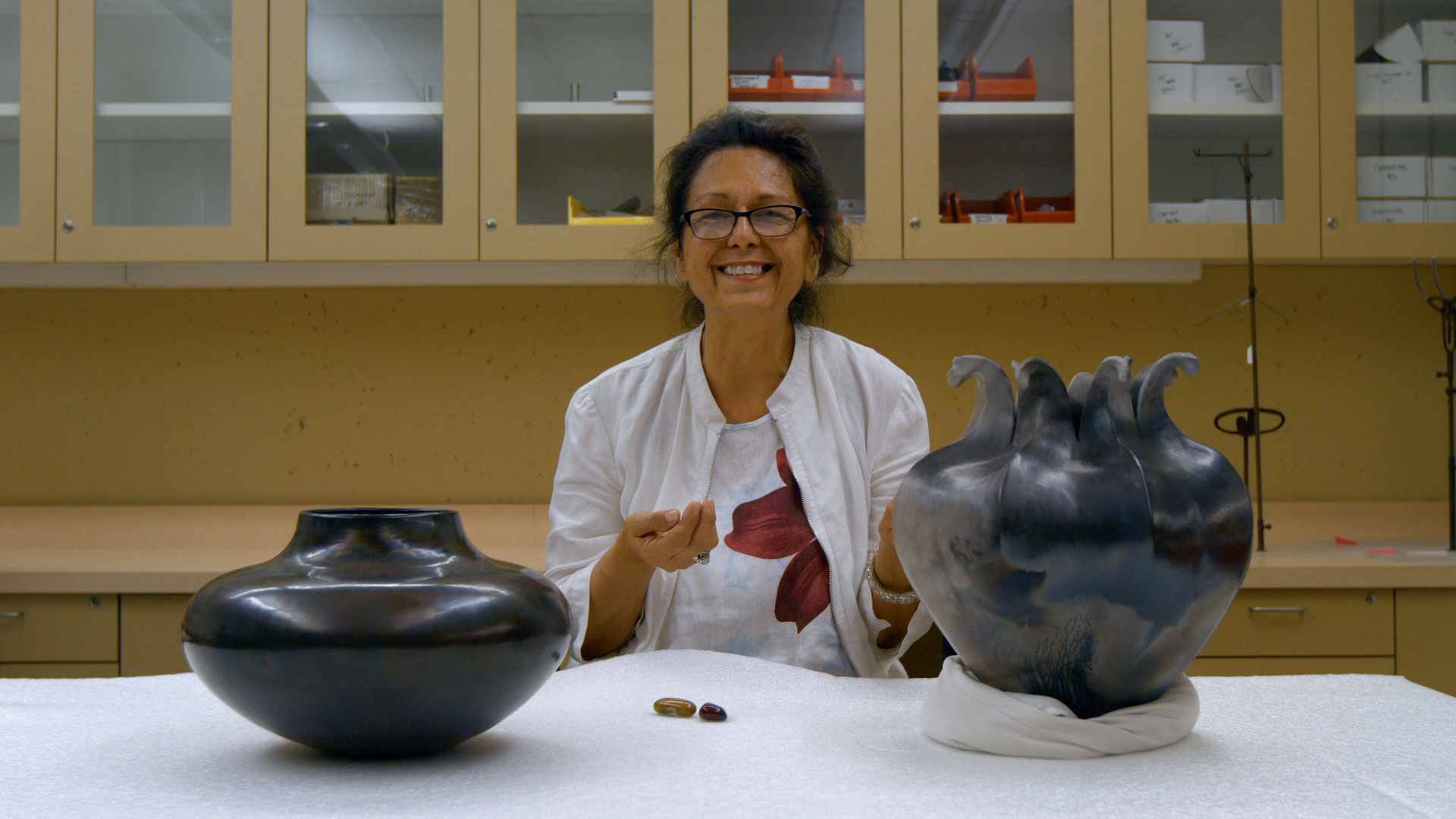
So, for me, these works are spirit works. These aren’t works of art. These are transformation pieces. Just as I take of the earth, so must I give back. It’s inviting the elements, and I always say a calling to the stars and to the moon, to the sun, to the earth. I thank them for being a part of this process, of working with this beautiful, beautiful material. I never know how they’re going to come out. They’re not glazed. They’re burnished or polished with these stones. So, at the leather-hard stage, I hold them and I rub the surface. It causes the clay particles to lay down flush to one another and, therefore, reflect light. Then I embed them in sawdust, inside and outside and up above them, and they could burn from two to four days, very slowly. The carbon that’s emitted enters into the surface and even a little bit deeper than that, and it creates this smoke fire pattern that you can see and sometimes this rainbow effect.
They’re not closed off like a glaze closes it off. They’re very, very porous. I also use natural-occurring glacier clay from Alberta. The Plainsman Company puts that out. The clay bodies are blended to get different colours. It’s not a chemically combined clay that I make up; it’s actually dug and mined. The body that I use is very smooth when I burnish it. So, they become very intimate. One of my most favourite parts is when you burnish it. When the stone glides over it, it kind of clicks. It’s got a sound and you can hear inside, if they’re round vessels, and they all have a certain pitch to them, as well. Bob Dylan has one of my pots and I wrote him this little note; I said, “If you hum into it, find the key in it.” Again, they really do. They have a real resounding sound that becomes a whole note; the big ollas do. They’re very lovely.
It’s a different way of looking at the earth and working with the earth and becoming part of that process. It connects me to that ethereal world, to a world you can’t express or explain, and that’s what I like about it. I like not knowing. I like being surprised and not always being in control of everything and, in that way, recognizing I’m a part of a bigger thing. I’m just not in it for myself, because there’s so much more to it than that. So, long story.
5. How the Vessels Are Made
MJ: What about the process of making these works?
LW: Sure. Well, I’m a hand builder, so I don’t throw on a wheel. I do use a thing called an abandoning wheel, which just is a little stationary wheel that you can turn by hand. But I also make low dishes of clay that support the bottoms, because this kind of angle is difficult to make as a hand builder. You might remember if you went to school and took art, you make what they called snakes or worms, where you would roll out coils. I start that way. One of my mentors was a fellow named Fred Owen. He was one of my instructors at college and he went one step further and taught me how to make these belts of clay.
I don’t put round coils on top of one another and paste them together with slip made from the clay. I actually take them and overlap them, then I compress them lightly and I join them from the inside and the outside and then I pinch them together. So, this one here is just, I would say, a good 20 coils to get up to this point. It’s a slow, very methodical process, which is something that I really like, too. I really am a solitary creature. I love quiet and I love being alone. This is very demanding because once you start, you can’t really stop, and sometimes they take three or four days. This one might take a week of me working on it. You’re never guaranteed that it’s not going to crack down here because of stress and drawing points. You never know what’s going to happen.
But once they’re finished, sometimes I use paddles to shape them. I use rubber ribs to help smooth them. I don’t directly spray water on them. I spray water on the clay that I’m wedging to make the coil, but water gets in and loosens the clay body. It can weaken it and it wants to fall apart. So, I use sponges to keep it damp and I use T-shirt material to keep the rim from drying out. See, if I’m going to add another one on, then I’ll cover it with some plastic to keep it overnight. Once I’ve finished making them, they have to dry until what’s called they’re leather-hard or bone dry, then I will polish it.
Sometimes if I’ve applied a slip, I start a little bit earlier to push the slip into the body, and that might take maybe two or three hours, depending on the size. Then, I’ll hold off, set it aside, go back to work on another piece, and then burnish it again. So, I might burnish it once or twice, then I let it sit and dry very slowly. That means in a cool, dry place. You don’t want it to dry really fast. Then, I put it into a bisque kiln so the burnish stays, and then, from there, I take it out and I go to all my cabinet makers, and I beg them for sawdust.
I get a combination of hardwood and softwood and different textures, some very long, thin, and some powdery, so that it burns slowly and evenly over the course of a couple of days. What I have is a very simple, red-brick box. That’s all it is, with a tin cover. Sometimes, I stack things on top of one another. I might put in four pieces, depending on the size, then I bring the sawdust up over them, about this much. I lay in layers of newsprint, then I start the corners of it and let the newsprint light the sawdust and then it burns down, hopefully, evenly and slowly over the two to four days. Then, when you open it up, there’s no sawdust left at all. Maybe a little tiny bit on the bottom, but it all burns even from the inside and it’s like, “Oh, wow. Look at that.”
When you live with them, sometimes there’s images on them that you don’t notice at first. I’ve lived with some pieces for maybe four years and all of a sudden there’s an image on it and I go, “Where do those eyes come from?” There’s some kind of bird or some kind of image on there and I’m going, “Wow. Didn’t see that.” So, they kind of reveal themselves to you over a period of time, as well. That’s pretty much the essence of the building part of it.
6. Mentorship, Blue Corn, and a Life in Clay
MJ: You want to speak about the other pieces, as well?
LW: Sure. I’ll start by saying that when I first started, I went to high school and I had a great art teacher. He’s the one that introduced me to clay. Then I went to Douglas College, now called Coquitlam College, the first year that it opened, in 1970. I was just sampling courses but I always knew I loved pottery and working with clay. They had a ceramic course, so I got involved in that.
Then I moved to the Vancouver School of Art. Actually, I didn’t want to go there so I went to London and I looked at the Royal Academy. I didn’t like it. I felt it was a bit too stuffy. Then I went to Paris and I looked in one of the schools there, and the language: no. Then I went to Belgium and I stayed in Ghent and I love the University of Ghent Art Department. I really wanted to go there and I had a little place that I was staying and I loved it, but the language was a barrier. So, I thought, “I don’t know if I can do this.” I ended up coming home. I was there for more than a month.
I had a letter from the Vancouver School of Art saying that I could bring in my portfolio and I thought, “Well, I’ll try.” They accepted me into second year. Back then, it was just a diploma-granting institution. It’s not like Emily Carr now — big, huge, get your Masters. Right. But it was a true art school and now it’s a different entity, but I loved my time there. It was just so wonderful. Then, I started teaching and exhibiting and stuff like that. That’s how it all gelled together and this is my 50th year of working with clay. I should have a little anniversary party, get everybody over, and they can all pinch pots for a while.
Anyway, I started by making these ollas, or trying to make these ollas. When I was at art school, I was researching Indigenous people’s pottery making, so I would write letters to people in the Southwest, Africa, and all over the place, to try and get responses. Sometimes people would send me letters and go, “Yeah. We do have a history of that,” or, “Look here. Look there.”
Oddly enough, during the course of this time, I had come across a woman’s name called Blue Corn from the San Ildefonso Pueblo just outside of Santa Fe, New Mexico. I didn’t receive a letter from her, but I had some clippings from some research that I had done. And then years later, lo and behold, she came, and she did a workshop. I was living and studying Northwest Coast design and carving with Tony Hunt and all of that group. And these guys called me and said, “Hey. We’ve got this lady from the Southwest who does hand-built, burnished stuff. You should come and take the workshop.”
I said, “I can’t. I’m really working a lot in this area right now, but I’ll come and take them down to my place in Sooke for a barbecue.” It turned out to be Blue Corn, this woman who I had researched. I hadn’t really put two and two together until years later. She had just come from the San Ildefonso Pueblo where Maria Martinez and her husband were very, very well-known potters. They brought back the pottery renaissance of this pueblo pottery.
After we had dinner, we went for a walk. When we came back, we sat by the fire, and she said, “Okay, I have a story to tell you.” She said, “I’ve just come from San Ildefonso Pueblo, and Maria is not well; she’s going to pass away. She invited me before I left to talk with her. She said, ‘I’ve had a dream. I need to talk to you.’” And they don’t do that, usually, unless it’s something specific that they want to talk to you about. She said, “I understand you’re going to Canada. I had a dream. You’re going to meet a woman there who’s going to be very important to you in your life. So just keep your eyes open for it.” And so, she looked at me, she said, “I think you’re that woman.”
I just started crying. I was so moved because I knew who she was. She just makes these most remarkable vessels, and Blue Corn did as well. So, the spirit works in very funny ways. I’m not like talking in a religious sense; I’m talking about this ethereal way that we are connected through energy, and so stuff happens that you go, “Wow. That’s weird how that worked out.” So, she became one of my mentors and very close. I went and lived in Hawaii for 10 years and I brought her over there to do workshops and stuff.
She was a wonderful, wonderful woman. She did so well at her pottery making that she raised 10 children on her income. Her husband, who was a really fine silversmith, quit his job and started assisting her because she had so many orders. She was a really great influence in my life. She eventually adopted me into the San Ildefonso Pueblo as her daughter. I was just so honoured by the way everything turned out.
My life has been just an incredibly blessed life. Something has carried me. My dad says there are angels that are following me around that guide me. I’m the kind of person who says, “I’ve got to have $10,000. I need a new car. Where am I going to get it?” And all of a sudden, within like a month, somebody will say, “I need you to do something for 10 grand,” and I’m like, “Oh, thank you.” So, I live by my wits. I’m not really into money, yet I have everything in the world I could possibly want. Mostly, people have given me stuff. By the grace of whatever, I’m just carried through life and I have this just amazingly wonderful life. So, I’m so thankful. This has taken me all around the world, to Italy and to Australia and to China, and so I’m super thankful. This has been a very unusual, exciting way to be part of it all.
The other work that I’m doing is called a mountain bowl. I’ll just step out here and bring this guy over here. This one might be able to set on its own.
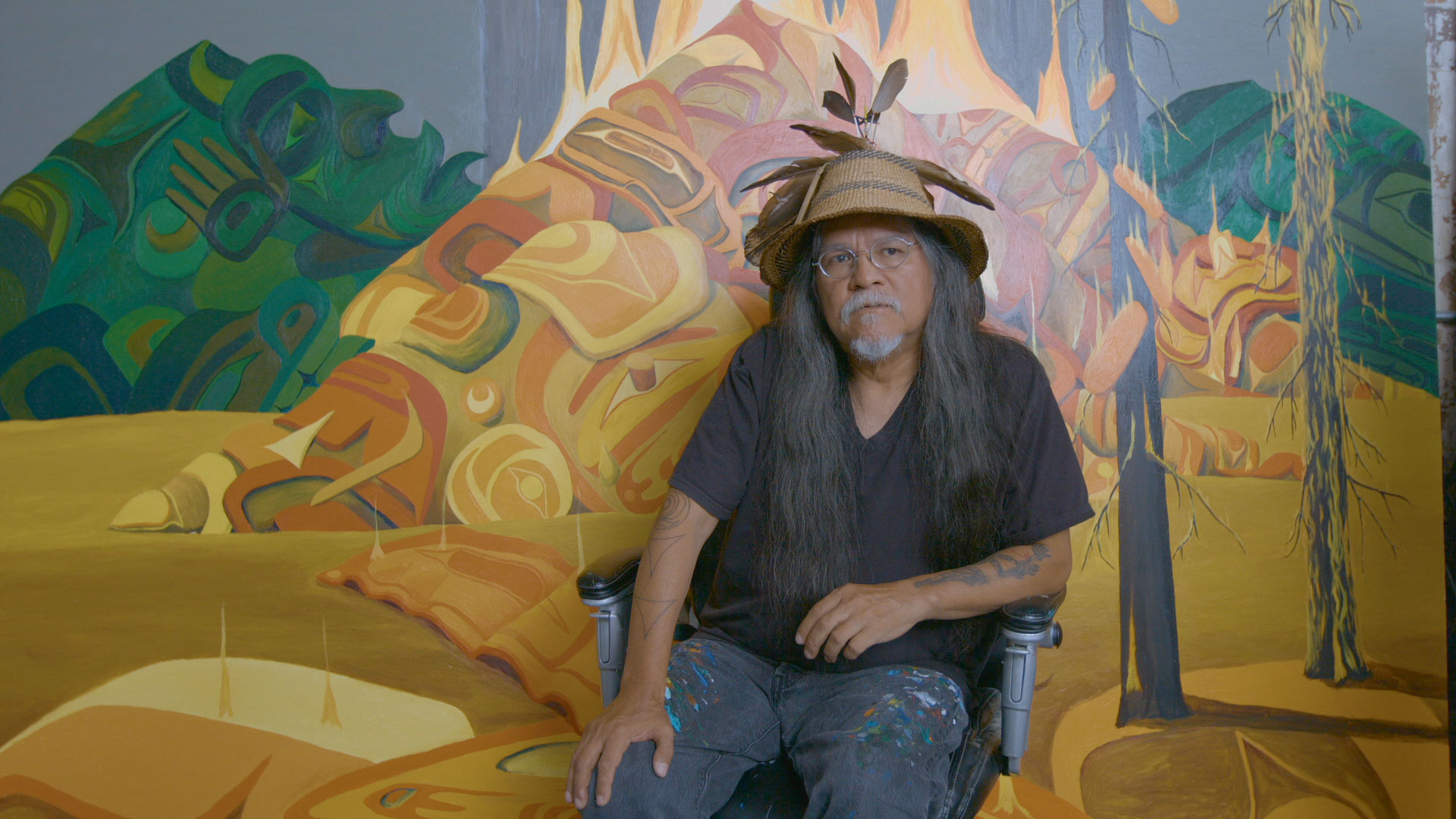
Every time I come here, I think of Lawrence’s opening and 3,000 people showing up (Lawrence Paul Yuxweluptun). Never in the history has that ever happened. Before that, I was saying to him, “Okay, honey. You have to practice for handshakes. This is going to be big. I don’t know. You’ve got to pucker up, kiss a mirror every day, and get calloused lips so that you can take all those kisses people are going to give you.” I made him do all this stuff and he was like, “Ha, ha, ha.” I didn’t come to the opening because it was just too big. I’m not really into that big kind of stuff. But all his family went and they said that he stood there and shook everybody’s hand and I thought, “Good on you.” I always tell everybody that story, because I don’t know any other opening that would ever command something like that. I think that one could sit on its own.
So, my work started out with these ollas. It took me years just to get something to, what I call, sing — to sit up and just to become this beautiful, uninterrupted entity of space. That took me a long time just to get that to happen. Then when it happened, I started thinking about how I’m really inspired by pods and how pods come up. They show you beauty, like a rose hip: it’s a rose, then it becomes a rose hip, and what’s left of it that holds the seeds is just so powerful, and then it bursts and it produces more beauty.
I became interested in this notion of capturing that moment of just before a pod is going to burst. I started making these pods and then I got into making petals that unfurl. To get the clay to kind of move, but still be still was tricky. This process is really difficult. Burnishing is not easy to do on these very delicate things and also, sawdust fire, it’s very temperamental, and so they can crack at any time. It depends. The form is a big part of it, how you wedge your clay and stuff like that. But they’re tricky to get out. They’re not that easy.
I traveled a lot, of course, with my work and shows. When I was traveling in airplanes, I always saw these beautiful mountains and I started to become inspired by the grand nature of mountains and their powerful entities. So, I just started whittling away. I don’t make these very often. I feel a calling to make one soon, so I’m going to make a new one.
Usually when I start on a segment of work, I start small and then I just slowly get bigger because it takes a great deal of stamina. I work for 12-hour days when I start and I don’t very often stop. I might just drink coffee or eat as I go because they require that kind of focus. Then I just randomly carve away. But when I moved out to Chilliwack to the same land where he grew up, I realized that that whole area is one big bowl of mountains. I thought, really, I think I’ve carried that from childhood. I think that driving in there and feeling that, that’s really where these mountain ollas or ollas came from. I just do variations on that. Really, there’s about four segments of work that I’ve been actively working on. Now I’m working on incorporating both petals and pods together and I have one that I can show you that I’ve done. There’s actually one called the Geometry of Space that’s probably the best. It recently got broken.
Speaking of transformation, my work brings about events that take place that require people to work on things together. Sometimes, it’s around them breaking. The biggest thing I’ve ever made is three feet tall by two and a half feet wide, which my mom has. I have two big pieces like that. I’ve only shown them twice, once at the Richmond Art Centre and once at UBC, which is now called the Balcony Gallery.
I was standing there and there were people around. I walked up to see this big piece and the lady that was standing there. All of a sudden, she just burst out in uncontrollable tears. It was very shocking. She said, “I’m sorry. I don’t know why I’m crying.” She didn’t know it was me who made the piece. I’ve had other people tell me that, but there’s something there, I guess, that they feel intuitively and find it very moving. I said, “It’s okay. It’s just the way it is. These things have a spirit all their own and they’re working on you. They’re doing something.” I don’t know why.
So, the Geometry of Space got broken by this guy who went in to photograph it. It was the first piece and the collector who had it just cherished it. He just did a funny thing. He broke a couple of pieces then he emailed me and wanted me to make another one for something like $200 or $300 because he had no money. He said he’d be happy to trade for photos. I said, “You know what? Your issue isn’t with me and I’m not going to do that. You need to talk to the person who had it as part of their collection, and that’s what you have to deal with.”
So, all these funny little things then start happening. Other people have told me that it comes in because there’s work, that needs to be done. That’s what the Indians around here say; that there’s work that needs to be done, and you just have to be intuitive about it and get the work done right, to right it so that it doesn’t get too off.
That’s the newest direction that I’m working in: this combination of pods and petals together. But all this has brought me to a certain kind of stillness. It becomes about positive and negative space. When you work three-dimensionally, you realize that it becomes about what’s inside the piece just as much about what’s outside the piece. And lots of times, for example, when you look at these, you can see the negative space that starts to form, and that becomes an integral part. Even though it’s hollow, it has a life in that hollowness.
When I lived in Hawaii, I was making these things where these fins were coming up and they were very sharp. People were going, “I really want to put my hand in there, but I’m afraid because it feels like it’s going to bite me or something.” They attract you to want to go in, and having three-dimensional concerns, I want your eye to go, not just surface quality, but I want it to go all the way around inside and then come back out again. Capturing negative space is really what I’m working on, and how that creates this external kind of thing. So even with these bigger things, it’s still that inside space, and seeing across it, and having your eye come in and out and around it.
But I am just so thankful that I started to work with clay when I was just 16. I’m thankful that I was able to find something that I truly, truly love and that I cherish the opportunity to thank the earth. So, life is good. I always say I mentor a lot of people and I have taught all my life, so I’ve taught thousands of people probably over the years. I always say to people when you are born into this world, you are born with gifts. It’s up to adults to nurture and to guide that gift, and basically our children are our teachers. We are here not to make them conform, but rather to watch for their inner beauty, to encourage their gifts to come out so they can reach their fullest potential, their fullest sentient-beingness. It’s so unfortunate that in this day and age we don’t do that with our children. We want to make them become of a part of a society. We don’t accept them on their terms and just go, “Wow, look at you. You’ve got this incredible stuff,” and encourage that.
I was lucky; my parents did that for me. My parents never told me what I could or could not do. They just stood beside me and let me feel my way through life. That is the hugest gift anybody can give to a young person. Just be there as this guide for them. I was so lucky and I’m so thankful that I was able to do that. I think that’s part of the creative process, is that you’re given that gift and that opportunity to explore things on your own terms. It’s truly a wonderful experience to do that. So that’s pretty much me in a nutshell, in a pottery shell. Are there any questions that you have?
7. Language, Community, and the Work Still to Be Done
There’s one other thing I would like to add. When I moved back to Chilliwack, I ended up being there by a quirky way. My parents were supposed to go there and build a house. My dad had a stroke. He needed to stay down here, so I ended up there, and I became part of what’s called social housing. My name came to the top of the list, miraculously. I never wanted a house. I didn’t want that responsibility. My mom kept saying, “You need to have some stability. I want to know you’re going to be safe; you’re going to always have a roof over your head, so you should really take this opportunity. You can have Grandpa’s land and build a house there. I just think it’s the right thing to do.” So, she talked me into it and I ended up moving up there.
When I went up there, I was sitting in this big, huge, empty house, and I said to myself, “What do you want to do? Do you want to come and go and fly over the world like you’ve been doing, which has been a really great life, with your work, or do you want to become a part of this community and honour your father and your ancestors who worked this land and became a part of the community?”
My dad was really respected guy. They always wanted him to come back and become the chief. He was just really loved. “What do you want to do?” I said, “I need to honour my dad.” So, I did, and my life changed very unexpectedly. I decided to set my work aside because I was really well established and I thought that’s what I need to do. I applied for a $10 an hour job at the band office and I became the first-ever clerk/receptionist.
That was a connected to a big community centre, so I got to know everybody, not only in Tzeachten community, but all of Stó:lō nation, because they would rent it for big events, and I became the girl who answered the phone. I did that for two and a half years. While I was there, I kept getting these faxes, “Learn your language. Learn your language over at Stó:lō. Come and learn your language,” and I thought, “Wow. I should do that. But I don’t think I can. I don’t think I’m smart enough to do that.” It kept pulling and pushing at me until one day I went “Laura, how are you going to know if you can do it if you don’t try? Get out there and try.” So, I did.
As soon as I did that, the language got a hold of me and I ended up going back to university and I got an honours degree in linguistics and curriculum development. I set my career aside for 20 years. I still did work, but that wasn’t my main focus. I went to my community where they didn’t have a language program. I developed the Tzeachten language program. After 10 years, I secured a $10,000 budget and we did all kinds of stuff together. I got enough for two classes a week and I said, “It’s time for you guys to get a new teacher. I have to do something else now and you’re perfectly capable of doing it. You need better and more experience.” And so, they did; they went and found a new teacher, and it’s still going 20-some years later.
As soon as I did that, the university posted a job for Halkomelem language. I was asked to apply for the job. So, I got the job and spent 10 years developing 14 accredited courses in upper Halkomelem. It’s a program that I did with the elders. I studied with six fluent-speaking elders. I don’t consider myself the doer of it. I’m the coordinator of this project with the elders’ voices. Yeah, I can speak the language, not nearly to the degree that they can. But still, that program exists and it’s still there. Then after 10 years I said, “Get yourself a new teacher. It’s time for you guys to have a new experience.”
I still do a lot of mentoring. I mentor on Skype and Zoom, and I also mentor people just in creative ways, through the arts and stuff like that. I’m still very much a teacher and very active with the language and do language projects for Emily Carr. But I’m no longer creating programs. It was exceptionally hard work and I really had to set everything aside. It’s like being a dog with a bone and going grrr, and just gnawing on it and just keep going until you’re dead tired, but I’m just going to keep doing it. I’m very tenacious when I start something.
I think, out of all the things I’ve done, that’s some of the things I feel so good about. Our language is hanging by a thread and we have language speakers, but they’re not fluent speakers; they’re language learners, and we can speak pretty good, but we can express the majority of the thoughts that we want to. It takes us a long time sometimes to coordinate our thoughts, but mostly it’s because we don’t have people to talk to. So, I work very much in isolation when I’m not teaching, but I am still actively working with the language and encouraging ancestral language acquisition every chance I can get.
That’s also been a really huge part of my life and always will be. It’s been very, very gratifying and very satisfying to be able to give back to the community. I have got to tell you: moving back to the reserve? What an experience. My entire life felt like I grew up off reserve. I was never an Indian. I was just a kid. But there was so much racism. There’s so much poorness around and it just was a huge eye-opening experience to become a marginalized person where I never was before. I had this big, wide-open life.
I really learned firsthand. I always say, “You can’t really talk about Indigenous people unless you live with Indigenous people and you understand how difficult it still is to make your way and maneuver way through this lifestyle in an easier way.” I don’t believe in reconciliation. I call it wreck, like W-R-E-C-K, and silly nation because I think that I have nothing to reconcile.
Everybody else has to do the work and it’s up to you to figure out how you’re going to do that. It’s not up to me. It’s not my concern. I’m living with it every single day of my life and I’ve learned to cope. It’s not my problem. It’s very much your problem, and don’t come to me and ask me to tell you how to resolve it. That’s your problem too. I’m not involved in any of that. I feel like it’s almost a detrimental process, like when we talk about missing and murdered women. It opens up these huge, scarring, gaping hurts. People are crying in circles about the people they have lost. They write reports about and put all that money in them, but nothing’s done. It’s still going on and nothing was resolved except we’re still sitting around in a circle crying about it.
I think that that’s another form of hypocrisy. Why are you forcing us to talk about and cry about this again? We’ve already done it for years and years and now we’re doing it in public and, holy, it’s just not fair. I don’t get behind any of that stuff. But I try and be positive and learn the language, learn the culture, learn the protocols, and the things that need to be passed on to try and help in that way. I’m not reconciling anything. I’m a firm believer that if you have to say you’re sorry, you just shouldn’t have done it in the first place. That’s what you need to deal with. By saying “sorry” to me, all that does is make you feel better. It doesn’t help me and it’s probably not going to help you. Just get the job done. Figure out how you can do it.
That’s how things are going to come to a better balance, and that’s the learning curve that people have to go through. It’s not easy, but the work needs to be done. That’s my little rant on reconciliation. I love people like Lawrence and Judy Chartrand, who stand up and just call it. It’s harsh and it’s hurts. But that’s just an inkling of the hurt that’s carried by so many Indigenous people.
I think too, you have to think big. We are here; we’re on a time continuum through the course of history and the universe, on universal time, and everything that is being done and has been done to us done to every other culture along the line. Everybody has experienced this. It’s just that we’re the newest kids on the block that have gone through this. I always think that, in a way, to be positive about it teaches us resilience. It teaches us compassion and how to become more compassionate citizens. When you see the damage that’s been done and that gets revealed, if you look at it from a point of view that we’ve all experienced that, it’s reminding you that we don’t have to do that. But here we are again, and we need to deal with that and remind ourselves that that’s the things that we need to pay attention to, and that we are basically here and stronger than we’ve ever been.
We’ve not gone away. We hold all this cultural knowledge about plants and medicines. The other thing I’m into is ethnobotany and medicines. We are still the holders of all this incredible ancestral knowledge and, if people actually gave us the credit that we deserve, they would be way better off for it. There’s so much good teaching and good understanding that we’ve been given to caretake and to nurture, and we’re still doing that work. Like I say to people, there are people in longhouses, up and down this coast and inland, that are dancing. There’s 500 people in the winter ceremonies. They’re all dancing for your wellbeing because they’re dancing for the earth and for spirit and they’re covering you in all this goodness and they’re still doing the work. You need to be aware that they’re still out there taking care of it, and that’s what affords you this great life that you’re having. You don’t even know that work’s going on.
I look in my backyard where all that land was taking care of my grandfather. My cousins have developed it and there are gated communities. I look out there and I go, “You people don’t even know that you’re sleeping all over my grandfather’s good intentions. You have no concept, but he’s basically afforded you this credible life that you’re living. That underlying tissue of life is taking place and supporting you through spirit, and through other people’s good intentions and dedication to tilling the land and caring for it.”
We need to always keep in mind that we’re part of a huge thing and to try and be more open and caring about that and nurturing those kinds of conversations, rather than focusing on that all the time. Goodness has come out of that stuff and we are stronger for it. It’s really important for us to also see and focus just as much on that side than pointing out these negative, difficult things. That’s my little rant on that part.
Anyway, I want to thank you for your time and for your interest. I hold my hands to you to thank you because it’s an honour to meet you and to talk with you Karen (Karen Duffek is a curator at the Museum of Anthropology) who I love dearly, and always thank you for your good work. I know how hard you work and care, so I want to thank you for that as well. I really, really appreciate it. Everybody, all the bones and the ancestors that live in here, they appreciate it too. They see the good work that you guys do. They know it’s coming from a really good place in your heart, so I thank you for that.
This work has been commissioned by the Vancouver Biennale
Acknowledgements
This work was made possible with the generous institutional support of the Museum of Anthropology (UBC), the Museum of Vancouver, the Vancouver Art Gallery, the Vancouver Biennale, the Vancouver Maritime Museum, Vivo Media Art Center, the Cultural and Scientific Service of the Embassy of France to Canada, and the Buschlen Mowatt Nichol Foundation.
This work could not have been possible without the support of Barrie Mowatt, Murray Nichol, Karen Duffek, and Jim Breukelman.
Copyrights notice
This interview is licensed under a Creative commons license CC BY-NC-ND. The license enables users to copy and distribute the material in any medium or format in unmodified form only, for noncommercial purposes only, and only with attribution to the author(s). Adaptations of the work are permitted. The Interview may be republished noncommercially so long as attribution is given to the author(s).
Note on copyright ownership and licensing
We are committed to respecting the intellectual property rights of others. While all reasonable efforts have been made to state copyright holders of material used in this work, any oversight is unintended and will be corrected in future editions, provided the publishers have been informed.