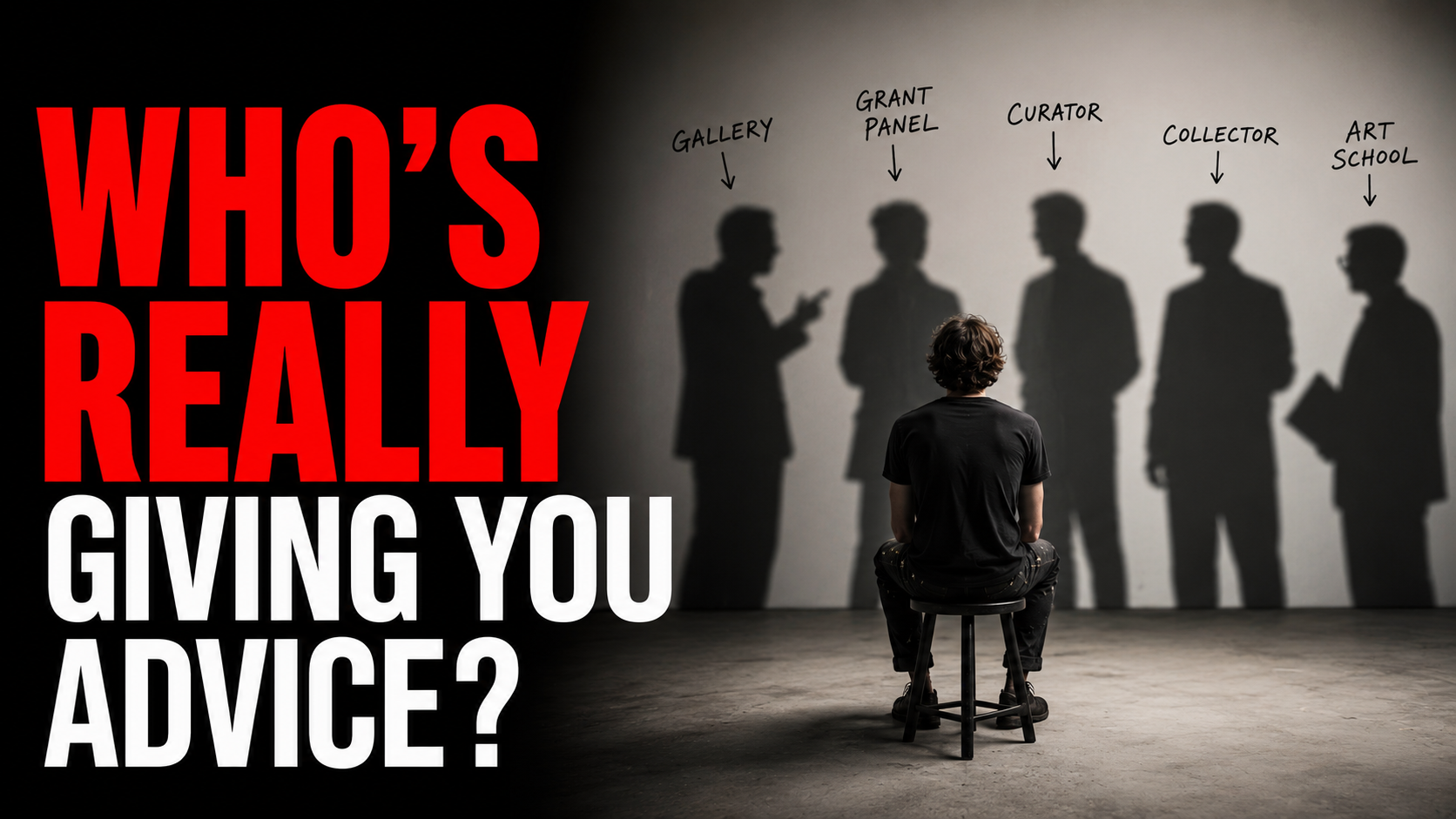
These tools will cut your research time by 80%. It is also about something harder: staying responsible for what you put your name on, even when the tool made it faster to get there.
Most artists I know treat AI like a fortune teller or astrologist: shake it, ask a big question, and either trust the answer or dismiss the whole thing. Neither response is useful. Instead, practice these tools the way you would treat a very fast, slightly unreliable research intern. Someone who can read everything on your desk in an hour but who will also, occasionally, invent a citation with total confidence.
That’s Deep Research. And it’s worth understanding what it actually is, because the hype obscures something genuinely practical.
It will lie to your face
Deep Research is a distinct mode inside ChatGPT, Claude, and Gemini that runs for 5 to 45 minutes, conducts dozens to hundreds of web searches in sequence, reasons across what it finds, and returns a long-form report with citations. It is not a chat reply. It is closer to what a research assistant would produce after a focused morning in the library (except it takes minutes instead of hours, and it hallucinates things).
AI hallucination is REAL
A 2026 study from the University of Pennsylvania found that between 3 and 13 percent of cited URLs in AI-generated research reports were entirely fabricated (Rao, Wong, and Callison-Burch, arXiv:2604.03173).
An earlier study in the humanities found DOI hallucination rates near 90 percent for niche topics. The more obscure your subject matter, the more likely the tool fills gaps with plausible-sounding fictions.
Researching a major canonical figure is relatively safe, but researching a mid-century Caribbean filmmaker’s relationship to a specific critical theory is a danger zone (Zhan et al., arXiv:2601.22984).
This is not a reason to avoid the tool. It is a reason to use it carefully, which is the purpose of this essay.
5 minutes or it falls apart
This is 3 steps:
– Writing the prompt: 5 to 10 minutes.
– Waiting for the report: 5 to 45 minutes.
– Verifying the citations: 20-60 minutes.
The first two steps are optional in the sense that you can skip them and get garbage. Checking for hallucinations is not optional.
Verification is mechanical once you’ve done it twice. Click every footnote. Paste each DOI into doi.org. Search exact paper titles in quotation marks on Google Scholar — if all three major academic search engines return nothing, the citation does not exist.
Spot-check direct quotes by opening the cited source and running a phrase search; if those words aren’t in the document, the quote is invented even if the source is real.
For auction prices: verify on the original auction house site.
For grant amounts: check the funder’s actual website, not the AI’s summary.
What you are building is a habit. And the habit is: fluent prose is not evidence of accuracy. Some of these reports are genuinely pleasant to read. They sound authoritative. The sentences arrive in a confident voice. None of that is meaningful. A fabricated citation about a nonexistent journal article reads exactly like a real one.
The tools know they’re doing this, sort of. The single most useful instruction across every domain is: flag any claim you cannot ground in a specific cited source. This doesn’t stop hallucinations, but it surfaces the tool’s own uncertainty rather than burying it in confident-sounding prose.
You’re asking the wrong questions
The dominant failure mode is not the tool. It is the prompt. Vague inputs produce what Simon Willison calls “surface-level charm,” output that looks like research and disintegrates on inspection.
A weak prompt: Tell me everything about Frida Kahlo’s influence on contemporary art. That has no bounded scope, no source tier, no format. You’ll get a Wikipedia summary stitched together from SEO blogs.
A strong prompt has roughly seven components: a role (“act as a senior art historian”), a focused research question rather than a topic, scope limits (time range, geography, language), depth requirements (word count, audience level), source specifications (peer-reviewed only, post-2015, museum catalogues), output format (literature review, annotated bibliography, comparison table), and guardrails (the flag-what-you-can’t-source instruction).
The strong rewrite of that Kahlo prompt looks like this: Act as a senior art historian. Produce a 1,500-word literature review of English- and Spanish-language scholarship from 2010 to present on Frida Kahlo’s influence on contemporary Latinx artists working in self-portraiture. Prioritize peer-reviewed journals, university press monographs, and major museum catalogues. Exclude Wikipedia, Pinterest, and AI-generated articles. Organize by: feminist re-readings; postcolonial frames; market-driven ‘Fridamania’ critiques. End with a gaps section. Flag any claim you cannot ground in a specific cited source.
That strong prompt produces a usable draft. The first produces waste.
The same logic applies to grant research. “Find me grants for sculptors” is useless. The tool will list defunct programs alongside active ones and miss the patterns that actually matter. A working version names your medium, theme, geography, and career stage, demands current deadlines, names the primary sources (Candid, IRS 990-PF, official funder pages), and includes the guardrail instruction.
More leverage point: Iterate
Consider your first report as a draft.
Ask the tool what the three weakest claims are. Ask what a hostile peer reviewer would challenge.
Ask it to redo the research using only sources from the last two years.
The adversarial follow-up moves reveal more than the initial output does.
Which one is worth your money?
ChatGPT’s Deep Research used to ask clarifying questions before it starts — a step that materially improves output and that most people skip. It tends toward concise, decision-oriented reports and has the lowest hallucination rate on benchmarks. It’s the right tool if you want something actionable rather than exhaustive.
Claude’s Research mode dispatches parallel subagents to investigate different facets of your question simultaneously, which is why it produces significantly more source citations than competitors on identical prompts. It follows instructions more reliably than the others and integrates tightly with Google Workspace tools. The weakness: it jumps in without asking questions, so your prompt quality matters more. Its default output can read as generic if you don’t push it hard.
Gemini Deep Research shows you an editable multi-step research plan before launching — which almost everyone ignores, to their detriment. Its outputs trend verbose (one test returned a 48-page report). It generates an optional audio summary, a two-host podcast-style overview, which is more useful than it sounds for busy artists who want to absorb a report during a commute rather than read it.
For getting started: Gemini is free for five reports per month and the lowest barrier to entry. Move to ChatGPT Plus if you want tighter, more concise output. Pay for Claude Pro if you live in Google Workspace and want the tool pulling from your own emails and Drive documents during the research process.
A real-world trick worth stealing:
Run the same important query through two tools and compare.
Disagreements between reports flag genuine uncertainty more reliably than any single tool’s confidence.
Steal these prompts
Researching grant funders.
Most funders say one thing and fund another. Their website talks about “supporting underrepresented voices.” Their actual grants go to mid-career artists with gallery representation in three cities. The only way to know what a funder really rewards is to look at who they actually funded 🤯. Check their recent grantee list, their press releases, and their board members’ professional backgrounds. Deep Research can pull all of this in one run.
Here is the prompt:
Act as a grants research assistant. I am applying to [funder name]. Search their website, their recent press releases, and their publicly available grantee lists from the last three years. Give me: (1) the last ten grants awarded with recipient names, project descriptions, and amounts; (2) recurring themes across funded projects; (3) the typical grant size range; (4) patterns in career stage, geography, medium, and identity of recipients; (5) the exact language the funder uses to describe their priorities on their current website. Provide a source URL for every claim. Flag any claim you cannot verify with a direct link.
Then verify every name and every amount directly on the funder’s site before you use any of it. AI invents grant recipients. It invents dollar amounts. It does this with total confidence and no disclaimer. If you cite a fabricated grantee in your application, the program officer will notice. You will not get a second chance.
Context for your artist statement
Do not ask AI to write your artist statement (for more on this subject read my article “Why AI Won’t Write Your Grant For You?”). Any experienced grants officer has read hundreds of AI-drafted statements in the past two years. They recognize the cadence immediately. The voice is flat, the sentences arrive in the same order, and the ambition sounds identical to every other application.
What Deep Research is genuinely useful for is finding the context you need before you write a single word yourself. The historical precedents. The contemporary artists working in adjacent territory. The museum catalogue essay that articulates something close to what you are trying to say, but better than you currently can.
Here is the prompt:
I am an artist working with [describe your practice in three sentences: medium, subject, scale, tone]. Build me a research map with four parts: (1) three to five historical precedents before 1980 whose work or methods connect to mine, with a verifiable museum collection link for each; (2) five to eight living artists working in genuine dialogue with my practice, with a one-sentence explanation of the connection and a link to a recent exhibition or collection page; (3) three museum catalogue essays or Tate/MoMA/Getty published texts that address concerns close to mine, with stable URLs; (4) one sentence on what my practice adds that none of these artists or texts have addressed. Verify every link. Flag anything you cannot source.
Read everything it returns before you write anything. The statement comes after the research, not instead of it.
Theoretical and critical frameworks
Before writing an artist statement or grant narrative, you need to know whose thinking is actually in dialogue with your work. Not name-dropping. Real intellectual lineage.
The good news: most of the best critical writing on contemporary art is free. E-flux Journal has published over 140 issues since 2008, all free to download. October abstracts are open. Triple Canopy is open. The material exists. The problem is finding the right eight pages out of ten thousand.
Here is the prompt:
Act as a contemporary art critic and researcher. I am an artist working with [describe your practice in three sentences: medium, subject, scale, tone]. Find ten thinkers, philosophers, or critics whose frameworks are most generative for this work. For each: a three-sentence summary of their key concept, one canonical primary text with a stable free URL (prioritize e-flux.com, Triple Canopy, open-access university repositories), and one artist or critic who has applied that thinker’s framework to visual art. Include thinkers from outside Western Europe and North America. Exclude anyone I could not engage with after one focused reading. Flag any source you cannot verify with a direct URL.
The last instruction matters. Without it the tool will confidently cite a Spivak essay that does not exist at the URL it gives you.
Market research for editions and sales
Before you price an edition or approach a gallery, you need to know what artists one or two steps ahead of you are actually charging. Not what you think the market is. What it actually is.
Here is the prompt:
I am a [medium] artist, [career stage: emerging/mid-career], based in [location], unrepresented [or represented by gallery name]. My work addresses [two to three sentences on subject and scale]. Find eight to ten living artists who are one to two career steps ahead of me working in adjacent territory. For each: (1) name and location; (2) current gallery representation with a link to their gallery page; (3) primary market price range for works similar to mine, sourced directly from gallery websites with URLs; (4) edition sizes and pricing if they produce multiples; (5) recent exhibition history from the last two years. Format as a comparison table. Do not include auction results. Flag any price you cannot source to a live gallery page.
The last instruction is critical. Remove auction results from the prompt entirely. AI fabricates secondary market prices to the dollar with total confidence. A number that looks like it came from Christie’s may have come from nowhere. If you need auction data, go directly to the auction house database and look it up yourself.
Residency research
Finding the right residency used to mean spending an afternoon clicking through TransArtists (transartists.org), which lists over 1,400 residencies worldwide, filtering by hand, and opening forty tabs. This is exactly the kind of labor Deep Research compresses well.
Here is the prompt:
I am a [medium] artist at [career stage], based in [country], working on [one sentence describing current project or concerns]. Find twelve residencies that meet all of the following criteria: (1) open to my discipline and practice; (2) provide a stipend or honorarium, not a fee-to-pay program; (3) duration between [your minimum] and [your maximum] weeks; (4) application deadline between [date] and [date]; (5) open to international applicants. For each: name, location, stipend amount, duration, deadline, application fee if any, and the direct URL to the current open call. Flag any residency where you cannot confirm the stipend amount or deadline with a direct link to the program’s own website.
That last instruction does real work. Residency deadlines and stipend amounts change every cycle. The tool’s training data can be months behind. Treat every deadline it returns as provisional and click through to the program’s own page before you put it in your calendar.
Comparable artists.
Here is the rewrite:
Similar artists
Most grant applications ask for artists working in dialogue with you.
I personally enjoy knowing who is making work which I relate to and also this is a form of genealogy not of your family history or tree but of your practice. Do you really think you are alone doing what you are doing? I can’t believe you are that egocentric. Look around, this research will be rewarding and may lead to new collaboration (if you reach out).
Here is the prompt:
I am an artist working with [describe your practice in three sentences: medium, subject, scale, tone]. Find ten living artists whose practices are in genuine dialogue with mine, not just superficially similar in medium or subject. For each: (1) name, nationality, and where they currently live; (2) current gallery representation or institutional affiliation; (3) one defining body of work with a direct link to a museum collection page, gallery page, or recent institutional exhibition; (4) two sentences explaining the specific overlap with my practice. Avoid defaulting to well-known names unless the connection is specific and defensible. Prioritize artists who have shown in the last three years. Flag any artist where you cannot provide a verified link to a current exhibition record or collection page.
Then look up every artist it returns. The links will sometimes be wrong. The artists will sometimes be real but the connection it describes will be thin. You are looking for three to five names you can genuinely defend in an interview, not ten names to copy into the application.
Exhibition history for pitch research.
Before you propose a show to a venue or curator, know their last five years of programming. Not a vague sense of what they do. The actual exhibitions, the actual curators, the actual artists they have shown. Walking into a pitch without this is like showing up to a job interview without having read the organization’s website. It signals you are not serious and ill-prepared.
Here is the prompt:
Build a five-year exhibition history for [venue name] from [year] to [year]. For each exhibition: (1) title; (2) dates; (3) curator name and credit; (4) participating artists; (5) direct link to the press release, exhibition page, or review. Then identify two or three programming gaps or recurring concerns that my practice could address. My practice is [two sentences]. Source everything directly from the venue’s own website. Flag any exhibition where you cannot provide a verified link.
Then cross-check every curator credit against the venue’s actual site. This is the most common failure point. AI fills gaps in incomplete exhibition archives confidently and incorrectly. A wrong curator credit in a pitch letter ends the conversation before it starts.
Conservation and material research
If your work will ever enter an institutional collection, a conservator will eventually ask how it ages, how it should be stored, and what you knew about its longevity when you made it. The artists who can answer that question clearly are the ones institutions trust. The ones who cannot create problems that outlast the acquisition.
The good news is that most conservation literature is free and well-indexed. AIC publications, Getty Conservation Institute PDFs, Tate Papers, and the CAMEO Materials Database at the MFA Boston are all openly accessible. This is exactly the kind of specialized literature Deep Research handles well.
Here is the prompt:
I am an artist working with [material or process]. Search the following sources: AIC publications (https://www.culturalheritage.org), Getty Conservation Institute (https://www.getty.edu/conservation-institute), Tate Papers (https://www.tate.org.uk/research/tate-papers), and the CAMEO Materials Database (https://cameo.mfa.org/wiki/Main_Page). Give me: (1) known degradation pathways and timelines for this material; (2) recommended storage and display conditions; (3) published case studies documenting conservation of this material in institutional collections; (4) alternative materials that achieve similar aesthetic results with better archival behavior. Cite every source with a direct URL. Flag any claim you cannot ground in one of these four sources.
Do this now. Once the work leaves your studio, it is too late. And it will demonstrate to every institution you approach that you care about your work long term.
Where it will embarrass you?
Deep Research MODE cannot access paywalled content. JSTOR, Project MUSE, Art Bibliographies Modern, most university press monographs all require actual library access. The tool gets you to the right paywall faster than any other method, but it cannot cross it. Go to the library.
The art world’s conversation about AI for research is calibrated differently than its conversation about AI-generated images. The critiques of AI image generation (displacement of creative labor, aesthetic homogenization, the “slop machine” problem) are largely about generation. For the research use, the field is considerably more comfortable. The consensus among practitioners: use these tools to research, not to draft your voice. That’s the right line. The tools are fast, useful, and imperfect for research. They are recognizably flat and hollow for anything that requires your actual perspective.
The time savings, when you work the method properly, are real. For grant research and exhibition history, you can cut 80% of the time you used to spend. For art-historical literature review on major canonical figures, it is closer to 50%. For niche, under-researched subjects, the savings shrink as the hallucination rate climbs, which is when the verification hour becomes an even more important investment.
The tools have gotten genuinely useful in the last months. The verification habit is what separates a working method from a credibility risk. Build that first. The speed arrives on its own.
One last thing
This article has not addressed the bigger question underneath all of this. What does it mean for your credibility when a literature review that used to take a week now takes forty minutes? What does intellectual honesty look like when the citations were assembled by a machine? What is the value of research labor when it can be compressed this dramatically?
These are real questions and the art world is starting to ask them seriously. Institutions, grant panels, and curators are beginning to notice what AI-assisted research looks like, the same way they noticed what AI-drafted statements looked like two years ago.
There are no clean answers yet. But the question is worth sitting with before you hit send on your next application. The verification habit this article describes is partly about accuracy.
It is also about something harder to name: staying responsible for what you put your name on, even when the tool made it faster to get there.
That conversation deserves its own article. For now, use the tools. Verify everything. And know what you are doing when you do it.