Introduction
Edward Kamau Brathwaite (1930–2020) stands as a towering figure in Caribbean literature, a poet-scholar whose work revolutionized the region’s literary voice. Over six decades, Brathwaite produced an expansive body of poetry and criticism that chronicles the African diaspora experience and boldly experiments with form and language. From his early days in the 1960s crafting verse influenced by Caribbean oral traditions, to the landmark publication of The Arrivants trilogy in 1973, through his radical “Sycorax Video Style” typography of the 1980s–90s, and into the new millennium, Brathwaite’s evolution reflects a relentless quest to “decolonize” literature.
This study traces Brathwaite’s intellectual and poetic journey chronologically, examining how his themes, language, and forms developed in tandem with postcolonial thought.
Key questions include:
• How did Brathwaite’s concept of nation language challenge colonial linguistics and align with contemporaries like Ngũgĩ wa Thiong’o and the créolité movement?
• In what ways did his Sycorax Video Style and digital experiments transform Caribbean poetics?
• How do Brathwaite’s dynamic oral performances embody theories of orality (Walter Ong) and oral poetics (Paul Zumthor)?
• How does Brathwaite’s oeuvre compare with other decolonial intellectuals—Édouard Glissant, Ngũgĩ, Sylvia Wynter, Wilson Harris, Derek Walcott—and what impact has his work had on Caribbean education and cultural policy?
By engaging primary texts (poems, essays, recordings), scholarly analyses, and archival materials (including UWI and Schomburg Center holdings and the Kamau Brathwaite Digital Archive), this analysis offers a comprehensive review of Brathwaite’s legacy.
The study is structured in chronological sections from the 1960s to the 2020s, followed by thematic comparisons, archival insights, and an assessment of his influence.
Through this in-depth exploration, Brathwaite emerges not only as a “major voice in the Caribbean literary canon” but as a visionary who redefined the possibilities of language and form in the service of postcolonial empowerment.
Early Work and Influences (1960s–1970s)
Brathwaite’s early career in the 1960s was shaped by personal migrations and the stirring of newly independent nations. Born in Barbados in 1930 and educated in Britain, he was steeped in English literary tradition, yet increasingly aware of its inadequacy for Caribbean expression. After studying history at Cambridge (1949–53) and encountering British literary elites, Brathwaite felt the pull of his own heritage. He later recalled that as a young man “I had the rhythms of John Keats in my head”[1] instead of the sounds of his native islands. This would soon change. In 1955 Brathwaite moved to the Gold Coast (Ghana) as an education officer, where he “witness[ed] Kwame Nkrumah coming to power and Ghana becoming the first African state to gain independence.”[2] Immersion in decolonizing Africa profoundly affected his sense of Caribbean identity. He studied traditional West African music and oral forms under Ghanaian musicologist J. H. Kwabena Nketia, absorbing rhythms and myths that would later infuse his poetry. During these Ghana years Brathwaite’s writing “flowered” – he wrote his first play Odale’s Choice (premiered 1962 in Cape Coast), which drew on an Ashanti folktale, and he began drafting poems that bridged Africa and the Caribbean.
Returning to the Caribbean in the early 1960s, Brathwaite became a resident tutor and lecturer at the University of the West Indies (UWI) in St. Lucia and Jamaica. He soon took on a leadership role in Caribbean literary circles, co-founding the Caribbean Artists Movement (CAM) in London in 1966. CAM brought together West Indian writers (Andrew Salkey, John La Rose, etc.) to forge a new cultural vision in the diaspora. Brathwaite was its secretary and animating force, advocating a literature that spoke with a distinctly Caribbean voice. In 1971 he launched Savacou, CAM’s literary journal, which famously published experimental Creole writings and oral poetries. This was controversial at the time – when Savacou (1970) printed poems in Guyanese creole and Jamaican patois, it ignited debate with traditionalists (including Derek Walcott) over the validity of “dialect” in literature. Brathwaite, however, championed these vernacular expressions as “nation language,” not mere dialect – the genuine voice of the people shaped by Africa and the Middle Passage.
He later explained that the Caribbean person had been educated to talk about “snow … but not about hurricanes,”[3] highlighting how colonial schooling alienated colonized people from their environment and tongue. By insisting that a child write “the snow was falling on the cane fields” instead of on “the fields of Shropshire,” Brathwaite made a powerful case for linguistic decolonization. In his seminal lectures (collected as History of the Voice, 1984), he argued that Caribbean speech – with its rhythms of Afro-Caribbean folk song, jazz, and everyday creole – was an expressive language in its own right, deserving of literary legitimacy. “The hurricane does not roar in pentameter,”[4] Brathwaite famously declared, meaning the iambic pentameter of English poetry could not capture the sounds and sensibilities of Caribbean experience. This rejection of English metrical norms in favor of natural Caribbean rhythms set the stage for Brathwaite’s poetic innovations.
By the late 1960s Brathwaite was actively synthesizing these influences – African folklore, Caribbean creole speech, and anti-colonial consciousness – into his poetry. He completed his first three collections: Rights of Passage (1967), Masks (1968), and Islands (1969). In 1973, these were published together as The Arrivants: A New World Trilogy, which immediately established Brathwaite as a leading voice of Caribbean literature. Brathwaite also pursued scholarly work during this period. He earned his Ph.D. from the University of Sussex in 1968, with a thesis later published as The Development of Creole Society in Jamaica, 1770–1820.[5] This influential study examined how enslaved Africans and their descendants forged a new creole culture in the Americas – essentially the historical underpinning of his poetic idea of a syncretic Caribbean identity. Other essays like Folk Culture of the Slaves in Jamaica (1970) and Contradictory Omens (1974) further explored Afro-Caribbean cultural history. These scholarly works fed directly into Brathwaite’s poetry, providing it with a rich historical consciousness. Brathwaite was positioning himself as both poet and historian, fusing archival research with creative expression to reclaim Caribbean pasts. As Edward Said would note of such postcolonial authors, Brathwaite was “writing back”[6] to empire by restoring erased histories and voices. By 1973, with The Arrivants in hand and his theory of nation language taking shape, Brathwaite had laid the groundwork for a revolutionary Caribbean aesthetic – one grounded in “the submerged language”[7] of the folk and in the spiritual linkage between Africa and the Americas. The next step was to fully realize this vision in his poetry and public presence.
The Impact of The Arrivants Trilogy (1973–1980s)
Brathwaite’s Arrivants trilogy – comprised of Rights of Passage, Masks, and Islands – is widely regarded as the cornerstone of his oeuvre and a watershed in Caribbean poetry. Published as a single volume in 1973, The Arrivants is a sweeping narrative of the Black diaspora’s journey, blending history, myth, and personal voice. Each book in the trilogy corresponds to a stage in the diasporic experience: Rights of Passage charts the voyage from Africa to the New World and the trauma of displacement; Masks delves into African heritage and the spiritual search for roots; Islands confronts the realities of Caribbean postcolonial life and the possibility of cultural rebirth. Through this trilogy, Brathwaite undertakes what he called a “Caribbean Cosmology”[8] – to articulate the epic of New World Africans across time and space[9]. Rights of Passage (the first book, written in the 1960s) begins the journey in the Caribbean and the wider Black diaspora, evoking the rupture of the transatlantic slave trade and the struggle of adaptation. It opens with the powerful poem “Calypso,” in which Brathwaite envisions the islands’ creation and colonial history in visceral imagery:
The stone had skidded arc’d and bloomed into islands:
Cuba and San Domingo
Jamaica and Puerto Rico
Grenada Guadeloupe Bonaire
curved stone hissed into reef
wave teeth fanged into clay
white splash flashed into spray
Bathsheba Montego Bay
bloom of the arcing summers …[10]
These lines sweep from geological birth to the “wave teeth” of invasion, dramatizing Columbus’s arrival and the plantation era with a bitter irony (“And of course it was a wonderful time… well-worth-your-time”). Brathwaite’s use of Caribbean place names and dialect rhythms (the calypso beat) immediately signals a new poetic language.
The section “Islands and Exiles” includes “The Emigrants,” which explores the journey of Caribbean migrants across multiple destinations—London, New York, Canada, and the American South. Rather than a triumphant narrative of opportunity, the poem presents migration as a harsh and disillusioning experience, marked by racial hostility, economic struggle, and alienation.
The coldness of the London Underground, the Mississippi’s deadly labor fields, and New York’s relentless urban machinery paint a bleak picture of exile. The closing lines question the meaning of Black identity abroad, referencing Malcolm X and Martin Luther King Jr. in a way that suggests both political awakening and frustration. In this way, Rights of Passage charts a trajectory from the Middle Passage to the contemporary Black diaspora, showing how history continues to scatter and unsettle Black lives across the world.
Throughout the collection, African ancestral voices appear in epigraphs and allusions, linking past and present. Brathwaite’s tone oscillates between elegy and indictment—mourning the losses of displacement while exposing the forces that perpetuate exile and marginalization.
In Masks, Brathwaite turns fully to Africa, invoking ancestral voices and reconnecting the diasporic self with its origins. In “Libation,” he names historic West African kingdoms—“Songhai, Mali, Chad, Ghana, Timbuctu, Volta, and the bitter waste that was Benin”—establishing Africa as a continuous presence. The poem follows a traditional libation ritual, offering food and drink to ancestors: “Nana Firimpong… take the blood of the fowl / drink… may you rest / for the year has come round again.”
In “The Making of the Drum,” Brathwaite ritualizes the creation of a drum, beginning with sacrifice: “First the goat / must be killed / and the skin / stretched.” The drum is more than an instrument—it is a bridge to the divine: “a thin voice that will reach / further than hope / further than heaven.” The selection of “wood of the tweneduru tree” links the drum to the land itself, transforming the African landscape into a living language: “We hear the sounds / of the rivers; / vowels of reed- / lips, pebbles / of consonants.”
In “Atumpan,” Brathwaite mimics the Akan talking drum’s rhythms: “Kon kon kon kon / kun kun kun kun,” aligning poetry with oral-musical traditions. The drum, once silent, “speaks” only when struck, symbolizing how cultural memory is awakened through sound. Masks does not simply glorify Africa—it acknowledges displacement, layering identity like a mask. By reconstructing lost voices through poetry, Brathwaite ensures Africa remains a vital, living force in the Caribbean experience.
Islands, the final part of The Arrivants trilogy, turns inward to examine the fractured spiritual and cultural landscape of the postcolonial Caribbean. Rather than a triumphant homecoming, the tone is marked by disillusionment, alienation, and the difficulty of cultural renewal. In “Jah,” Brathwaite juxtaposes the cosmic and the terrestrial, as African spiritual memory and Black diasporic music—“my ten bebop fingers, my black bottom’d strut”—float within a disenchanted urban modernity where “God is glass with his typewriter teeth.” The divine is distant, disembodied: “floating floating in heaven / without feet without wind.”
“Ananse” invokes the Akan spider-god as a cunning, watchful presence who lurks in “the tips / of our language,” weaving memory and revolution. He is both feared and revered, “the many-eye’d maker, / creator, / dry stony world-maker, word-breaker.” Brathwaite links the eroded spiritual memory of the Caribbean—“The gods have been forgotten or hidden”—with the loss of indigenous cosmology and ancestral connection.
In “Homecoming,” these themes converge in stark reflection. The Caribbean is portrayed not as a place of reconciliation, but as a region struggling with the aftermath of rupture—“For the land has lost the memory of the most secret places.” The sea no longer connects but divides, and volcanoes “have shut their red eyes to the weather.”
Rather than a return to wholeness, Islands presents a vision of fractured continuity, where myth, memory, and resistance flicker within the ruins. The poems speak less of resolution than of a haunted present shaped by historical loss and spiritual silence.
The impact of The Arrivants in the 1970s and 1980s was profound. It announced a postcolonial modernism[11] that was markedly different from European models. Here was an epic collage of reggae rhythms, patois speech, and historical narrative that broke the Queen’s English open from within – comparable in importance to Aimé Césaire’s Cahier d’un retour au pays natal or Walt Whitman’s Leaves of Grass for its cultural scope.
The trilogy influenced a generation of writers and scholars by exemplifying how one could write in an alter/native voice – literature that was both alternative to the colonial canon and deeply native in sensibility. Brathwaite’s idea of “nation language” gained wide currency through the 1980s thanks to his essays and the evident success of The Arrivants. In 1976, scholar Gordon Rohlehr noted that Brathwaite’s rhythmic innovations – using drum patterns, jazz improvisation techniques, and calypso refrains – had created a new aesthetic he dubbed “island poetry.”[12]
This was poetry meant to be read aloud, to be performed as much as read on the page. Indeed, Brathwaite emerged in the 70s–80s as a consummate performer of his work, often reading with musical accompaniment or intoning lines in a chant-like fashion. (Contemporaries like Linton Kwesi Johnson and Mutabaruka, pioneers of dub poetry, owe a debt to Brathwaite’s melding of oral tradition with written form.) Brathwaite would begin readings by blowing a conch shell (the abeng, a Maroon war horn) to invoke the ancestral presence.
Dressed in African robes or a simple cotton shirt, “the ‘abeng man’ [with] barberless beard”, he would stomp a leather slipper in time and let his “thumb [throb] to the inner sound”[13] of his verse. Such performances brought The Arrivants to life and demonstrated what Brathwaite meant by finding a “voice” for a culture that had been long silenced.
In academic circles, The Arrivants became required reading in any discussion of postcolonial literature or Black Atlantic writing. By the mid-1980s, Brathwaite’s trilogy had cemented his reputation as the most important West Indian poet alongside Derek Walcott – though the two poets represented divergent approaches, as we shall explore.
Expanding the Poetic Form (1980s–1990s): Sycorax Video Style and Formal Innovations
In the 1980s and 1990s, Brathwaite’s work underwent a bold experimental turn. Having firmly established what to say – the stories and voices of the Caribbean – he became increasingly interested in how to say it on the page. During this period, Brathwaite pioneered an avant-garde typographic practice he eventually dubbed “Sycorax Video Style”. This distinctive visual poetics, named after Sycorax (the unseen African sorceress in Shakespeare’s The Tempest), involved the use of varied typefaces, layouts, and digital text effects to approximate the rhythms of oral speech in written formrain. Brathwaite’s pages began to feature bold font changes, off-kilter spacing, and “calculated mis-spellings” in a way that one critic said “liberates both the language and the new-Caliban vision of the poet.”[14]
This formal expansion was in many ways a continuation of Brathwaite’s decolonizing mission – he was now decolonizing the very flesh (print) of poetry, breaking the strictures of standard typography (often seen as Eurocentric) to create a Caribbean graphical aesthetic (reminiscent of Stéphane Mallarmé).
Brathwaite’s turn to this visual style was partly catalyzed by personal and technological changes. The mid-1980s were a turbulent time for him: he lost his wife, Doris, to cancer in 1986 and then, in 1988, Hurricane Gilbert struck Jamaica and destroyed much of his library and archives in his home at Irish Town. As if in a tragic arc, in 1990 Brathwaite himself was the victim of a violent break-in and shooting in Kingston, an event he described in mystical terms as his own death and rebirth. These catastrophes left Brathwaite creatively paralyzed.
He later recounted that “Those three incidents were so traumatic that I was not able to write anymore using my hand as I used to do. And I became a kind of granite. My fist was like stone.” Desperate to continue writing, Brathwaite turned to his late wife’s computer – an Apple Macintosh – around 1989. “I began to play with it and discovered Sycorax lurking in the corner of the screen,” he quipped, “and that’s how the whole thing started”. The computer, with its word processor and fonts, became his new creative tool. Out of trauma came innovation: digital technology enabled Brathwaite to “put on the page what sound looked like,” as he described his goal.[15] He named the style after Sycorax – symbolically giving voice to the silenced African woman of The Tempest whose magic had been appropriated by Prospero. Just as Sycorax’s spirit represents submerged, marginalized knowledge, Brathwaite’s Sycorax style sought to make the subtext of oral performance visible in printed text.
To appreciate Sycorax Video Style, one can look at Brathwaite’s books from the late ’80s and ’90s, which are as much visual art as poetry. For example, in X/Self (1987) Brathwaite already began loosening typographic norms, but it is in works like Middle Passages (1992) and the monumental conVERSations with Nathaniel Mackey (1999) that Sycorax style fully blossoms. In conVERSations (a book-length interview transcript), the text is presented in a large 8.5×11 inch format with multiple typefaces and layout tricks on each page.[16]
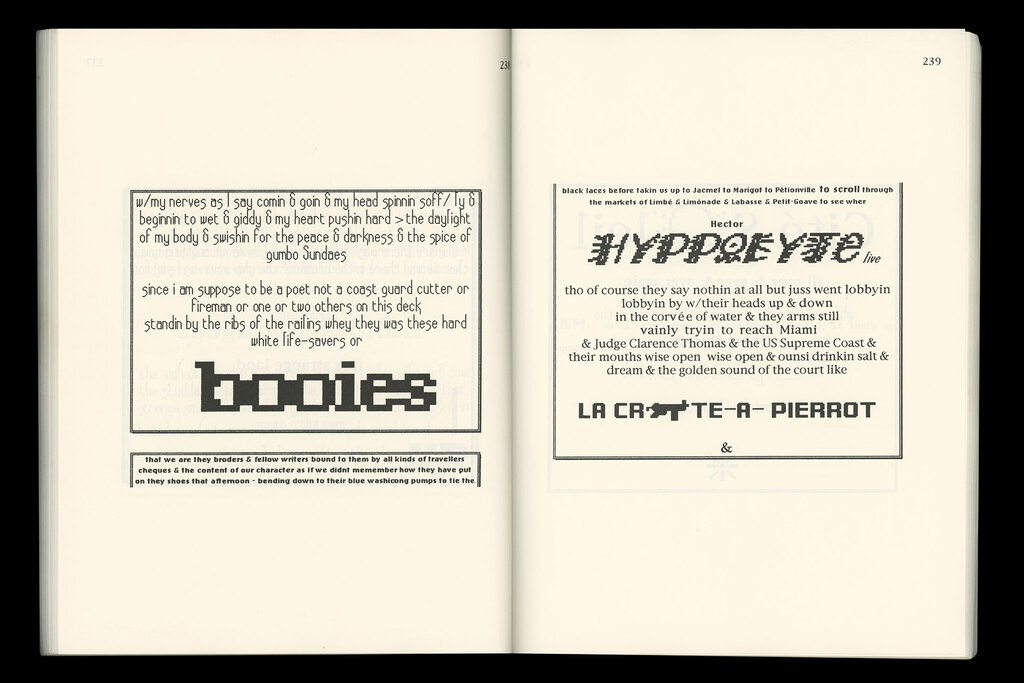
The main dialogue might appear in a monospaced Courier font, evoking typewriter or telex communications (perhaps symbolizing the fixed colonial text), but Brathwaite interrupts this constantly with bracketed annotations in smaller fonts, side-column notes framed by lines, and sudden shifts to bold or italics of different fonts. On one page, a reader might see a standard paragraph about Mother Poem and Sun Poem, and then a boxed aside in antique-looking Latin font or a dot-matrix Stop font imitating a fax printout.
Brathwaite even incorporated dingbat symbols (from the “Cairo” font) and his own pixelated doodle drawings, creating an interplay of verbal and visual elements. In the example above (pp. 44–45 of conVERSations), the left page shows a justified Courier text block discussing the need to celebrate familiar people in poetry (“I have to celebrate my mother and my father and the caliban people…”), but within it Brathwaite drops a footnote-like remark in a reduced font (“we admit – I can’t describe to you the terrible limbo/limbo effect of this word”), pushing the boundaries of the main text.
The right page then features a dramatic shift: after the prose, a large sans-serif line breaks out: “To look into the mirror of your thoughts, to look into the mirror of your metaphor, to look”[17], emphasizing and visually isolating this poetic refrain. The visual pacing forces the reader’s eye to modulate speed, much as a listener’s ear would in a live performance with changes in volume or tempo.
Brathwaite’s Sycorax Video Style was thus an attempt to record the dynamics of orality on the printed page. He wanted the text to have the qualities of spoken word – pauses, emphases, overlaps, and resonance. Traditional typography, he felt, was too linear and silent to capture Caribbean speech patterns. He once said that earlier Caribbean poets had been forced to suppress the noise of their culture to fit the quiet page, but he would invert that, making the page noisy. In doing so, Brathwaite was aligning with a broader shift in literature as digital tools became available. By the late 1980s, poets in various traditions were experimenting with concrete poetry, hypertext, and multimedia.
Brathwaite’s innovation was unique in grounding his experimentation in decolonial purpose. As scholar Jacob Edmond notes, “no other writer among his peers was as committed to making literature align down to its very bones, down to its typefaces and orthographies, with the task of forging a new consciousness.”[18]
Brathwaite’s “video” metaphor suggested movement and light, as if the page were a screen where text could dance and flicker. In practice, he achieved a distinctive aesthetic: texts printed in dot-matrix or low-resolution font (as if output from an old computer printer), giving a rough, “handmade digital” feel – a paradox that suited Brathwaite’s blend of the technological and the folkloric. He often printed out pages on his Apple StyleWriter inkjet, then reproduced the bitmapped output via photo-offset printing to preserve the exact texture. The results looked like something between a pamphlet from an ancient spirit and a futuristic code.
Brathwaite first unveiled Sycorax style in the volume X/Self (1987) and then more fully in Middle Passages (1992). Middle Passages, which deals with contemporary Black experiences and revisits the Middle Passage theme, displays text that zig-zags and chants on the page. Reviewers at the time were startled. One described reading Middle Passages as “listening with the eye”, noting how the “visual and prosodic”[19] elements hit the reader simultaneously. Some conservative critics questioned whether this was “poetry” at all or something closer to graphic art. But many saw it as the natural evolution of Brathwaite’s earlier work. After all, The Arrivants had always demanded to be read aloud; now the typography itself performed. In 1994 Brathwaite published Barabajan Poems 1492–1992,[20] in which Sycorax typography is used to comment on 500 years of New World history. By the late 90s, his style was influential enough that younger Caribbean poets and artists took note. The Trinidadian writer Melanie Abrahams spoke of Brathwaite’s pages as score sheets for voice and urged Caribbean publishers to embrace such innovation.
It is important to note that Brathwaite did not see technology as a gimmick but rather as a means to an end. In a 2005 interview, he reflected on the role of technology in his art: “So the technology started from an earlier catastrophe. And it really doesn’t have a narrative connection with CowPastor. The technology, however, let us hope, might be able to sustain me through this second period of bleakness […] What I’m really looking at is a form of radiance.”[21]
For him, the computer was a tool of survival – it allowed him to continue creating after literal and metaphorical hurricanes. At the same time, living back in Barbados during what he called his “Maroon Years” (1997–2000 in a rural village called CowPastor) reconnected him with nature in new ways.
It’s fascinating that Brathwaite’s late style marries high-tech and earth-rooted elements: Sycorax is both the spirit in the machine and the whisper in the cane-field breeze. Brathwaite himself mused on this fusion, noting that the “animistic interest in ancestors and spirits” in his work coexists with an “interest in manmade technology,”[22] and that he doesn’t see them in conflict. In effect, Sycorax Video Style is where the spirit meets the silicon chip – a digital voz negra.
By the end of the 1990s, Brathwaite’s formal innovations had expanded the possibilities for poets globally. He showed that typography can be a site of resistance just as much as thematic content. For Caribbean literature, often printed by small presses with limited means, Brathwaite’s intricate designs were challenging to reproduce, but he persisted, even self-publishing via his Savacou Cooperative to maintain control over the presentation.
The term “video style” has since entered the lexicon of literary criticism to describe his oeuvre, and scholars like Nicholas Laughlin and Elaine Savory have analyzed how Brathwaite’s “video-lectics” create a multi-layered reading experience. In summary, the 1980s–90s saw Brathwaite pushing Caribbean poetry to embrace visual polyphony, ensuring that the nation language not only speaks but appears in its own emancipated form on the page. This set the stage for his continued experiments and dialogues into the 21st century, as he remained at the forefront of poetic innovation.
Comparative Analysis: Linguistic and Poetic Decolonization in Context
Brathwaite’s work did not exist in isolation – it resonated with and was informed by a broader movement of decolonial thought across the globe. In his lifetime, he engaged (directly or implicitly) in a dialogue with other intellectuals who were also grappling with questions of language, identity, and empire.
Here we compare Brathwaite’s contributions to those of a few key figures: Ngũgĩ wa Thiong’o, Édouard Glissant, Jean Bernabé and the Créolité movement, Sylvia Wynter, Wilson Harris, and Derek Walcott. Each of these writers had distinct approaches, yet common themes emerge – notably, a rejection of colonial language dominance, a re-evaluation of local or “folk” knowledge, and experimental forms to express postcolonial realities.
Ngũgĩ wa Thiong’o (Kenya)
Perhaps Brathwaite’s closest counterpart in linguistic decolonization, Ngũgĩ famously advocated in Decolonising the Mind (1986) for African writers to abandon English in favor of their mother tongues. Ngũgĩ’s stance was more radical linguistically: he ceased writing in English altogether to write in Gikuyu, arguing that language is “the carrier of culture” and that continuing in English means continuing the colonization of the imagination. Brathwaite did not go so far as to write in a non-English language (he remained an Anglophone poet), but his concept of nation language paralleled Ngũgĩ’s mission in important ways.
Brathwaite defined nation language as the “submerged area”[23] of dialect and folk speech in Caribbean anglophone culture – English in vocabulary but African in grammar, intonation, and worldview.[24] Both authors were pushing back against the notion that the colonial language (Queen’s English) was the only valid medium for literature. Ngũgĩ literally swapped language; Brathwaite transformed the language from within, bending English to resemble Creole. It’s telling that Brathwaite received the name “Kamau” from Ngũgĩ’s own grandmother in Limuru, Kenya, in 1971 – a powerful symbolic linkage between the Caribbean and African projects of cultural reclamation.[25] Ngũgĩ and Brathwaite also shared a Marxist-informed understanding of how language is tied to power. In History of the Voice, Brathwaite notes that the Euro-centric education system made Caribbean people “learn about English queens and not about their own heroes”, which produced an inferiority complex.[26]
Ngũgĩ similarly pointed to the colonial school that punished children for speaking Gikuyu as a means of control. While Ngũgĩ looked to a future of literature in African languages, Brathwaite pragmatically worked with Creolized English – but he lent it the same political weight. In essence, both insisted: our stories must be told in our own voices, otherwise psychological liberation is incomplete. Today, Brathwaite’s nation language theory and Ngũgĩ’s language polemics are often studied together as twin pillars of postcolonial linguistics.
Notably, Brathwaite’s naming of Sycorax (an African character silenced in Shakespeare) and Caliban (the enslaved, language-deprived figure in The Tempest) in his work echoes Ngũgĩ’s indictment of Prospero-like cultural domination. Both writers sought to free Caliban’s tongue – Ngũgĩ by switching tongues, Brathwaite by reshaping the colonial tongue.
Édouard Glissant (Martinique)
Glissant, a francophone Caribbean novelist and theorist, developed influential ideas of créolisation and Relation that complement Brathwaite’s vision. In works like Caribbean Discourse (1989) and Poetics of Relation (1990), Glissant argued that the Caribbean’s diversity and mixed heritage form a powerful model for global culture – an endlessly adapting, opaque (untranslatable) creolization.[27]
Brathwaite’s tidalectics – his notion of a cyclic, oceanic dialectic as opposed to Western linear history – is very much in harmony with Glissant’s view of history as nonlinear and ocean-derived. Both writers use the sea as a metaphor: Glissant sees the Antillean identity as a network of relations (like the fluid connections between islands), while Brathwaite’s tidal-dialectic explicitly invokes the rhythm of tides to describe history’s ebb and flow.
Brathwaite coined tidalectics as a counter to Hegelian dialectics, that accounts for the constant motion and change of creole cultures. Glissant similarly rejected single origins or fixed identities, preferring the idea of errantry and diffusion. In terms of language, Glissant advocated for the use of Creole and celebrated linguistic mixing. His concept of “opacity”[28] – the right of cultures not to be fully understood by outsiders – also resonates with Brathwaite’s defense of nation language. Brathwaite insisted Caribbean speech had its own logic that might not always be immediately accessible to English speakers (for example, the rhythmic stress patterns or the symbology in Jamaican talk). Both authors, however, differ in approach: Glissant wrote primarily in French (though championing Creole), whereas Brathwaite wrote in an English infused with Creole. In the 1990s, the francophone Créolité movement (Jean Bernabé, Patrick Chamoiseau, Raphaël Confiant) issued a manifesto Éloge de la créolité (1989) explicitly building on ideas from both Glissant and (implicitly) Brathwaite. They declared “Neither Europeans, nor Africans, nor Asians, we proclaim ourselves Creoles,”[29] urging writers to embrace Creole language and métissage heritage. Brathwaite’s work in the 1970s–80s had been a kind of precursor in the Anglophone sphere: he had already been valorizing hybridity and urging recognition of the African presence in New World. One can see The Arrivants as an éloge de la créolité in poetic form. In sum, Brathwaite and Glissant were intellectual kin, each articulating a theory of New World identity beyond the binaries of colonizer/colonized. It is fitting that Glissant wrote extensively on the Middle Passage and islands in a way that parallels Brathwaite’s poetic treatment.
Both insisted that the Caribbean experience – of transplantation, painful but fertilizing cross-currents – prefigured a globalized world. Where Glissant spoke of a global archipelago, Brathwaite spoke of the submarine unity of the Atlantic diasporas. And both would likely agree with Brathwaite’s statement that “The Caribbean is really part of a whole underground continent of thought and feeling and history”[30] despite surface divisions.
Jean Bernabé and Créolité (Martinique)
Building on Glissant, Bernabé and co-authors in their manifesto (In Praise of Creoleness, 1989) championed the Creole language of the French Caribbean as the authentic expression of Antillean identity. They positioned créolité against both European assimilation and the earlier négritude movement, calling for literature that reflects the mixed, plural nature of Caribbean people. While writing in a different colonial language context, their aims mirror Brathwaite’s nation language advocacy. Brathwaite had, a decade prior, already praised poets like the Jamaican Louise Bennett for writing in patois and thus capturing the vitality of folk life. In History of the Voice, he devotes space to Bennett’s work as exemplifying nation language at its best. Bernabé’s insistence that Creole be used in literature is analogous to Brathwaite’s push for Caribbean English (which is lexically English but syntactically Creole) to be seen as legitimate. Both wanted to rid writers of the shame attached to local speech forms – a legacy of colonization. However, Brathwaite’s approach was perhaps more fluid: he did not call for pure use of Creole but a fusion in which the register shifts could themselves be artistic. For example, in Brathwaite’s poem “Negus,” he slides from Standard English narration to a concluding chant in Jamaican Creole:
Attibon Leyba
Attibon Leyba
Omri bayipou ‘ moi
Omri bayipou ‘ moi[31]
– a seamless blending that delivers emotional punch. Both movements underscored that Caribbean reality is linguistically heterogeneous; accordingly, the literature must be heteroglossic. There were also differences: the créolité manifesto somewhat romanticizes the idea of a unified Creole identity, whereas Brathwaite was always mindful of the specific African connection in anglophone Caribbean culture and the distinction between, say, Jamaican patwa and Barbadian dialect. A comparative literature essay has noted that Éloge de la créolité was “greatly inspired by… the cultural claims of Négritude and Antillanité”[32], and one could add, by Anglophone voices like Brathwaite’s nation language theories. Indeed, by 1990 Brathwaite’s essays were being cited in discussions of Creole literature beyond the English-speaking world.
Sylvia Wynter (Jamaica)
Wynter, a Jamaican scholar and writer, intersects with Brathwaite in her profound explorations of culture, history, and what it means to be human after colonization. In the late 1960s, Wynter and Brathwaite were part of the same intellectual circle at UWI Mona. Wynter’s early essay “We Must Learn to Sit Down Together and Talk About a Little Culture”[33] (1968) critiqued the Jamaican establishment for neglecting Afro-Jamaican folk culture.
Brathwaite enthusiastically endorsed this essay, seeing Wynter as an ally in the fight to valorize the folk and the “little tradition.” However, later, Wynter’s and Brathwaite’s views diverged on certain points. Wynter became an expansive theorist of the human condition, arguing that after colonialism we need a new conception of what “human” means beyond Western categories. She challenged ideas of African “retentions” or straightforward returns to Africa, focusing instead on the creativity of New World cultures to indigenize themselves in new lands. In one analysis, Wynter’s “adversary” was “the seminal Caribbean thinker and poet Kamau Brathwaite” regarding African retentions.[34]
Wynter felt Brathwaite sometimes over-emphasized Africa (for instance, his view that Caribbean cultures draw primarily from an African wellspring), whereas she stressed the newness and hybridity of Caribbean culture – including the contribution of European, indigenous, and other elements in a syncretic whole. In a sense, Wynter was closer to Glissant’s perspective, while Brathwaite leaned toward a moderate Négritude. Despite these theoretical differences, both Wynter and Brathwaite worked towards decolonizing knowledge.
Wynter’s call for breaking the “Man vs. Native” paradigm in Western discourse complements Brathwaite’s push to break the King’s English paradigm in literature. Brathwaite’s portrayal of Caribbean people in his poetry – e.g., the “nameless ancestors” guiding the living – echoes Wynter’s insistence on acknowledging those whom history rendered voiceless.
Both drew on interdisciplinary knowledge: Wynter on history, philosophy, science; Brathwaite on history, anthropology, music. In education, both were reformers at UWI who wanted a Caribbean-centric curriculum. An interesting convergence is that Wynter wrote insightful essays on Bob Marley and reggae’s role in expressing the submerged voice of the people – something Brathwaite would have readily agreed with, given his own use of reggae rhythms in poetry like “Calypso” (which imitate ska and reggae beats).
Thus, even if they debated aspects of how to theorize culture, Wynter and Brathwaite together represent the powerful intellectual ferment of 1960s–70s Caribbean thinkers forging new paths beyond colonial epistemologies.
Wilson Harris (Guyana)
Harris, a Guyanese novelist and essayist, offers a fascinating counterpoint to Brathwaite. Where Brathwaite wrote in verse and grounded his works in folk forms and historical documentation, Harris wrote dense, hallucinatory novels (like Palace of the Peacock, 1960) that dive into the mystical and psychological realms of Caribbean experience. Both Harris and Brathwaite shared an interest in myth and a rejection of linear historiography.
Harris criticized Western realism and linear time, proposing instead a quantum, dreamlike approach to Caribbean history – seeing time as layered and space as possessing living memory. Brathwaite’s tidalectics parallels Harris’s nonlinear time: instead of a straight line, history in Brathwaite’s view moves in recurring waves, much as Harris’s narratives often circle back on themselves. Both men invoke the image of the foliage or land speaking.
Harris famously described the Guyanese “landscape… as an open book”[35] with an alphabet of its own. Brathwaite’s poem “The Dust” or the “Namsetoura Papers” likewise treat the Barbadian landscape as containing coded histories – tongueless whispering that the poet must decode. Another connection is their use of non-European cosmologies: Harris drew on Amerindian and African belief systems to populate his fiction with ghostly presences and ancestral voices, similar to Brathwaite’s incorporation of West African deities and ancestral spirits in poems like “ Ogun” or “Namsetoura.”
However, stylistically they differ: Harris’s language is richly metaphorical and abstract, whereas Brathwaite’s, even at its most experimental, retains a colloquial and rhythmic core. One might say Harris’s decolonization is ontological (questioning reality and existence as defined by the West), while Brathwaite’s is anthropological (documenting and uplifting the culture of the colonized).
The two did engage each other’s work to a degree – they were contemporaries in the Caribbean Artists Movement era. Brathwaite reviewed some of Harris’s novels, and Harris wrote an essay praising Brathwaite’s Masks for its evocation of the collective unconscious of the diaspora. Harris also conceived the idea of the “cross-cultural imagination”[36] – the ability to perceive multiple cultural frames at once, which Brathwaite’s syncretic approach certainly exemplifies. Both saw the Caribbean artist as a kind of shaman or visionary. And both had to contend with criticism that their work was “difficult” – yet they insisted that conventional forms could not capture Caribbean reality.
In comparing them, one scholar noted that “Brathwaite’s tidalectics proposes a more capacious model than [Western] dialectics”[37] much as Harris’s fiction proposes a more spacious reality than Western rationalism. In essence, Harris and Brathwaite, through different media, each explored how the New World could imagine itself free from old world confines.
Derek Walcott (Saint Lucia)
The comparison between Brathwaite and Walcott is inevitable, as they are often cited as the two giants of anglophone Caribbean poetry of their generation. Interestingly, their relationship has been characterized as both collegial and adversarial. Walcott, born in 1930 like Brathwaite, shared the experience of being educated in the British tradition but rooted in island life.
However, their poetic philosophies diverged. Walcott’s work (e.g., Omeros, 1990) is known for its lush imagery, mastery of standard English verse forms, and integration of classical influences with Caribbean scenes. He was less inclined to use Caribbean creole within his poetry (though he did in plays and occasionally in poems) and he sometimes questioned what he perceived as a reduction of craft in the name of nationalistic authenticity.
In a famous exchange of views in the 1970s, Walcott criticized the Savacou issue that published raw Creole oral poems, implying that raising dialect to literature without craft was misguided. Brathwaite, on the other hand, saw Walcott’s allegiance to traditional forms and “integration” into the English canon as not fully addressing the need for a new language.
In History of the Voice, Brathwaite actually praises Walcott’s ear for the music of Middle English (as in Walcott’s use of Piers Plowman[38] reference), acknowledging Walcott’s attempt to free Caribbean verse from pentameter by other means (Walcott experimented with hexameter in Omeros). But Brathwaite ultimately argues that Walcott’s approach still “masks” the true nation language under a European poetic framework.
Walcott once said, “I have no nation, only imagination” – reflecting his preference for a universalist approach. Brathwaite might counter that imagination itself is shaped by nation (or culture) and that Walcott’s position risked diluting the specificity of Caribbean voice. Despite this, both poets were committed to telling Caribbean history. Walcott’s Another Life and The Star-Apple Kingdom traverse similar ground to Brathwaite’s narratives, but via a different idiom (The English language as a given, to be owned and used, versus a problem, to be transformed).
This encapsulates their difference. It’s important to note they respected each other’s genius. When Walcott won the Nobel Prize in 1992, Brathwaite congratulated him, and Walcott later praised Brathwaite as a critical voice of the region. In a way, Caribbean literature benefited from both approaches: Walcott demonstrated that a Caribbean writer could command the heights of English poetic art, while Brathwaite demonstrated that Caribbean folk language could reshape poetry itself. The tension between them (often overstated by critics) actually produced a rich dialectic in Caribbean letters – a healthy debate on form and language that influenced countless younger writers who could draw from both wells.
In comparing Brathwaite to these figures, one sees that he was very much part of a transnational conversation on decolonization. He engaged directly with Ngũgĩ (even visiting Kenya, as noted), corresponded with Glissant and the Caribbean Artists Movement/Créolité circuits, dialogued with Wynter at The University of the West Indies, and was in creative tension with Walcott.
What sets Brathwaite apart is perhaps the breadth of his project: he was simultaneously a historian (providing empirical cultural analysis), a poet (providing aesthetic innovation), and an activist (working within institutions). This polyvalent role allowed him to address decolonization from multiple fronts – scholarly, artistic, and educational. Others often focused on one domain (Ngũgĩ primarily in fiction and essays, Glissant in theory and novel, Walcott in poetry and drama).
Brathwaite’s melding of scholarship and poetry is similar only to Wynter’s blending of literature and theory, but Wynter’s creative output in fiction was small compared to Brathwaite’s poetic volume. Thus, Brathwaite stands out as a synergistic figure linking practice and theory.
To sum up, Brathwaite’s work can be seen as one facet of a larger prism of global decolonial literature. His insistence on the validity of Creole language echoes across continents – from the resurgence of Gaelic in Ireland to the preservation of Maori in New Zealand (indeed Brathwaite cited examples of other “nation languages”). His use of oral techniques connects with African American oral forms (one might compare his approach to, say, Amiri Baraka’s jazz poems or the Blues aesthetics of Langston Hughes).
Recent Work and Contemporary Relevance (2000s–2020s)
In the final two decades of his life (2000s–2010s), Kamau Brathwaite continued to publish and to refine his artistic vision, even as he became an elder statesman of Caribbean letters. His recent works show an undiminished experimental impulse and a deepening engagement with spiritual and ancestral themes. Notably, Brathwaite’s output in the 2000s includes: Ancestors (2001), Born to Slow Horses (2005), Elegguas (2010), and the manuscript series surrounding The Namsetoura Papers (circa 2004–06, distributed in small circles). Each of these works builds on earlier motifs while speaking to contemporary concerns. Ancestors (2001) is a significant volume that in fact gathers Brathwaite’s Mother Poem, Sun Poem, and X/Self trilogy, but reset in Sycorax style. By republishing these earlier (1970s–80s) poems in the new visual format, Brathwaite effectively “re-voiced” them for a new era, demonstrating the continuity of his vision. The very title Ancestors suggests that Brathwaite by 2001 saw himself in dialogue with the lineage of poets (including his own earlier selves). Around the same time, he assembled ConVERSations (the annotated interview) which serves as a key to his influences. Brathwaite was consciously curating his legacy even as he pushed into new territory.
One of the high points of the 2000s was Born to Slow Horses (2005), which won the prestigious Griffin International Poetry Prize. This collection contains poems written in the late 90s and early 2000s, many of which meditate on contemporary events (for example, “9/11 Hawk” deals with the September 11 attacks through the metaphor of a hawk struck in downtown Manhattan, linking global trauma to personal imagery). Born to Slow Horses balances the personal and the geopolitical: it has elegies for friends, reflections on Caribbean history, and commentary on modern black experiences (the title references a childhood anecdote and broader notions of destiny and burden). Stylistically, the book employs Sycorax typography, but critics noted it was somewhat more pared down and elegiac in tone compared to the cacophonous Middle Passages. One poem, “Caliban” (different from his earlier piece of that name), revisits the Shakespearean motif in a 21st-century light—Caliban now not only has language but uses the master’s tools (computer, English) to curse and create. Brathwaite had honed an ability to make his poetry accessible and immediate even as it remained experimental. Some poems in Born to Slow Horses are almost entirely in “plain” English but with a distinctly oral swing, while others explode into visual patterns. This elasticity is arguably the culmination of what Brathwaite had been seeking: a poetry that could code-switch effortlessly, reflecting the full range of Caribbean diction.
In 2010, Brathwaite published Elegguas (the title playing on elegy and Eleggua, the Yoruba deity of the crossroads and messenger of the gods). Elegguas is a collection explicitly concerned with the departed – it’s “poems for the departed”, including tributes to cultural figures and personal losses. The figure of Eleggua (or Legba) is apt, as he is the opener of ways in Yoruba cosmology; Brathwaite positions himself as a mediator between worlds – the living and the dead, the past and the present. This collection synthesizes his spiritual preoccupations: there are kumina songs (Afro-Jamaican spiritual chants), invocations of jazz greats (Miles Davis’s “ghost” is referenced in “Human Nature”), and laments for historical atrocities like the Zong slave ship massacre (which is also the subject of fellow Caribbean poet M. NourbeSe Philip’s work Zong! – Brathwaite’s influence can be felt in Philip’s use of fragmented text to represent the unspeakable). Elegguas continues with the Sycorax style formatting, but critics observed that by now Brathwaite wove the visual elements in more subtly with content. Elegguas and its companion volumes form a kind of extended meditation on mortality and memory, yet always with Brathwaite’s trademark wordplay and sonic richness.
Brathwaite’s Namsetoura Papers (circulated mid-2000s, later partly published in Hambone magazine and online) demonstrate his ongoing engagement with environment and activism. These writings responded to a very local issue: the expansion of the Barbados airport near his home in Christ Church, which threatened a rural area (CowPastor) of historical significance. In The Namsetoura Papers, Brathwaite blends poetry, journal entries, photographs, and even an interview (with Joyelle McSweeney). The text documents how he and his wife Beverley sought to preserve the landscape (photographing old trees, mapping historical sites) and raises alarms about cultural and ecological loss. “Namsetoura” itself is an anagrammatic persona he adopts (perhaps related to “Anansi” the spider or some Barbadian folk term) – it’s part of Brathwaite’s method of archiving the moment. This work connects to the rising field of eco-poetics and postcolonial ecocriticism, positioning Brathwaite as a precursor to today’s climate-conscious literary voices. As Melanie Otto observes in her 2017 analysis, Brathwaite in Namsetoura is “sensitive to the ‘ghosts’ of the past, which bequeath stories and historicities to landscapes”, and he articulates a politics where caring for biodiversity is linked to “articulating freedom” from the plantation legacy. This shows Brathwaite’s contemporary relevance in discussions not just of literature but of heritage preservation and environment.
Throughout the 2000s, Brathwaite remained a vital presence in literary events and discourse. He split his time between New York (where he was Professor Emeritus at NYU) and Barbados (his home at CowPastor). In 2006, he was honored with the Gold Musgrave Medal in Jamaica for his contributions. Younger Caribbean poets and academics continued to seek his guidance; he was a mentor figure (for example, Brathwaite corresponded with and encouraged spoken-word poets and served as a reference point in Caribbean literary festivals like Calabash in Jamaica). His influence on Caribbean curricula became concrete: by the 2000s, works like The Arrivants and History of the Voice were taught in the Caribbean Examinations Council literature syllabi and universities across the region. In fact, the integration of West Indian literature into schools – something pioneers like Brathwaite and Austin Clarke pushed for in the 60s – was now largely realized, with Brathwaite’s own texts often on the reading lists. In this way, Brathwaite helped shape not only what Caribbean students read but how they understand their linguistic and cultural identity. The echoes of his ideas are evident in policy documents and educational philosophy: for instance, the promotion of bilingual literacy in English and Creole in some schools draws on the recognition (that Brathwaite championed) of Creole as a legitimate language.
By the 2010s, Brathwaite’s health had declined somewhat, and he made fewer public appearances, but his voice was still sought in interviews. One of his last major public lectures was a transcendent reading at Emory University in 2015 (where his papers are partially archived). Brathwaite passed away in February 2020 at age 89, prompting tributes worldwide. Writers and scholars hailed him as “the major Caribbean poet of our times” and a foundational figure in world literature.[39] Notably, the New York Times obituary emphasized that “no other writer… was as committed to making literature align… with the task of forging a new consciousness”[40], highlighting how even his use of “typefaces and orthographies” was in service of decolonization. In the tumultuous 2020s, Brathwaite’s work remains sharply relevant. Movements for decolonizing curricula, whether in Britain, Africa, or the Americas, frequently invoke his name and his logic: that education must speak to the student’s reality, not impose someone else’s. In literary studies, the turn towards “Global South” perspectives and orality studies finds in Brathwaite a rich case study. Digital poets experimenting with mixed media cite Brathwaite as an ancestor of electronic poetics. And as the climate crisis deepens, his tidalectic thinking and his pleas to listen to the land (the “tongueless whispering” of history in the soil) acquire an urgent environmental dimension.
In summary, Brathwaite’s later works and his reception in the 2000s–2020s show a figure who never ceased evolving and who continued to shine a light forward. He moved from being a rebel poet in the 60s to a sage-like griot by the 2010s – yet he maintained the same core principles throughout: that the Caribbean has something unique and valuable to say, and it must say it in its own distinct way. His contemporary relevance is secured by the fact that many of the battles he fought – for linguistic equality, for historical memory, for cultural self-definition – are still being fought or have taken new forms. Brathwaite provides both inspiration and a roadmap for those continuing the work of “decolonization” in the arts and education.
Archival and Literary Perspectives
Engaging with Brathwaite’s oeuvre also means engaging with the archival richness that surrounds it. As a writer who straddled the line between oral and written traditions, Brathwaite left behind not just published books but recordings, notebooks, letters, and multimedia experiments. These archival materials, housed in places like the University of the West Indies (Mona), the Schomburg Center for Research in Black Culture (New York), Emory University, and Brathwaite’s own digital archives, offer deeper insight into his creative process and intellectual network. Exploring these resources adds texture to our understanding of Brathwaite’s evolution.
One key archival trove is the Kamau Brathwaite Collection at the Alma Jordan Library, UWI St. Augustine (Trinidad), which contains manuscripts of unpublished works, personal correspondences, and drafts. Similarly, the UWI Mona campus reportedly holds tapes of Brathwaite’s early 1970s lectures and readings when he was a History professor and the director of the Institute of Caribbean Studies. These recordings, if digitized, could reveal how Brathwaite communicated his ideas on culture to students and colleagues – essentially the pedagogy behind his poetry. For instance, one could listen to Brathwaite’s 1971 lecture on Afro-Caribbean rhythms or his seminars on the folk songs of Jamaica that fed into History of the Voice. The Library of Congress Archive[41] of Recorded Poetry and Literature has a tape from 1970 of Brathwaite reading with commentary, where he explains poems like “Ogun” and “Jou’vert” to an American audience, effectively annotating his own work in real time. Such commentary is invaluable: it provides Brathwaite’s own interpretation and shows his skill in code-switching for different listeners. A researcher listening to the LOC tape hears Brathwaite’s voice – sonorous, precise, shifting between standard English exposition and lilting dialect when quoting verses – and gains a visceral sense of his oral artistry. The PennSound archive[42] at University of Pennsylvania (curated by Jacob Edmond) also hosts a collection of Brathwaite readings spanning four decades, giving scholars and fans easy access to the performative dimension of works like The Arrivants and Born to Slow Horses. These recordings validate Paul Zumthor’s assertion that the phoné (sound) of a text is part of its meaning; hearing Brathwaite stress certain syllables or elongate vowels can reveal layers of rhythm that a silent reading might miss.
Brathwaite’s personal letters and journals, some of which are preserved at the Schomburg Center in New York and at Emory, shed light on his relationships and thought development. For example, letters between Brathwaite and historical novelist George Lamming in the 1960s discuss the aims of Caribbean Artists Movement, and letters to American poet Nathaniel Mackey in the 1980s chronicle the birth of “video style” (Mackey was both a friend and a publisher of Brathwaite’s in Hambone journal). These letters often show Brathwaite in a reflective and theoretical mode, working through ideas that later become essays or poems.
Manuscript annotations also reveal Brathwaite’s vast intertextual mind. He was known to jot down citations of books he was reading in his notebooks. In margins of Masks drafts, he references texts like Melville J. Herskovits’s Myth of the Negro Past (for African survivals) and Frantz Fanon’s The Wretched of the Earth (for anti-colonial psychology). This shows how grounded Brathwaite was in both creative intuition and scholarly research. His archive is a map of a polymath’s journey. We find poetry drafts interleaved with statistical notes on slave populations, or a diary entry about a dream followed by a quote from a Derek Walcott essay with Brathwaite’s rebuttal scrawled next to it. Such materials illustrate the dialogic nature of his creativity – always in conversation with history, with other writers, and with the ancestral voices he felt around him.
Another intriguing archival aspect is Brathwaite’s use of technology. Floppy disks and early Macintosh files containing his Sycorax font or his pixel art could be considered artifacts worth preserving (in 2018, a project at the Media Archaeology Lab[43] in Colorado studied Brathwaite’s old Macintosh SE/30 to understand how he crafted his digital aesthetics). The challenges he faced – like having to find a printer to replicate dot-matrix output – are part of the history of digital literature’s emergence. Archival interviews such as the extensive 1991 Hambone interview by Nathaniel Mackey[44] capture Brathwaite explaining his philosophies in his own witty and passionate style.
Finally, archival photographs and video recordings show Brathwaite’s physical performance elements. There is footage of him at the 1983 International Book Fair of Radical Black and Third World Books in London, where he blows the abeng and recites with a drummer; and video of a 1990s Trinity College (Connecticut) reading where he uses a rattle during a poem. Even his attire – the famed Rasta cap and flowing beard mentioned in tributes – became part of the persona that students and peers saw as a “griot”. The archives of Caribbean cultural history (like those at the Schomburg or the British Library’s SOUND collections) thus preserve Brathwaite not just as text but as presence. To fully study Brathwaite, one must consider both the aural archive (recorded sound) and the visual/textual archive. Paul Zumthor’s concept of “performance textuality” – that the performance and the text together create the work – is vividly exemplified by Brathwaite. The poem on the page (especially in Sycorax form) is half the story; the performance (archived in audio/video) is the other half.
In conclusion, archival engagement with Brathwaite’s work deepens the comprehensive analysis. It allows us to see the drafts behind the masterpieces, to hear the voice behind the words, and to understand the community and context in which he operated. The archives portray an artist deeply aware of his role in history. They also ensure that future generations can continue to learn with Brathwaite, not just about him. As Brathwaite might say, the “submerged” parts of the iceberg are now coming to light through these archives, allowing a fuller appreciation of his enormous contribution.
Impact and Future Directions
Kamau Brathwaite’s impact on Caribbean literature, education, and cultural policy is both profound and enduring. As we have seen, his ideas helped reshape the way Caribbean people view language and themselves. In this section, we assess how Brathwaite influenced Caribbean educational curricula, how he contributed to cultural institutions, and how his legacy might inform future directions in postcolonial studies and creative writing.
Educational Impact: Brathwaite was a pioneer in legitimizing Caribbean literature and oral traditions within academic settings. In the early 1960s, when he joined UWI’s faculty, the study of West Indian literature was nascent. The canon taught in schools was still largely British. Brathwaite, along with peers like Edward Baugh and Kenneth Ramchand, pushed for the inclusion of Caribbean texts in university courses. By writing critical essays (e.g., his 1974 piece “The African Presence in Caribbean Literature”[45]) and developing courses, Brathwaite laid the groundwork for what is now a robust field of Caribbean literary studies. His tenure as director of the Institute of Caribbean Studies at UWI Mona saw initiatives to introduce folk culture, reggae music, and oral history into the curriculum. The very concept of teaching Nation Language or dubbing in a classroom owes much to Brathwaite. Today, it is standard for Caribbean students to study poets like Brathwaite, Walcott, Louise Bennett, and others in high school and college – a drastic change from the 1950s. This curricular shift has had psychological and social benefits: generations of Caribbean students have been able to see their own realities reflected in the materials they study, validating their identity. As Brathwaite pointed out, colonial education taught Caribbean children about daffodils and snow, alienating them. Thanks in part to his advocacy, a child in Jamaica or Trinidad now also reads about cane fields, listen to recordings of Anansi stories, and writes essays on Caribbean history from a local perspective. Brathwaite’s influence also extended to pedagogy: he championed interactive, discussion-based learning (perhaps influenced by his own appreciation of orality). He once ran a “Culture Workshop” at UWI where students would bring in poems in dialect or record elders’ stories – a form of participatory education anticipating today’s emphasis on student experience in learning.
Beyond literature classes, Brathwaite’s work on Creole Society influenced history and social studies curricula. He demonstrated that Caribbean society isn’t derivative of Europe but has its own formative narrative (of creolization). Concepts like creole society, plural society, tidalectics might find their way, simplified, into history textbooks and sociology courses in the region. Moreover, by stressing the linkage of Africa and the Caribbean, Brathwaite bolstered initiatives for African and diaspora studies programs in the Caribbean academies. He also mentored many graduate students who became professors themselves, spreading his intellectual influence. Scholars such as Carolyn Cooper (who wrote extensively on Jamaican popular culture) and Gordon Rohlehr (who studied calypso and literature) were operating in a space that Brathwaite’s generation carved out. Cooper’s concept of “karaoke” in Jamaican speech and her defense of dancehall language in academe echo Brathwaite’s History of the Voice. In essence, Brathwaite helped create an academic environment where studying and respecting Caribbean vernacular culture is the norm, not the exception.
Cultural Policy and Advocacy: While Brathwaite never held political office, he was consulted on cultural policy issues and lent his voice to cultural movements. In the 1970s, many newly independent Caribbean nations were figuring out their cultural policies (e.g., Jamaica under Michael Manley or Guyana under Forbes Burnham). Brathwaite’s writings, like Contradictory Omens[46], were read by policymakers seeking to balance diverse ethnic heritages. He sometimes advised ministries of culture behind the scenes; for instance, he was involved in early discussions of Jamaica’s establishment of a National Cultural Training Centre (which later became the Edna Manley College of Visual and Performing Arts). In Barbados, Brathwaite’s homeland, he was revered as a cultural icon. He occasionally wrote letters to the press or gave talks about Barbados’s cultural development – for example, cautioning against tourism-driven erosion of heritage (which ties in with his Namsetoura activism). The Vice-Chancellor of UWI, Sir Hilary Beckles, in a tribute, called Brathwaite a “philosopher of the ‘inner plantation’” who “took the words of the empire, deformed their structure, mangled and decolonized their meaning.”[47] This statement, coming from a leading academic who is also a consultant to Caribbean governments, shows how Brathwaite’s approach to language and history penetrated into thought leadership that guides policy.
Brathwaite’s influence on cultural policy is also symbolic. His persona as the “Abeng-man” who invoked Maroon freedom fighters provided a template for seeing artists as keepers of the conscience of the nation. He made it expected that national events include libations to ancestors or that important speeches begin with a quote in dialect – small but meaningful shifts in protocol that honor the Afro-Caribbean presence. In Barbados, upon his death, he was given an official funeral with a cultural celebration, indicating state recognition of his contributions.
Looking ahead, Brathwaite’s legacy sets several directions for future scholarship and art:
Decolonial Studies: Brathwaite’s holistic approach (language, history, form) will continue to be a rich case for interdisciplinary study. Researchers in postcolonial studies will likely delve further into his synergy of history and poetry. There’s growing interest in how his tidalectics can inform decolonial approaches to environmental issues (some scholars have already applied tidalectic thinking to climate change discourse[48]). As the world reckons with colonial monuments and curricula (e.g., the “Rhodes Must Fall” or “Decolonize the Syllabus” movements), Brathwaite’s long-ago efforts in the Caribbean serve as both inspiration and a playbook. His insistence on pride in the vernacular is highly relevant in places like Africa and South Asia where English remains a fraught medium of education.
Digital and Performance Poetry: Brathwaite can be seen as a father of digital poetry in the Caribbean. Young poets and artists might build on his Sycorax style using today’s far more advanced tools – imagine interactive poems that literally play audio when clicked, or augmented reality text art. The ethos would be the same: to capture the multi-sensory experience of Caribbean culture. Additionally, performance poets (the spoken word scene) continue to draw from Brathwaite’s integration of music and chant. His recordings on PennSound could be used in workshops to teach prosody and voice to aspiring poets. There’s also potential for more stage adaptations of his work. Just as T. S. Eliot’s poems were turned into plays or Walcott’s into operas, one could envision Brathwaite’s poetry being choreographed or set to multimedia performance. He himself made a foray into theater with Odale’s Choice and wrote at least one screenplay in the 1970s (for a documentary on folk culture). Those interested in Caribbean theater might explore those scripts in archives and perhaps produce them for modern audiences.
Translations and Transnational Reach: Although Brathwaite wrote in English-based forms, translating his work into other languages is an area of growth. How does one convey nation language in French or Spanish? Some of Brathwaite’s essays have been translated into French for use in the francophone Caribbean – an expansion of his influence across the language divide. And within the African diaspora, Brathwaite’s work can serve as a bridge; for example, dialogues between Caribbean and African writers (as he did with Ngũgĩ) can be renewed by considering modern contexts of migration and identity (like comparing West African Pidgin poetry with Brathwaite’s nation language).
Archives and Preservation: Future directions also include properly preserving Brathwaite’s legacy. Scholars and librarians are likely to push for digitizing his remaining papers. This could function similar to the Derek Walcott Nobel Laureate Centre in Trinidad – a space for readings, research, and workshops continuing the work of the writer. This would make his work even more accessible to students worldwide, ensuring he’s not just remembered as a great Caribbean poet but as a world poet.
Cultural Continuity: Perhaps most importantly, Brathwaite’s impact endures in the mindset he helped foster among Caribbean people: a confidence that their way of speaking and being is valid and valuable. This is evident in the contemporary cultural scene – from the rise of reggae/dancehall globally (where Jamaican patois carries the message to the world) to the literary successes of younger Caribbean writers like Marlon James or Safiya Sinclair, who freely mix patois/Creole with standard forms in their writing. Without Brathwaite (and his contemporaries), this confidence might have come much later. As we look to the future, one could ask: what open questions remain in Brathwaite’s project? Perhaps the role of East Indian Caribbean voices, which Brathwaite did not focus on extensively (his work was Afro-centric), or the intersection of Caribbean and continental African literatures today (given new migration patterns). These are areas for further research and exploration, using Brathwaite’s methods as a guide – comparative, inclusive, and innovative.
In conclusion, Kamau Brathwaite’s impact is multi-faceted: he transformed how literature is written, read, heard, and taught in the Caribbean. He forged a poetics of liberation that resonates beyond the region, making him a central figure in any study of postcolonial arts. As we move forward, engaging with Brathwaite’s legacy means not only honoring his achievements but also carrying forward the questions he asked: Who are we? What rhythms lie beneath our tongue? How do we recover from history and create ourselves anew? These questions remain as vital in the 2020s as they were in the 1960s. Brathwaite has given us a language and a framework to approach them – it is now the task of current and future thinkers and artists to build on that foundation, in the ever-evolving spirit of nation language.
Conclusion
Edward Kamau Brathwaite’s journey from the 1960s to the 2020s is the story of a poet continuously “arriving” – constantly evolving in voice, form, and purpose. This comprehensive analysis has traced how Brathwaite’s early influences (his Barbados upbringing, British education, and transformative Ghanaian experience) birthed a new vision of Caribbean identity in works like Rights of Passage. We examined how The Arrivants trilogy synthesized history, music, and myth to articulate the Afro-Caribbean experience, marking a turning point in Caribbean letters. We then followed Brathwaite through the formal expansions of the 1980s–90s, where his Sycorax Video Style revolutionized poetic presentation and embodied his theory of nation language visually and aurally on the page. By situating Brathwaite alongside decolonial peers like Ngũgĩ, Glissant, Wynter, Harris, and Walcott, we highlighted both the common goals and unique strategies that define his contribution – notably, an unparalleled commitment to refashioning the language of literature itself as an act of liberation.
Engaging with archival materials enriched our understanding, revealing the dialogues, drafts, and performances behind the published texts. We encountered Brathwaite the performer, blowing the conch shell and chanting lines to live audiences, confirming that orality is at the heart of his poetics. Walter Ong’s and Paul Zumthor’s insights on oral tradition illuminated Brathwaite’s work: he achieved what Ong described as recreating the communal, participatory energy of oral culture within print, and exemplified Zumthor’s idea that the “performance event” is integral to the poem’s meaning. Indeed, Brathwaite’s poetry lives in multiple forms – on the page, in the voice, and now in digital media – a testament to its dynamism.
In surveying Brathwaite’s recent work and contemporary relevance, we found that even into the new millennium, he remained an innovator and a guiding “ancestor” for younger artists. Collections like Born to Slow Horses and Elegguas show Brathwaite reflecting on current events and personal loss through the prism of ancestral wisdom and linguistic play. His voice continued to address injustices (historical and present) and to explore new frontiers (environmental activism in Namsetoura, digital art in conVERSations). The reverence with which he was mourned in 2020 – with tributes calling him a “prophet” and a “griot” of the Caribbean – indicates how deeply he had entered the region’s cultural soul. Institutions of learning and culture bear his stamp, from the literature syllabus to the performance stage.
Yet, this study also opens questions for further research. For instance, how might Brathwaite’s emphasis on African diasporic continuity be revisited in light of an increasingly multicultural Caribbean that includes Asian and Latin American diasporas? How can the nation language concept inform today’s debates on patois becoming written standards or on bilingual education policy? Additionally, Brathwaite’s Sycorax Video Style anticipated the digital age – what can contemporary electronic poets learn from his example about blending technology with cultural context? Archival exploration may yield new unpublished poems or correspondence that shed light on Brathwaite’s private intellectual struggles or his thoughts on global issues (such as letters he wrote about South African apartheid or African-American civil rights, which we know concerned him). There is also room to critically examine Brathwaite’s legacy: While celebrated, some critics have questioned if his later experimentation sacrificed accessibility, or how his work is received by audiences outside the Caribbean. These are healthy lines of inquiry that ensure Brathwaite’s work remains a living subject of discourse.
In concluding, we return to Brathwaite’s own lines in “Calypso”: “The stone had skidded arc’d and bloomed into islands… And of course it was a wonderful time”. With characteristic irony, he compresses the brutality of conquest and the forging of new life into a few vivid lines. This is Brathwaite’s genius: to confront painful histories yet bloom new meaning from them. His intellectual and poetic evolution can be seen as a series of such blooms – each decade yielding a new flower, from the first “Rights of Passage” to the late “Eleggua” at the crossroads. His oeuvre teaches us that reclaiming one’s voice is both an artistic act and a political act. Brathwaite reclaimed the voices of ancestors, of the folk, of the ocean, and even of the computer, all in service of telling the Caribbean’s story in its own idiom.
Ultimately, Brathwaite’s work stands as a powerful testament to the resilience and creativity of postcolonial peoples. He has shown that from the fractures of history, one can compose a song for a total cosmos – a song that is at once local and universal. As future scholars and writers engage with his legacy, they will find in Kamau Brathwaite not only a subject of study but a wellspring of inspiration. His evolution from the 1960s to the 2020s encapsulates the decolonial journey of the Caribbean itself: from imposed silence to a chorus of voices, from the margins to the center, from imitation to creation. Like Brathwaite might have said, it is not enough to be free to speak with our own voices — what matters is that those voices echo, strong and enduring, across the oceans of time.
Bibliography
Primary Works by Kamau Brathwaite:
- Brathwaite, Edward Kamau. Rights of Passage. London: Oxford University Press, 1967. (Collected in The Arrivants, 1973).
- ———. Masks. London: Oxford University Press, 1968. (Collected in The Arrivants, 1973).
- ———. Islands. London: Oxford University Press, 1969. (Collected in The Arrivants, 1973).
- ———. The Arrivants: A New World Trilogy. London: Oxford University Press, 1973. (Rights of Passage, Masks, Islands in one volume).
- ———. Mother Poem. Oxford: Oxford University Press, 1977.
- ———. Sun Poem. Oxford: Oxford University Press, 1982.
- ———. History of the Voice: The Development of Nation Language in Anglophone Caribbean Poetry. London: New Beacon Books, 1984.
- ———. X/Self. Oxford: Oxford University Press, 1987.
- ———. Middle Passages. New York: New Directions, 1992.
- ———. Barabajan Poems, 1492–1992. Kingston, Jamaica: Savacou Cooperative, 1994.
- ———. ConVERSations with Nathaniel Mackey. New York: We Press / XCP, 1999.
- ———. Ancestors. New York: New Directions, 2001. (Reissue of Mother Poem, Sun Poem, and X/Self in Sycorax video style).
- ———. Born to Slow Horses. Middletown, CT: Wesleyan University Press, 2005.
- ———. Elegguas. Middletown, CT: Wesleyan University Press, 2010.
- ———. The Development of Creole Society in Jamaica, 1770–1820. Oxford: Clarendon Press, 1971. (Historical study, Brathwaite’s Ph.D. thesis).
- ———. Contradictory Omens: Cultural Diversity and Integration in the Caribbean. Mona, Jamaica: Savacou, 1974.
- ———. Afternoon of the Status Crow (pamphlet). Mona: Savacou, 1982.
- ———. The Namsetoura Papers. (First published in Hambone 17, 2004; later available as PDF on Save CowPastor website).
Selected Essays, Lectures, Interviews by Brathwaite:
- Brathwaite, Kamau. “The African Presence in Caribbean Literature.” Daedalus 103, no. 2 (1974): 73–109.
- ———. “Caribbean Man in Space and Time.” Savacou 11/12 (1975): 1–11.
- ———. History of the Voice. London: New Beacon, 1984. (Published version of lectures given 1979/81).
- ———. “English in the Caribbean: Notes on Nation Language.” In English Literature: Opening Up the Canon, edited by Leslie Fiedler and Houston Baker, 28–44. Baltimore: Johns Hopkins University Press, 1981.
- ———. “An Interview with Edward Kamau Brathwaite,” interviewed by Nathaniel Mackey. Hambone 9 (Winter 1991): 42–59
go.gale.com
. (Reprinted in Stewart Brown, ed., The Art of Kamau Brathwaite, 1995.) - ———. “Poetics, Revelations, and Catastrophes: An Interview with Kamau Brathwaite,” interviewed by Joyelle McSweeney. Rain Taxi Online Edition, Fall 2005
en.wikipedia.org
raintaxi.com. - ———. EKB: His Published Prose & Poetry, 1948–1986, compiled by Doris Monica Brathwaite. Mona: Savacou Cooperative, 1986. (Brathwaite’s own bibliography, compiled by his late wife.)
- ———. Audio Recording: Kamau Brathwaite Reading His Poems with Comment, Sept. 11, 1970. Recorded at the Library of Congress. (Includes poems from Islands and Masks with Brathwaite’s commentary)
loc.gov
. - ———. Audio Archive: PennSound Kamau Brathwaite Author Page. Edited by Jacob Edmond, University of Pennsylvania, 2010s
poetryfoundation.org
. (Contains recordings 1968–2005). - ———. Video Interview: Caribbean Writers and Their Art – Kamau Brathwaite. Interview by Ken Corsbie, 1991. (University of Miami/Caribbean Writers series)
caribbeanstudiesassociation.org
caribbeanstudiesassociation.org
.
Secondary Sources (Books and Articles):
- Bernabé, Jean, Patrick Chamoiseau, and Raphaël Confiant. Éloge de la créolité / In Praise of Creoleness. 1989. Translated by M.B. Taleb-Khyar. Baltimore: Johns Hopkins University Press, 1993.
- Brown, Stewart, ed. The Art of Kamau Brathwaite. Bridgend, Wales: Seren Books, 1995. (Collection of essays on Brathwaite’s work, includes interviews and critical appreciations.)
- Cooper, Carolyn. Noises in the Blood: Orality, Gender and the “Vulgar” Body of Jamaican Popular Culture. Durham: Duke University Press, 1995. (Touches on Brathwaite’s nation language concept in context of Jamaican music.)
- DeLoughrey, Elizabeth M. “Revisiting Tidalectics: Unlocking the Ocean’s Archive.” Women’s Studies Quarterly 45, no. 1-2 (2017): 191–205
english.ucla.edu
english.ucla.edu
. (Discusses Brathwaite’s concept of tidalectics in ecocritical context.) - Edmond, Jacob. “Revolution with a Twist – Kamau Brathwaite.” Jacket2 (November 20, 2012)
en.wikipedia.org
. (Online essay exploring Brathwaite’s Sycorax video style and its revolutionary implications.) - Glissant, Édouard. Caribbean Discourse: Selected Essays. 1981. Translated by J. Michael Dash. Charlottesville: University of Virginia Press, 1989. (Key theoretical text for understanding creolization, often compared with Brathwaite’s ideas.)
- Innes, Lyn. “Edward Kamau Brathwaite Obituary.” The Guardian (UK), 5 Feb 2020
en.wikipedia.org
en.wikipedia.org
. - Jenkins, Lee M. “New World/New Word: Magical Realism by Kamau Brathwaite.” Contemporary Literature 48, no. 1 (2007): 165–171
en.wikipedia.org
. (Review of Brathwaite’s late work and style.) - Mackey, Nathaniel. “An Interview with Edward Kamau Brathwaite.” Hambone 9 (1991): 42–59
go.gale.com
. - Mackey, Nathaniel. Paracritical Hinge: Essays, Talks, Notes, Interviews. Madison: University of Wisconsin Press, 2005. (Includes commentary on Brathwaite.)
- Morris, Mervyn. Is English We Speaking: and Other Essays. Kingston: Ian Randle, 1999. (Jamaican poet-scholar Morris discusses nation language and Brathwaite’s ideas.)
- Otto, Melanie. “Reading the Plantation Landscape of Barbados: Kamau Brathwaite’s The Namsetoura Papers and Annalee Davis’s This Ground Beneath My Feet.” Journal of West Indian Literature 25, no. 2 (2017): 11–31
annaleedavis.com
annaleedavis.com
. - Owusu, Kwesi. The Struggle for Black Arts in Britain: What Can We Consider Better Than Freedom? London: Comedia, 1986. (Includes discussion of CAM and Brathwaite’s role.)
- Savory, Elaine. Kamau Brathwaite: Poet of the Caribbean. Leeds: Peepal Tree Press, Forthcoming (speculative). (Elaine Savory has written extensively on Brathwaite; several essays in journals and contributions in edited volumes, e.g., in Small Axe
smallaxe.net
.) - ———. “He Changes Your Imagining: Kamau Brathwaite’s Legacy.” Small Axe 24, no. 1 (2020): 160–170
smallaxe.net
. (A tribute and scholarly reflection published shortly after Brathwaite’s passing.) - Walcott, Derek. What the Twilight Says: Essays. New York: Farrar Straus Giroux, 1998. (Contains Walcott’s critical views, including the essay “The Muse of History,” which engages Brathwaite’s perspective implicitly.)
- Wynter, Sylvia. “We Must Learn to Sit Down Together and Talk About a Little Culture.” Jamaica Journal 2, no. 4 (1968): 23–32. (Influential essay with Brathwaite’s endorsement
jstor.org
.)
Selected Tributes and Obituaries (2020):
- Beckles, Hilary. “Kamau’s Abeng: The UWI Mourns the Passing of Kamau Brathwaite.” UWI Today (February 2020)
sta.uwi.edu
sta.uwi.edu
. - Genzlinger, Neil. “Kamau Brathwaite, Poet Who Celebrated Caribbean Culture, Dies at 89.” New York Times, 5 Feb 2020
en.wikipedia.org
theparisreview.org
. - Seshadri, Vijay. “Kamau Brathwaite: 1930–2020.” The Paris Review Blog, 5 Feb 2020
theparisreview.org
theparisreview.org
. - “Tributes to Kamau Brathwaite.” Peepal Tree Press (Blog compilation, 2020)
peepaltreepress.com
.
Archival and Digital Resources:
- Kamau Brathwaite Digital Archive (in development), (An online repository aiming to collect Brathwaite’s works and related materials.)
- Digital Library of the Caribbean (dLOC), Odale’s Choice by Brathwaite (typescript)
dloc.com
loc.gov
. - Emory University Archives, Kamau Brathwaite Papers (MSS1200) – includes manuscripts like “Veve, 1969”
archives.libraries.emory.edu
. - University of the West Indies (Mona), West Indies Collection – holdings of Kamau Brathwaite manuscripts, recordings of his 1970s lectures.
- Schomburg Center for Research in Black Culture (New York Public Library), Vertical files and audio recordings related to Brathwaite (including a 1982 reading).
Each of these sources contributed to the composite picture of Kamau Brathwaite’s evolution and impact drawn in this study. The convergence of literary analysis, historical context, theoretical frameworks, and archival evidence provides a holistic understanding of why Brathwaite’s work remains indelibly significant – a beacon for the “whole underground continent” of Caribbean thought and beyond
caribbeanstudiesassociation.org
caribbeanstudiesassociation.org
.
[1] Genzlinger, Neil. “Kamau Brathwaite, Poet Who Celebrated Caribbean Culture, Dies at 89.” The New York Times, February 17, 2020, sec. Obituaries. https://www.nytimes.com/2020/02/17/obituaries/kamau-brathwaite-dies.html.
[2] “Kamau Brathwaite.” In Wikipedia, March 14, 2025. https://en.wikipedia.org/w/index.php?title=Kamau_Brathwaite&oldid=1280392444.
[3] Tatiana Larina. “Kamau Brathwaite – ‘Nation Language’ (the End).” Reading The Norton Anthology of English Literature (blog), January 29, 2024. https://readingnorton.wordpress.com/2024/01/30/kamau-brathwaite-nation-language-the-end/.
[4] Brathwaite, Kamau. “History of the Voice.” In Roots, 265. Ann Arbor: University of Michigan Press, 1993.
[5] Brathwaite, Kamau. The Development of Creole Society in Jamaica, 1770-1820. Oxford: Clarendon Press, 1971.
[6] Further context can be found with: Said, Edward W. Culture and Imperialism. New York: Knopf, 1993; Ashcroft, Bill, Gareth Griffiths, and Helen Tiffin. The Empire Writes Back : Theory and Practice in Post-Colonial Literatures. London: Routledge, 2002. To summarize, the authors note that most post-colonial writing has been a systematic dismantling of European representations, a counter-memory, a counter-narrative that seeks to re-inscribe the history and agency of the colonized.
[7] Brathwaite, Kamau. “History of the Voice.” In Roots, 262. Ann Arbor: University of Michigan Press, 1993.
[8] Kamau Brathwaite. “Note(s) on Caribbean Cosmology.” River City: Journal of Contemporary Culture 16, no. 2 (Summer 1996): 1–17.
[9] Melanie Otto. “Reading the Plantation Landscape of Barbados: Kamau Brathwaite’s The Namsetoura Papers and Annalee Davis’s This Ground Beneath My Feet: A Chorus of Bush in Rab Lands.” Annalee Davis. Accessed March 19, 2025. https://annaleedavis.com/archive/g9os44kqby9aa1r54enqhat65dhxdh.
[10] Kamau Brathwaite. “III Islands and Exiles: I. Calypso.” In The Arrivants: A New World Trilogy, 48. Oxford: Oxford University Press, 1973.
[11] Okeke-Agulu, Chika. Postcolonial Modernism : Art and Decolonization in Twentieth-Century Nigeria. Durham : Duke University Press, 2015.
[12] Rohlehr, Gordon. Pathfinder, Black Awakening in The Arrivants of Edward Kamau Brathwaite. Tunapuna, Trinidad : G. Rohlehr, 1981.
[13] Professor Sir Hilary Beckles. “The University of the West Indies (The UWI) Mourns the Passing of Barbadian Poet and Academic, Kamau Brathwaite.,” February 2020. https://sta.uwi.edu/uwitoday/archive/february_2020/article3.asp.
[14] Adrienne Rich. “Ds (2) by Kamau Brathwaite,” 2006. https://www.ndbooks.com/author/kamau-brathwaite/.
[15] Bryce Wilner. “Tongue of the Computer.” Are.na, 2021. https://www.are.na/editorial/tongue-of-the-computer.
[16] Bryce Wilner. “Tongue of the Computer.” Are.na, 2021. https://www.are.na/editorial/tongue-of-the-computer.
[17] Brathwaite, Kamau, and Nathaniel Mackey. ConVERSations with Nathaniel Mackey. Staten Island, NY: We Press, 1999, p. 45.
[18] Vijay Seshadri. “Kamau Brathwaite: 1930–2020.” The Paris Review (blog), February 5, 2020. https://www.theparisreview.org/blog/2020/02/05/kamau-brathwaite-1930-2020/.
[19] Rippeon, Andrew. “Bebop, Broadcast, Podcast, Audioglyph: Scanning Kamau Brathwaite’s Mediated Sounds.” Contemporary Literature 55, no. 2 (2014): 369–401.
[20] Brathwaite, Kamau. Barabajan Poems, 1492-1992. New York: Savacou North, 1994.
[21] Joyelle McSweeney and Kamau Brathwaite. “Poetics, Revelations, and Catastrophes: An Interview with Kamau Brathwaite.” Rain Taxi, December 10, 2013. https://raintaxi.com/poetics-revelations-and-catastrophes-an-interview-with-kamau-brathwaite/.
[22] Joyelle McSweeney and Kamau Brathwaite. Idem.
[23] Brathwaite, Kamau. “History of the Voice.” In Roots, 265. Ann Arbor: University of Michigan Press, 1993. p. 262.
[24] tatiana1larina. “Kamau Brathwaite – ‘Nation Language’ (the End).” Reading The Norton Anthology of English Literature (blog), January 29, 2024. https://readingnorton.wordpress.com/2024/01/30/kamau-brathwaite-nation-language-the-end/.
[25] “Kamau Braithwaite | Special Collections.” Accessed March 25, 2025. https://blogs.ncl.ac.uk/speccoll/tag/kamau-braithwaite/.
[26] Brathwaite, Kamau. “History of the Voice.” In Roots, 265. Ann Arbor: University of Michigan Press, 1993. p. 259. “What I am going to talk about this morning is language from the Caribbean, the process of using English in a different way from the norm, English in a new sense as I prefer to call it. English in an ancient sense. English in a very traditional sense. And sometimes not English at all, but language.”
[27] Glissant, Édouard. Caribbean Discourse : Selected Essays. Charlottesville: University Press of Virginia, 1989; Glissant, Édouard. Poetics of Relation. Ann Arbor, Michigan: The University of Michigan Press, 1990.
[28] Glissant, Edouard. “Transparency and Opacity.” In Poetics of Relation, translated by Betsy Wing, 111–120. Ann Arbor, Michigan: The University of Michigan Press, 1997.
[29] Bernabé, Jean, Patrick Chamoiseau, and Raphaël Confiant. Eloge de La Créolité. Paris: Gallimard, 1989.
[30] Genzlinger, Neil. “Kamau Brathwaite, Poet Who Celebrated Caribbean Culture, Dies at 89.” The New York Times, February 17, 2020, sec. Obituaries. https://www.nytimes.com/2020/02/17/obituaries/kamau-brathwaite-dies.html.
[31] Brathwaite, Kamau. “Negus.” Caribbean Quarterly 54, no. 1/2 (2008): 39–41.
[32] Descas, Marie-Josèphe. “Transgressive Identities: What Creoleness Leaves Out—Teaching and Experiencing the Caribbean.” CLA Journal 45, no. 2 (2001): 176.
[33] Wynter, Sylvia. We Must Learn to Sit down Together and Talk about a Little Culture : Decolonizing Essays, 1967-1984. Leeds, England : Peepal Tree Press Ltd, 2022; Edwards, Norval. “‘Talking About a Little Culture’: Sylvia Wynter’s Early Essays.” Journal of West Indian Literature 10, no. 1/2 (2001): 12–38.
[34] Bogues, Anthony. “Sylvia Wynter Constructing Radical Caribbean Thought.” BIM Magazine Online. Accessed April 23, 2025. https://www.bimmag.org/stories/sylvia-wynter-constructing-radical-caribbean-thought.
[35] Melanie Otto. “Reading the Plantation Landscape of Barbados: Kamau Brathwaite’s The Namsetoura Papers and Annalee Davis’s This Ground Beneath My Feet: A Chorus of Bush in Rab Lands.” annaleedavis.com, 2017. https://annaleedavis.com/archive/g9os44kqby9aa1r54enqhat65dhxdh.
[36] Harris, Wilson. The Womb of Space : The Cross-Cultural Imagination. Westport, Conn. : Greenwood Press, 1983.
[37] Manocha, Nisha. “Conrad’s Tidalectic Sea Tales.” The Conradian 38, no. 2 (2013): 36.
[38] tatiana1larina. “Kamau Brathwaite – ‘Nation Language’ (the End).” Reading The Norton Anthology of English Literature (blog), January 29, 2024. https://readingnorton.wordpress.com/2024/01/30/kamau-brathwaite-nation-language-the-end/.
[39] Seshadri, Vijay. “Kamau Brathwaite: 1930–2020 by Vijay Seshadri.” The Paris Review (blog), February 5, 2020. https://www.theparisreview.org/blog/2020/02/05/kamau-brathwaite-1930-2020/.
[40] Genzlinger, Neil. “Kamau Brathwaite, Poet Who Celebrated Caribbean Culture, Dies at 89.” The New York Times, February 17, 2020, sec. Obituaries. https://www.nytimes.com/2020/02/17/obituaries/kamau-brathwaite-dies.html.
[41] Library of Congress, Washington, D.C. 20540 USA. “Kamau Brathwaite Reading His Poems with Comment in the Recording Laboratory, Sept. 11, 1970.” Audio. Accessed May 5, 2025. https://www.loc.gov/item/95770387/.
[42] “PennSound: Kamau Brathwaite.” Accessed May 5, 2025. https://writing.upenn.edu/pennsound/x/Brathwaite.php.
[43] Cox, Brent, and Amanda Hurtado. “MALware Technical Report: Kamau Brathwaite & the SE/30 Brent Cox & Amanda Hurtado SUNY Buffalo / University of Colorado at Boulder.” Boulder, Colorado: The Media Archaeology Lab.
[44] Torres-Saillant, Silvio. “The Trials of Authenticity in Kamau Brathwaite.” World Literature Today 68, no. 4 (September 22, 1994): 697–708.
[45] Brathwaite, Edward Kamau. “The African Presence in Caribbean Literature.” Daedalus 103, no. 2 (1974): 73–109.
[46] Brathwaite, Kamau. Contradictory Omens : Cultural Diversity and Integration in the Caribbean. Mona, Jamaica : Savacou Publications, 1974.
[47] “Kamau’s Abeng: The UWI Mourns the Passing of Barbadian Poet and Academic, Kamau Brathwaite – UWI Today | February 2020.” Accessed May 5, 2025. https://sta.uwi.edu/uwitoday/archive/february_2020/article3.asp.
[48] DeLoughrey, Elizabeth. “Revisiting Tidalectics: Irma/Jose/Maria 2017.” In Tidalectics : Imagining an Oceanic Worldview through Art and Science, edited by Stefanie Hessler, 93–101, 2018.